Electric Bus Use Cases: Classification of funding after the 2026 call

Already over 3,500 electric buses have been subsidized – when will you electrify your fleet? The funding call ended on July 21, 2026, but rising diesel prices and the Clean Vehicles Directive remain the decisive drivers for your planning.
The topic briefly and concisely
The federal funding call for buses ended on July 21, 2026; the acquisition and retrofitting of e-buses were subsidized with up to 70% of the additional costs.
The Total Cost of Ownership (TCO) of electric buses is often lower than that of diesel buses due to lower energy and maintenance costs.
The Diesel-to-Electric conversion (DTE) is a sustainable alternative to purchasing new, conserving resources and adhering to the principles of a circular economy.
Switching to electromobility is no longer an option for bus fleet operators, but a strategic necessity. High operating costs due to fluctuating diesel prices, the CO₂ tax of 55 euros per ton since 2025, and strict EU regulations such as the Clean Vehicles Directive are creating significant pressure to act. The last funding round of the Federal Ministry for Digital and Transport (BMDV) subsidized up to 70% of the additional costs for procurement or conversion, otherwise 55%; this call ended on July 21, 2026. This article shows you in four clear steps how to assess the funding situation, reduce the Total Cost of Ownership (TCO) of your fleet, and operate sustainably.
After July 21, 2026: Understanding the funding landscape
The electrification of bus fleets remains on the agenda. The federal call for funding for alternative bus drivetrains ran from May 26 to July 21, 2026. Public transport companies were able to submit project outlines for the procurement of battery buses or conversion; the funding rate was up to 70% of the additional investment costs compared to a diesel bus with a low level of electrification, and 55% otherwise. The associated charging and workshop infrastructure was subsidized at 40%. This funding was a direct response to climate goals and regulatory requirements. More than 1,000 subsidized e-buses are already in use on Germany's roads, avoiding around 830,000 tons of CO₂. The allocation was based on a competitive process, with criteria such as CO₂ savings potential and the fleet's level of electrification being evaluated. The legal basis for this transition is the Clean Vehicles Directive, which obligates public contracting authorities to meet fixed quotas for clean vehicles.
Your 4-point action plan for electrification
A structured approach is key to classifying the funding situation and successfully mastering the transition. Navigate safely through the process with this checklist:
Conduct a needs analysis: Analyze your current route profiles, circulation schedules, and daily mileages. Record the energy demand per line to precisely determine the necessary battery capacity. This forms the basis for all further decisions.
Define the vehicle solution: Weigh the advantages of converting your vehicles compared to a new vehicle. A conversion conserves resources and is often the more economical choice for specialized bodies. HEERO offers field-tested solutions with a range of up to 425 km for this purpose.
Prepare the funding application: Gather all necessary documents for a project outline; the 2026 call for funding ended on July 21, 2026. Detailed planning and a convincing presentation of the CO₂ savings potential are crucial for success here.
Plan the charging infrastructure: Design an intelligent charging management system. Plan depot chargers (overnight) and any fast-charging points (DC) along the route. HEERO buses support DC charging power of up to 165 kW.
Careful planning of these four steps lays the foundation for a fleet transformation that is successful both economically and in terms of emissions.
TCO Analysis: Evaluating the Cost-effectiveness of E-Buses
Total Cost of Ownership instead of acquisition price
The higher acquisition price of an electric bus is often perceived as a hurdle. However, an analysis of the Total Cost of Ownership (TCO), i.e. the total operating costs over the entire service life, shows a different picture. The TCO calculation takes all incurred costs into account and makes different drive types fairly comparable. Studies show that the TCO of an electric bus can already be up to 10% lower than that of a diesel bus today. Lower maintenance costs due to the elimination of oil changes or exhaust systems contribute up to 40% to this. Considering the total cost of ownership is crucial for a future-proof investment.
Cost comparison: conversion vs. new purchase
Converting an existing diesel bus is a particularly economical option. It is not only cheaper to purchase than a new vehicle, but also preserves the value of the existing vehicle. This is a central aspect of the circular economy. The key cost advantages of a converted electric bus include:
Lower energy costs: Electricity is cheaper and more price-stable in operation than diesel.
Reduced maintenance: The simple design of the electric drive reduces workshop costs by up to 40%.
Elimination of the CO₂ tax: From 2025, the levy of 55 euros per ton of CO₂ will no longer apply.
No toll costs: Electric vehicles are exempt from the truck toll.
These factors mean that investing in a conversion often pays for itself after just a few years.
Technology and Sustainability: The Heero Solutions in Detail
Circular economy through diesel-to-electric conversion
A DTE conversion is sustainability in practice and a clear commitment to the circular economy. Instead of scrapping a fully functional vehicle, its life cycle is extended by many years. Over its entire service life, a converted vehicle causes significantly fewer emissions than a newly produced electric vehicle. This approach conserves valuable resources such as steel and aluminum and avoids the energy-intensive production of a new chassis. HEERO has perfected this process and offers serial conversion for existing vehicles, ensuring quality and reliability.
HEERO Electric Buses: Performance for every application
For different electric bus applications, HEERO offers specific vehicle solutions with state-of-the-art battery technology. All models are characterized by long ranges and practical charging capacities. Here is an overview of the current key figures:
Medium low-floor bus: With a 137 kWh battery (gross), it achieves a range of up to 300 km and charges with up to 165 kW DC power.
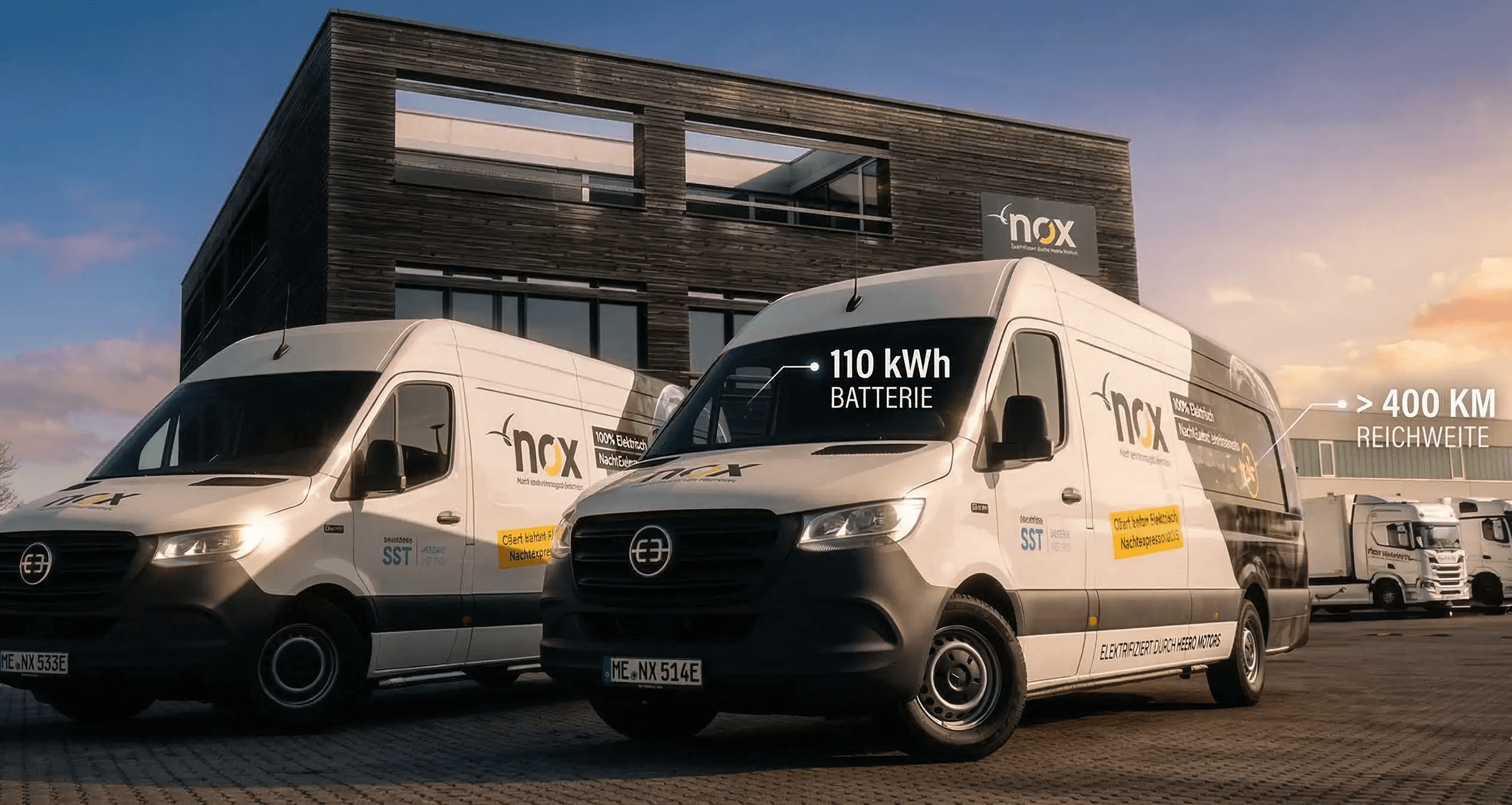
Rear low-floor bus: Equipped with a 110 kWh battery (gross), it also achieves a range of up to 300 km with a DC charging capacity of up to 135 kW.
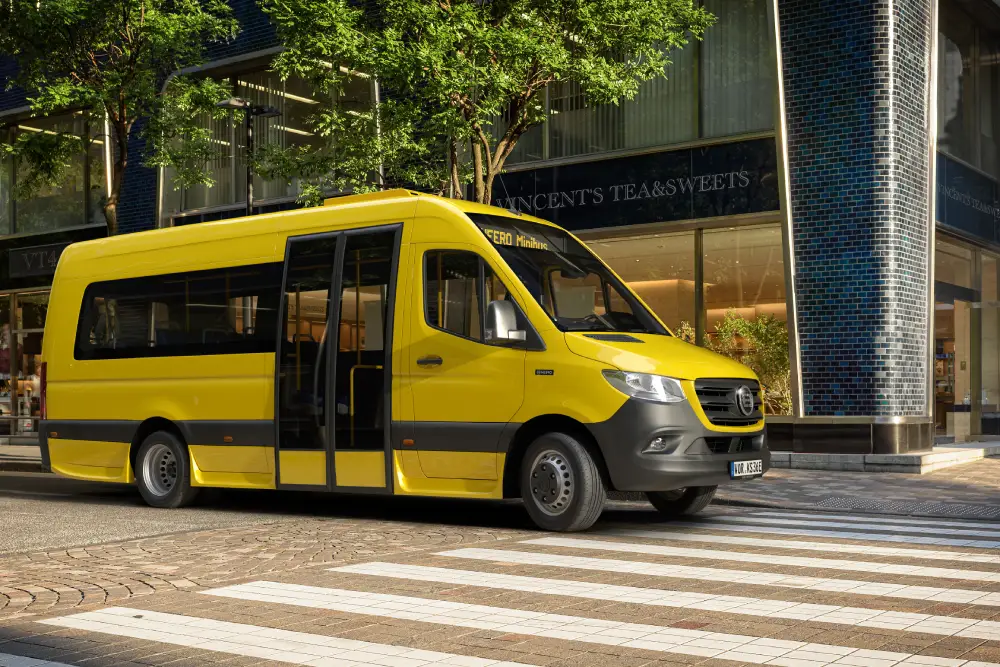
Tourer (Minibus 9 Pax): The flexible minibus for up to 9 people achieves a range of up to 400 km with its 110 kWh battery (gross) and charges with up to 135 kW.
These technological key data guarantee that a suitable and powerful solution is available for almost every urban and regional application.
Your Opportunity: Set the Course for 2025 Now
The combination of statutory pressure from the Clean Vehicles Directive and federal funding of recently up to 70% of the additional costs shaped the window of opportunity for the transformation of your fleet. The 2026 funding call ended on July 21, 2026; structured action nevertheless remains necessary. Retrophitting or acquiring new vehicles not only reduces your operating costs in the long term, but also positions your company as a pioneer for locally emission-free mobility. Do not wait until rising costs and regulatory penalties impair your competitiveness. Use the time to make an informed decision and clarify the funding situation for your project. Start your funding analysis: Answer three questions and receive your grant roadmap, including classification of the federal funding of recently up to 70% of the additional costs.
To the free analysis
free of charge · non-binding · straightforward
More useful links
The BMDV provides a press release regarding a funding call for buses.
The Nationale Leitstelle Ladeinfrastruktur provides information on charging infrastructure.
The Umweltbundesamt offers an analysis of the environmental balance of motor vehicles.
You can find an article on electromobility in Germany at the BMDV.
PwC offers an analysis of the market for electric buses within the framework of their E-Bus Radar.
Statista provides statistics on the number of electric buses in Germany by drive type.
The VDV (Verband Deutscher Verkehrsunternehmen) offers information on the topic of e-mobility.
Wikipedia provides a comprehensive article on electric buses.