Quiet on set: Converting film production vehicles to electric drive and meeting green shooting standards.
Quiet on set: Converting film production vehicles to electric drive and meeting green shooting standards.

Loud diesel generators on film sets jeopardize sensitive audio recordings and often exceed noise protection limits. A film production vehicle converted to a quiet electric drive solves this problem, provides locally emission-free power for the equipment, and secures your access to locally emission-free filming locations. Discover a solution that convinces both in terms of emissions and cost-effectiveness.
The topic briefly and concisely
Converting a film production vehicle to electric drive eliminates noise and emissions on set, allowing for original sound recordings and filming in sensitive locations.
A converted Sprinter serves as a mobile power station, providing 230V to all technical equipment and rendering expensive, loud diesel generators unnecessary.
By continuing to use the expensive special body, the conversion is more economical than buying a new vehicle and is an active contribution to the circular economy; government subsidies contributed up to 80% of the additional costs until 2024.
Film productions face the challenge of drastically reducing noise and exhaust emissions in order to obtain filming permits for sensitive locations and to meet the "Green Motion" standards in force since 2023. Conventional diesel vehicles with noisy auxiliary generators are an obstacle here and cause high operating costs. HEERO offers the technologically leading solution: converting proven film production vehicles such as the Mercedes-Benz Sprinter to a powerful, quiet electric drive. This not only protects your investment in expensive technical equipment, but also positions your production as sustainable and future-proof.
The challenge on set: noise thresholds and emission regulations
On film sets, especially in urban or nature-adjacent areas, noise is the greatest enemy. A diesel generator running at over 70 dB(A) makes original sound recordings impossible and requires costly post-synchronization. Furthermore, the limit values of the TA Lärm, which are 50 dB(A) at night in commercial areas and only 35 dB(A) in residential areas, are often exceeded. This can lead to fines and the revocation of filming permits. The need to switch to locally emission-free drives is therefore no longer an option for modern productions, but an operational necessity. Switching to quiet technologies is the first step to overcoming these hurdles. This problem highlights the need for integrated and quiet energy solutions directly in the vehicle.
The HEERO D2E solution: Your special vehicle becomes a quiet powerhouse
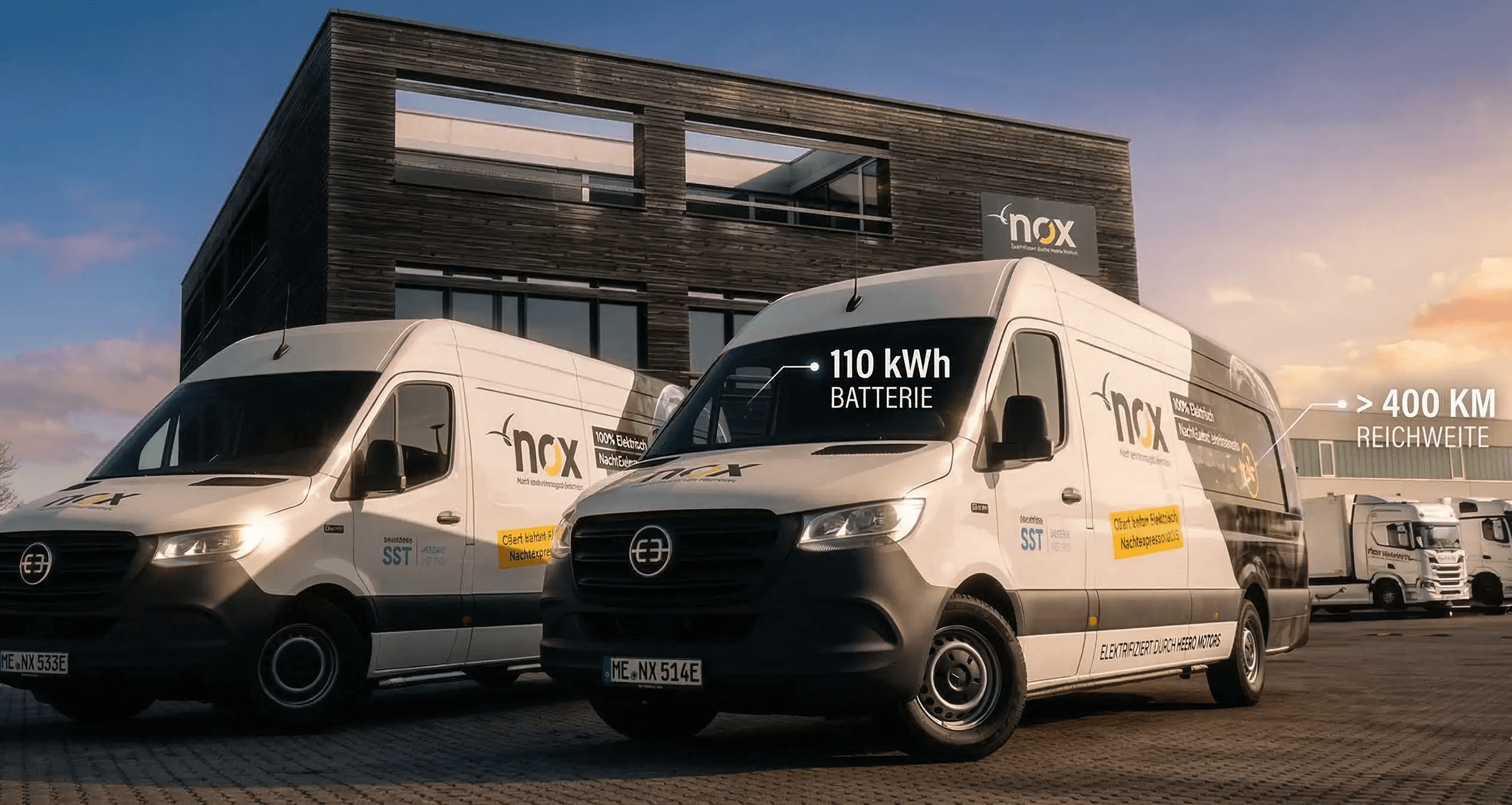
Instead of replacing your proven film production vehicle with an expensive interior design, we convert it into a future-proof electric vehicle. Our patented conversion for the Mercedes-Benz Sprinter is the foundation for a new era of mobile production. Within just 10 days, we replace the diesel engine with our highly efficient electric powertrain. The result is a vehicle that not only drives whisper-quietly but also serves as a mobile power station for your entire equipment. With a practical range of up to 425 km, you can reliably reach any filming location. Converting special-purpose vehicles conserves valuable resources and your budget. In this way, a problem vehicle becomes a highly efficient, sustainable production center.
Autonomous power supply directly from the vehicle: No more diesel generators
A converted HEERO Sprinter is more than just a means of transport; it is a mobile power station that completely eliminates the need for separate, noisy generators. The trend is clearly toward battery-based systems, which are already being used today for many shoots. Our system goes one step further and integrates this power directly into the vehicle.
Powerful on-board battery: Reliably supplies cameras, monitors, lighting, and sound equipment with 230V power.
No noise emissions: Enables sound recordings with original sound even in the immediate vicinity of the vehicle.
Reduced logistics: You do not need an additional generator, which saves transport effort and generator costs of up to 150 euros per day.
Continuous operation possible: The battery capacity is designed for a full day of shooting with typical equipment requirements of 5 kWh to 10 kWh.
Safety and reliability: Our systems are VDE-tested and designed for professional continuous use.
This technical self-sufficiency offers unprecedented flexibility and efficiency on set, which is otherwise only offered by a workshop vehicle with power for tools.
Redefined economic efficiency: TCO advantages and government subsidies
The decision in favor of a conversion is a strategic investment that pays off. The Total Cost of Ownership (TCO) of a converted e-Sprinter is significantly lower than that of a diesel. Studies show that the additional costs often amortize in just 4 to 6 years due to lower operating and maintenance costs. You save up to 70% of energy costs per 100 kilometers and benefit from greatly reduced maintenance costs, as oil changes or the replacement of exhaust systems are eliminated. In addition, the state supported the transition with several instruments:
KsNI Directive: Until 2024, companies received subsidies of up to 80% of the additional costs for converting commercial vehicles to electric drive. New funding calls have not been planned since August 2024.
Tax advantages: Benefit from the vehicle tax exemption and degressive depreciation models since July 2025.
Toll exemption: Locally emission-free vans remain exempt from the truck toll.
A detailed analysis of the total costs shows the full savings potential. These financial incentives make the switch alternative-free, not only in terms of emissions, but also economically.
Sustainability as a brand value: Circular economy and Green Production
With a converted HEERO vehicle, you send a strong signal for sustainability. You act in accordance with the Kreislaufwirtschaftsgesetz (KrWG) by continuing to use an existing vehicle chassis and the valuable special body instead of scrapping them. This conserves valuable resources and avoids the CO2 emissions that would occur during the production of a completely new vehicle. A converted vehicle is the fastest way to achieve sustainability goals in the fleet. This circular economy approach is increasingly evaluated by customers and funding institutions as a decisive criterion. Your production thus becomes a pioneer for environmentally conscious business practices in the media industry. This not only strengthens your image, but also opens up new opportunities.
Successfully pass the "Green Film Pass"
Since July 2023, compliance with ecological standards has been mandatory for all publicly funded productions in Germany. In order to receive the coveted "Green Motion" label, productions must meet at least 17 out of 22 mandatory requirements of the "Green Shooting" working group. An electric production vehicle is a decisive factor here. It helps you directly meet several criteria, such as the reduction of CO2 emissions and noise. A HEERO vehicle is therefore more than an investment in your fleet; it is a tool to secure the future viability of your entire production. Whether it is a mobile library or a playmobil, the principles of quiet, locally emission-free mobility are universal. In this way, your vehicle becomes a flagship for a modern, responsible production method.
More useful links
Green Motion describes the ecological standards for film productions.
Green Motion provides the official document on ecological standards for film productions (as of January 2024).
Filmförderungsanstalt (FFA) provides information on its initiatives and requirements for sustainability in the film industry.
British Board of Film Classification (BBFC) explains its approaches and recommendations for locally emission-free film productions.
Nordmedia provides information on "Green Filming", ecological standards and the "Green Motion" label from the perspective of regional film funding.
Deutscher Nachhaltigkeitskodex (DNK) provides a guideline for sustainability reporting in film and television production.
Deutsches Filminstitut & Filmmuseum (DFF) offers insights into the topic of sustainability in film production from the perspective of a leading cultural institution.