Efficiency from the first trio: Economically electrifying your logistics fleet of 3 vehicles.
Efficiency from the first trio: Economically electrifying your logistics fleet of 3 vehicles.

Rising diesel prices, CO2 taxes, and impending driving bans are straining the finances of logistics companies. Even a small logistics fleet of 3 vehicles feels this pressure significantly. Discover a pragmatic solution that not only reduces costs but also prepares your proven vehicles for the future.
The topic briefly and concisely
Converting a logistics fleet of 3+ diesel vehicles to electric drive reduces operating costs by more than 50% through savings on energy and maintenance.
By continuing to use existing Sprinter chassis and special structures, investments are protected and the principles of a circular economy are implemented.
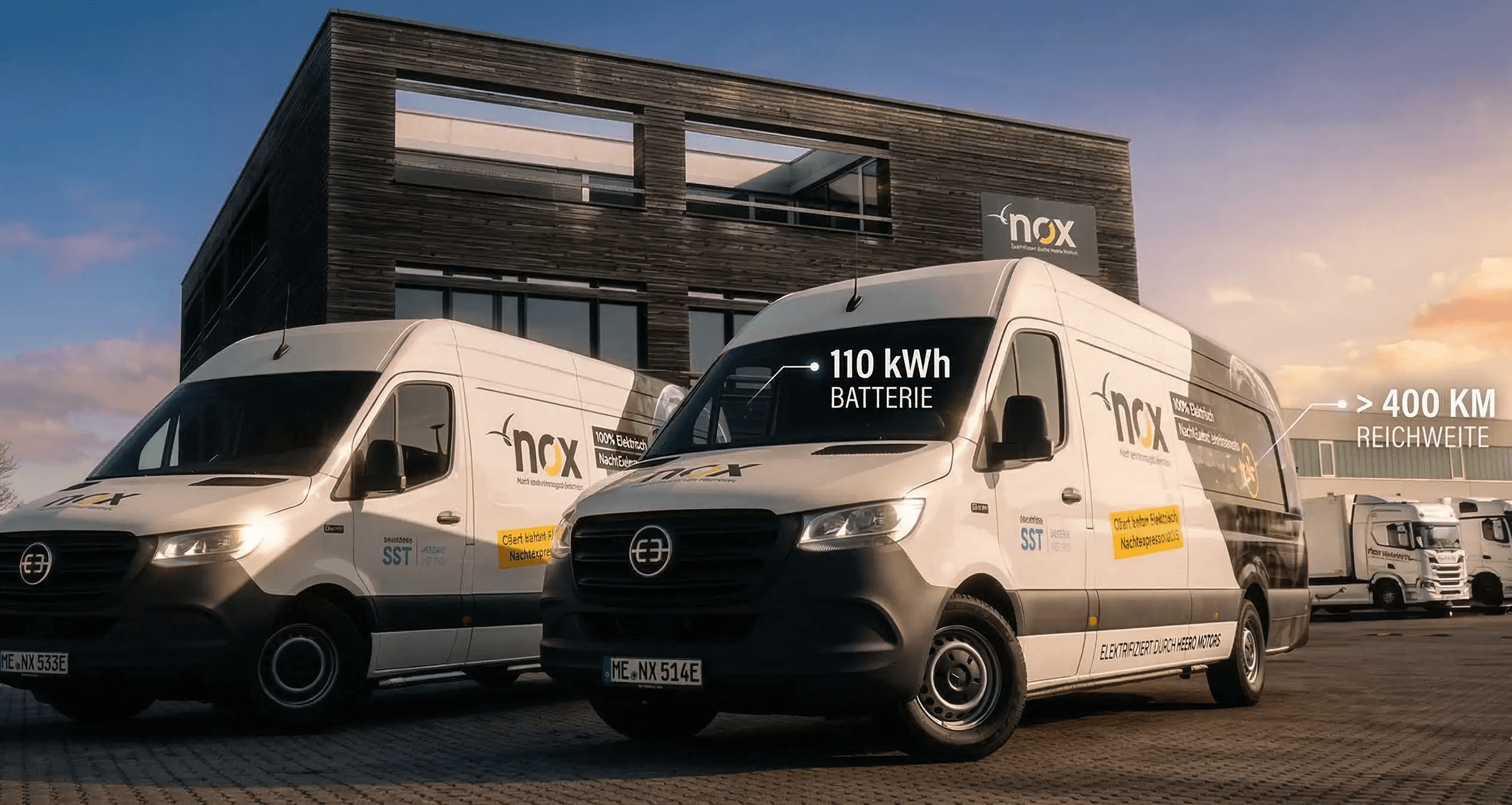
With a range of up to 425 km and a payload of 1,350 kg, converted transporters meet the demanding requirements of modern logistics.
For operators of commercial vehicle fleets, from municipalities to craft businesses, the transition to locally emission-free drives is becoming a strategic necessity. The challenge lies in shaping this transition economically and without operational compromises. Many shy away from the high initial investments and long delivery times for new electric vans, especially when expensive special bodies are already in place. HEERO offers a technologically leading alternative. We retrofit your existing Mercedes-Benz Sprinter to a powerful electric drive in just 10 days, thereby securing the value of your fleet while you benefit from lower operating costs and full operational readiness.
Increasing cost pressure: The new realities for small logistics fleets
Operating costs for diesel fleets are rising inexorably. Since December 1, 2023, a CO2-differentiated truck toll has added an extra burden to transport costs, with a surcharge of 200 euros per ton of CO2. For a logistics fleet of 3 vans, these additional costs quickly add up to several thousand euros per year. At the same time, experts predict a further increase in the CO2 tax to 55 euros per ton for 2025, which will make a liter of diesel around 16 cents more expensive. This development makes the analysis of total cost of ownership an urgent task for every fleet manager. The question is no longer whether, but how the transition to electromobility succeeds.
Purchase versus Retrofit: A Strategic Decision
The acquisition of new e-transporters often seems like the obvious solution, but it carries significant disadvantages. The investment costs are high, and already incurred expenses for expensive special bodies are lost. In addition, delivery times for new electric commercial vehicles are often long, which makes flexible fleet planning difficult. Converting existing vehicles is a superior alternative here. It is not only more cost-effective than a new purchase, but also conserves valuable resources. By continuing to use your proven vehicles, you can bypass long delivery times and accelerate the modernization of your fleet. This approach protects your invested capital and accelerates the transition to locally emission-free logistics.
HEERO D2E Retrofit: A Quantum Leap through Circular Economy
Our patented conversion is the answer to the challenges faced by modern fleet operators. We transform your reliable Mercedes-Benz Sprinter into a powerful electric vehicle within just 10 days. This process is based on the principle of the circular economy, in which the vehicle chassis and the valuable bodywork are preserved. This not only reduces waste and CO2 emissions that would be generated during the production of a new vehicle, but also significantly lowers your investment costs. You retain the familiar operation and functionality of your vehicles. The advantages of this approach are clear:
Investment protection: Your expensive special bodyworks remain completely preserved and usable.
Cost efficiency: The conversion costs are significantly lower than the price of a comparable new electric van.
Fast availability: The conversion takes only 10 days, meaning your vehicles are quickly ready for use again.
Proven basis: You continue to use the robust and reliable platform of the Mercedes-Benz Sprinter.
With this method, you can electrify your fleet without compromising on quality. In this way, the technological modernization of your fleet becomes plannable and economically viable.
Performance without compromise: Technical specifications for professional use
An electrified van from HEERO is in no way inferior to a new electric vehicle – quite the contrary. Our converted Sprinters offer impressive performance data optimized for demanding everyday logistics. With a practical range of up to 425 km (WLTP), your vehicles can easily handle even longer daily stages. The payload of up to 1,350 kg ensures that you do not have to make any compromises on transport capacity. Powered by an electric motor with a peak output of 150 kW, our vehicles guarantee confident driving dynamics even when fully loaded. This performance makes our solution ideal for a variety of sectors, from courier, express, and parcel services to demanding applications in construction site logistics. The performance proves that a conversion is the future-proof choice.
TCO analysis: How retrofitting outperforms purchasing new equipment economically
The total cost of ownership (TCO) is the decisive factor for the profitability of a fleet. This is where conversion shows its full strength. The pure energy consumption costs of an electric van, at around 6 euros per 100 kilometers, are almost 60% lower than those of a diesel vehicle at around 14.40 euros. In addition, there are massive savings in maintenance, as electric drivetrains generate up to 50% fewer maintenance costs. The exemption from vehicle tax for 10 years further improves the balance sheet; government subsidies have recently worked in the same direction. If we consider a logistics fleet of 3 Sprinters, the conversion costs often amortize within 4 to 6 years through these savings. A detailed amortization calculation quickly highlights the significant savings potential. These economic advantages make conversion the strategically smartest decision.
Sustainability as a competitive advantage through active circular economy
The decision to convert is a strong commitment to sustainability. By continuing to use your existing vehicles, you avoid the emission of several tons of CO2 that would be generated during the production of a completely new van. This approach of the circular economy not only conserves valuable raw materials such as steel and aluminum, but also strengthens your corporate image. The remanufacturing of commercial vehicles can enable material savings of up to 15% compared to new production. For companies and municipalities pursuing ambitious environmental goals, this is a decisive advantage. You can achieve your sustainability goals faster and act economically at the same time. In this way, ecological responsibility becomes a measurable economic success.
More useful links
Umweltbundesamt analyzes the environmental balance of motor vehicles.
The Bundesamt für Logistik und Mobilität (BALM) offers information on the Climate Protection and Mobility (KSNI) funding program.
The Statistisches Bundesamt provides tables on the vehicle fleet in Germany.
The KfW provides information on the promotion of electromobility for companies.
The Deutsche Energie-Agentur (dena) presents a market survey on the IAA on LinkedIn.
The Fraunhofer ISI offers a press release on the deployment planning of electric trucks, potentials, and costs.
Another press release from Fraunhofer ISI addresses falling costs for locally emission-free trucks.
Wikipedia offers a comprehensive article on the topic of electromobility.
The Verband der Automobilindustrie (VDA) provides recommendations on charging infrastructure for commercial vehicles.
Agora Verkehrswende provides a factsheet on the topic of municipal electric fleets.