Electric Bus Funding 2026 in Review: Up to 70% Federal Funding for Buses with Alternative Drive Systems
Electric Bus Funding 2026 in Review: Up to 70% Federal Funding for Buses with Alternative Drive Systems

The Federal Ministry of Transport started a funding call in 2026: transport companies, public transport authorities, and lessors were able to have electric, hydrogen, and biomethane buses subsidized with up to 70% of the additional investment costs – including charging infrastructure. The call ended on July 21, 2026. What had changed, who was eligible to apply, and how the outline had to be prepared: all the details in the full article.
The topic briefly and concisely
Until July 2026, the BMV funded buses with alternative drive systems (battery, fuel cell) with up to 70% of the additional investment expenses.
The submission deadline for the project outline was July 21, 2026, via "easy-Online" (federal funding portal); the deadline has expired.
Eligible applicants include transport operators, public transport authorities, and financing entities.
Those who invest in new bus fleets are investing in the public transport infrastructure of tomorrow. The 2026 funding call from the Federal Ministry of Transport seamlessly concluded the first funding directive (2021–2025) and established a new foundation based on the General Block Exemption Regulation (GBER). This meant: higher legal certainty, modernized prioritization criteria, and a clear path up to 2030. The call ran from May 26 to July 21, 2026, and has expired.
This article summarizes all the essential information from the online seminar on May 28, 2026 (BMV, project sponsor Jülich, NOW GmbH) – compact, action-oriented, and as a direct decision-making basis for transport companies and authorities.
Status Quo: Where does Germany stand regarding locally emission-free buses?
As of April 2026, there are 86,741 buses registered in Germany. Of these, 6,053 are locally emission-free, which corresponds to just under 7 % of the total fleet. The picture looks significantly more encouraging for new registrations: in April 2026, the share of climate-friendly buses was around 17 %, and averaged approximately 23 % over the last twelve months. The market is turning, but the bulk of the fleets still runs on diesel.
The previous funding program contributed significantly to this: a total of 5,309 buses with alternative drivetrains were applied for, including 4,658 battery-electric buses (87.7 %), 629 fuel cell buses (11.8 %), and 22 biomethane buses (0.4 %). In addition, there are over 2,000 funded charging stations as well as two hydrogen filling stations. 64 % of the approved vehicles have already been ordered, and 43 % have been procured.
The direction is clear. However, the transformation of the entire bus fleet in Germany requires further political momentum. This was present in 2026: with a funding guideline, new rules, and a budget for at least 1,500 additional buses. The call for funding applications ended on July 21, 2026.
The 2026 BMV funding program – key data in retrospect
Key Facts | BMV 2026 Funding Call (expired) |
|---|---|
Program | Funding directive for alternative drives of buses (BMV / NOW / PtJ) |
Term | From 2026 to 2030 (new directive according to GBER) |
Bus Funding Rate | 2026 Call: Activation program up to 70%, Scaling program up to 55% |
Infrastructure Funding Rate | Up to 40% in the 2026 call (activation program only) |
Minimum Volume | At least 1,500 buses |
Submission Deadline Sketch | Ended on July 21, 2026 (easy-Online) |
Max. Grant | €12.5 million per sketch submitter |
Application Portal | easy-Online (Federal funding portal) |
Activation Program vs. Scaling Program: Which program is right for you?
The program distinguished between two pillars aimed at the level of electrification of the existing fleet:
Program | Funding rate bus | Funding rate infrastructure |
|---|---|---|
Activation program (K1–K3) | Up to 70 % | Up to 40 % |
Scaling program (K4) | Up to 55 % | Not eligible for funding |
Activation program (Funding pillar 1 & 3)
For transport companies that are only at the beginning of their electrification, the activation program was the right starting point. It was aimed at companies whose fleets fell into categories K1 to K3:
• K1: No electrification existing, conversion rate ≤ 30 %
• K2: Low electrification, conversion rate ≤ 30 %
• K3: Medium electrification, conversion rate ≤ 50 %
Within the activation program, both buses (up to 70 % of the additional investment costs) and the associated charging infrastructure (up to 40 % of the total investment costs) were funded. Important: Infrastructure could only be applied for in conjunction with the vehicle; separate infrastructure funding was not possible.
Scaling program (Funding pillar 2)
Those who already had a high electrification rate (category K4) automatically ended up in the scaling program. There, the funding rate was up to 55 %, and infrastructure was not subsidized. The focus was on the further rollout of proven technology.
For coaches and long-distance buses as well as other transport services (according to §§42a, 43, 44, 46, 48, 49 PBefG), only the activation program via funding pillar 3 applied.
What was funded and what was not?
The following were funded:
• Additional investment expenses for buses with alternative drivetrains (battery bus, fuel cell bus, biomethane bus, trolleybus) compared to the diesel reference bus
• Purchase of charging and refueling infrastructure including transformers, chargers, contact systems, battery buffer storage, H2 storage, pipelines and much more
• Software for load, charging, and refueling management
• Lines for power transmission and communication (technology-dependent)
• Delivery, installation, and construction planning costs in connection with the funded infrastructure
• Maximum grant: €12.5 million per outline submitter (all submitted outlines are added together)
The following were not funded:
• Manufacturers, research projects, studies
• Buses that are not used in Germany
• Buses already ordered or infrastructure already procured
• Personnel and training, licensing and rental models (e.g., SaaS)
Additional real estate, depot management systems
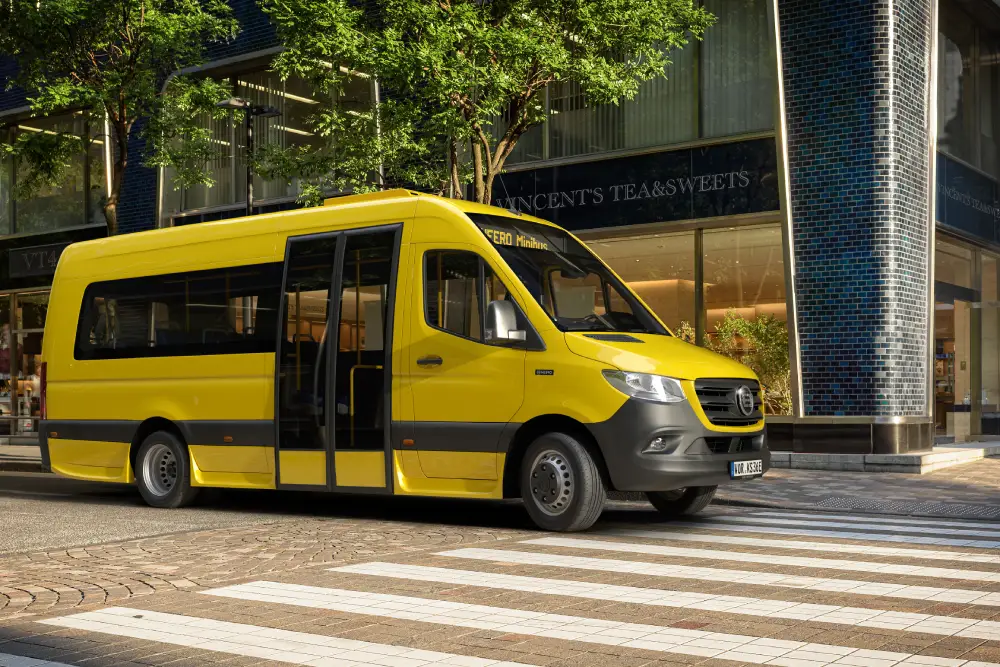
Here you can find more information about our buses that were eligible for funding in the 2026 call.
Calculation example: How high was the subsidy in concrete terms?
Example: 12 m solo battery bus in the activation program • Cost of battery bus: €525,000 • Cost of diesel reference: €280,000 • Additional investment expenditure: €245,000 • Maximum funding (70 %): €171,500 • Cost after funding: €353,500 • Delta to diesel bus after funding: €73,500
The funded amount was the difference between the battery bus and the comparable diesel bus (basic version, no special equipment). The subsidy was up to 70 % of this additional expenditure. After the funding, a 12 m solo battery bus was thus a good €73,000 more expensive than a comparable diesel – this gap shrinks further when operating costs and CO₂ reduction potentials are factored in.
For the infrastructure, the funding rate of 40 % was applied to the full investment costs (not just additional expenditure). Infrastructure items had to be directly related to the introduction of the technology.
The subsidy process step by step
In principle, the following were eligible to apply:
• Public and private transport companies
• Public transport authorities
• Financiers (e.g., lessors)
Separate outlines had to be submitted for different propulsion types (battery vs. fuel cell buses) and different operational contexts (public transport, coach and long-distance transport, other transport). Multiple outlines from a single applicant were added together for the maximum limit of €12.5 million.
Step 1: Submit outline – deadline ended on July 21, 2026
The project outline was submitted electronically via the federal funding portal "easy-Online". In addition, the Excel spreadsheet for determining eligible expenses had to be uploaded as a PDF along with the outline and sent as an Excel file (with easy-Online ID) to ptj-evi-busse@fz-juelich.de.
• Always download the documents anew in advance from the project management organization's website
• For coaches/long-distance buses: Prove diesel reference prices in the outline with offers
• For public transport buses: Proof of offer only required upon application
Step 2: Prioritization by PtJ
The Projektträger Jülich (PtJ) reviewed and prioritized all received outlines based on the categories K1–K4, environmental benefit, funding efficiency, as well as the implementation concept and perspective.
Step 3: Invitation to apply (from mid-August 2026)
Prioritized submitters received an invitation to formal funding application via email (address from the outline). The application period was 8 weeks from approximately mid-August 2026. The overall financing had to be secured at the time of application.
Step 4: Approval and implementation
After approval, the project duration of a maximum of 3 years started. Within this period, the following deadlines applied:
• Buses: Tender within 6 months, order within 12 months
• Infrastructure: Start of construction within 12 months
Important obligations: Funded companies had to provide master and operating data of the vehicles and infrastructure, involve PtJ and NOW in public relations events (at least 8 weeks in advance), and enable logo placements on the funded items.
The eBusTool: Digital planning before the application
For preparation, the free eBusTool from NOW GmbH is recommended. It offers:
• Basic knowledge about electric buses and propulsion types
• Cost comparison calculator for different propulsion options
• Analysis of operational processes and climate impacts
• Vehicle database with current models (battery, fuel cell, trolleybus)
The eBusTool is accessible free of charge.
When was the submission deadline for the project outline?
The sketch had to be submitted electronically via the "easy-Online" funding portal by July 21, 2026.
Which drive technologies were funded?
Buses with battery drive, fuel cell drive (hydrogen), trolleybus drive, and biomethane were funded. The program was designed to be technology-neutral.
What was the maximum funding amount per sketch submitter?
A maximum funding of 12.5 million euros is available per applicant. Multiple project outlines from the same applicant will be aggregated.
Could infrastructure alone also be subsidized?
No. Infrastructure was only eligible for funding in conjunction with the vehicle and was exclusively intended for the activation program. No infrastructure was funded in the scaling program.
I have already ordered buses – can I still submit an application?
No. Buses that had already been ordered or infrastructure that had already been procured were generally not eligible for funding. The application had to be submitted before the order was placed.
How was my company assigned to a funding program (Activation vs. Scaling)?
The allocation was determined by the fleet's level of electrification and the conversion rate. Companies with less than 30% of their fleet electrified generally fell into the activation program (higher funding rate). Companies that already had a high level of electrification (category K4) were assigned to the scaling program.
More useful links
With the 2026 call, the Federal Ministry for Transport funded the procurement of buses with alternative drives and the expansion of the necessary charging and refueling infrastructure.
The easy-Online funding portal enables the digital submission of funding applications and project outlines of the federal government.
The NOW GmbH – National Center for Charging Infrastructure coordinates funding programs and initiatives for electromobility in Germany.
The eBusTool of NOW GmbH supports transport companies in the economic evaluation of the electrification of bus fleets.
As a funding organization, the Projektträger Jülich (PtJ) accompanies the implementation of federal funding programs in the field of energy and mobility.
The ElektromobilitätsMONITOR of NOW GmbH provides current registration statistics and market data on electromobility in Germany.