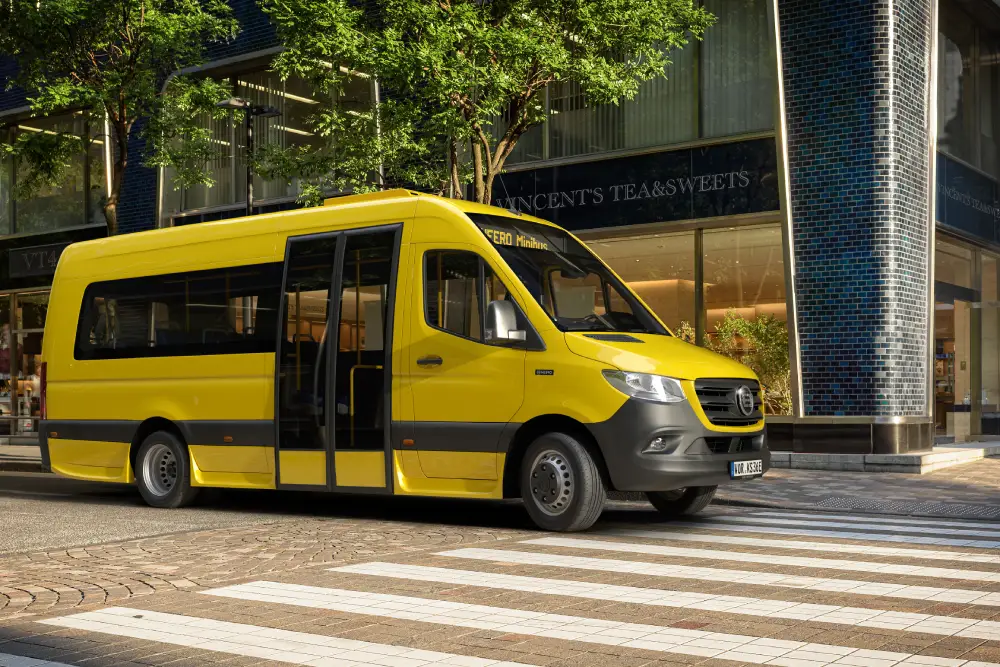
Investment protection through electrification: Equip your Mercedes Sprinter chassis with special equipment for the future.
Investment protection through electrification: Equip your Mercedes Sprinter chassis with special equipment for the future.

Your Mercedes Sprinter with an expensive special build is the centerpiece of your fleet, but diesel driving bans and rising costs threaten your investment. A new purchase is costly and often unnecessary when only the drive system is outdated. Discover a solution that combines the best of both worlds: the fully electric power of tomorrow with the proven build of today.
The topic briefly and concisely
Protect your investment: An electric conversion of the Mercedes Sprinter chassis retains expensive special builds 100%.
Reduce operating costs: Benefit from up to 50% lower maintenance costs, tax exemptions, and lower energy costs compared to diesel.
Act sustainably and future-proof: The continued use in terms of circular economy reduces waste and CO2 emissions and meets upcoming legal requirements.
For fleet operators in municipalities, logistics, and trade, a pressing question arises: How do you secure the value of a fleet when its core component – the diesel drive – becomes a liability? A Mercedes Sprinter chassis is the basis for countless special bodies, from refrigerated boxes to mobile workshops, whose value often exceeds that of the base vehicle. The HEERO conversion offers a pragmatic and economically superior solution here. Instead of writing off a functional and valuable body, we only replace the drivetrain. In this way, your proven commercial vehicle becomes a powerful electric van that is not only locally emission-free during operation, but also significantly more cost-effective to operate.
The double challenge: emission targets and the protection of expensive specialized structures
Companies and municipalities are faced with the necessity of making their vehicle fleets greenhouse gas-neutral by 2045 in order to meet legal requirements. At the same time, they have often invested six-figure sums in special bodies for their Mercedes Sprinter. A refrigerated box body or a workshop conversion can easily cost over €50,000 and has a lifespan that often exceeds that of a diesel engine by double. Purchasing a new electric van would force the depreciation of these fully functional and expensive bodies. This destruction of capital is neither economical nor sustainable. Retrofitting is a strategic decision to secure your sustainability goals and your balance sheet. This problem affects thousands of vehicles in daily use. The continued use of these bodies is therefore a key lever for reducing costs.
Maximizing value creation: The patented D2E conversion as a strategic alternative
Instead of investing in a completely new electric van including the body, HEERO offers an intelligent alternative: the conversion. During this process, the entire diesel drivetrain is removed from your Mercedes Sprinter chassis and replaced with our powerful electric drive. Your individual body remains 100% preserved and untouched. This circular economy approach not only conserves valuable resources but also your budget. The conversion usually takes only 10 working days.
The following bodies can be preserved without any problems:
Refrigerated and fresh food box bodies for food logistics
Workshop fittings and shelving systems for trade businesses
Furniture box bodies and tail lifts for freight forwarders
Municipal special-purpose bodies such as sweepers or aerial work platforms
Sales and promotional vehicles with complex interior fittings
This process protects your original investment and makes it fit for the locally emission-free future.
TCO Analysis: Why Retrofitting Outweighs Purchasing Economically
The Total Cost of Ownership is the decisive key figure for fleet managers. A study by Transport & Environment shows that electric vans are on average 25% cheaper to operate than comparable diesel models. With a conversion, these advantages are even more significant. The amortization of the conversion costs often occurs after just 4 to 6 years. The maintenance costs for an electric drive are up to 50% lower, as components such as the exhaust, oil changes, or clutch are eliminated. In addition, you benefit from 10 years of vehicle tax exemption in Germany and significantly lower energy costs per kilometer. Through funding programs such as KsNI, up to 80% of the additional costs compared to a new diesel vehicle could be subsidized until 2024, making the templated conversion solution even more attractive. The economic efficiency is therefore clearly proven.
Performance without compromise: Technical data and practicality
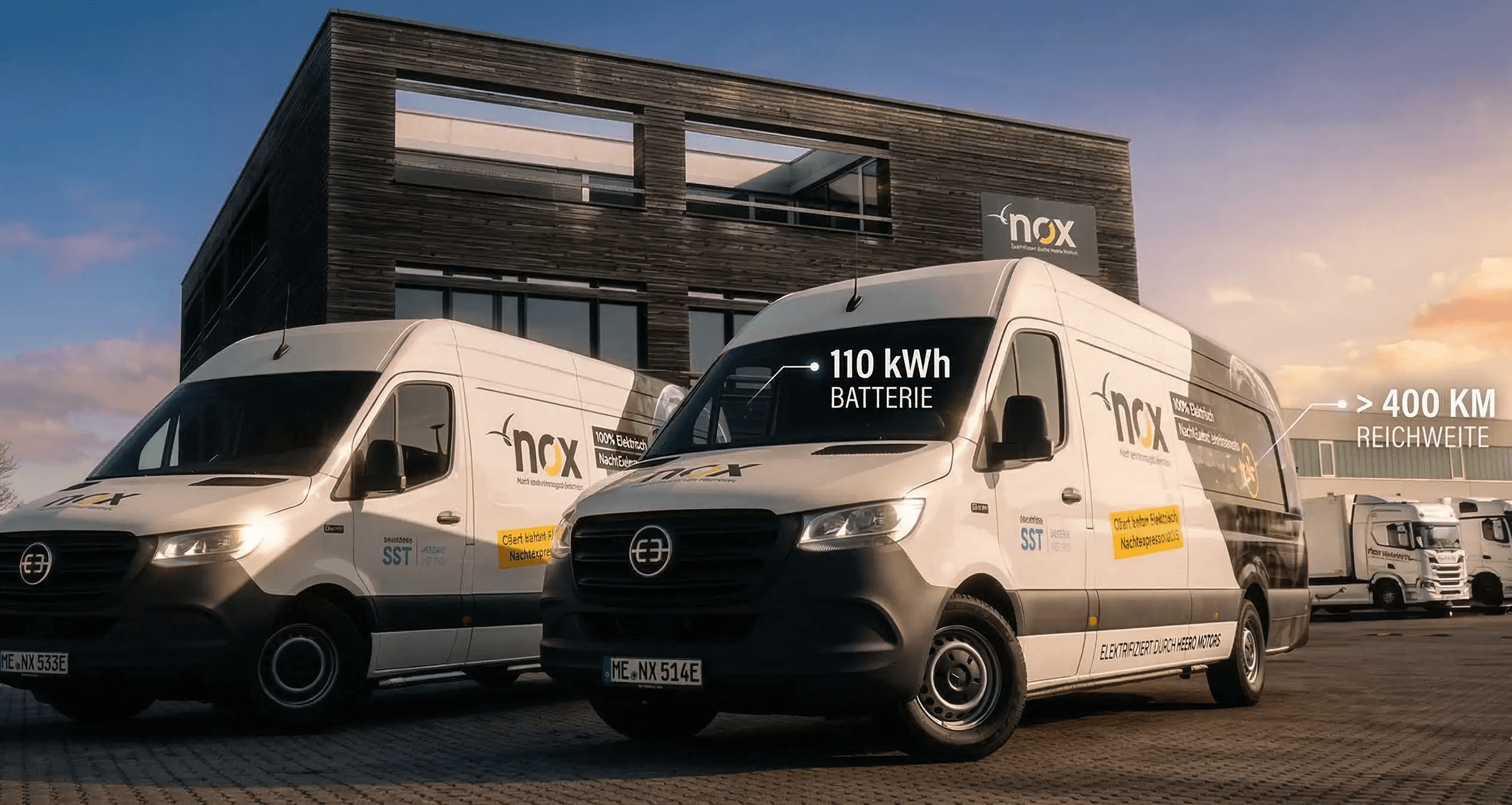
An electric conversion does not mean sacrificing performance – on the contrary. With up to 180 kW (245 hp), the HEERO electric Sprinter offers higher performance than many series-production e-vans. The field-tested range of up to 425 km (combined WLTP) ensures planning reliability in the daily work of logistics providers and craftspeople. The payload and driving characteristics of the original Sprinter chassis remain almost unchanged. This is how we ensure that your vehicle is ideally equipped for tough daily work.
The conversion process in our factory follows a standardized and certified procedure:
Analysis and preparation of the base vehicle.
Professional dismantling of the entire combustion engine drivetrain.
Integration of the HEERO e-drive module and the battery units.
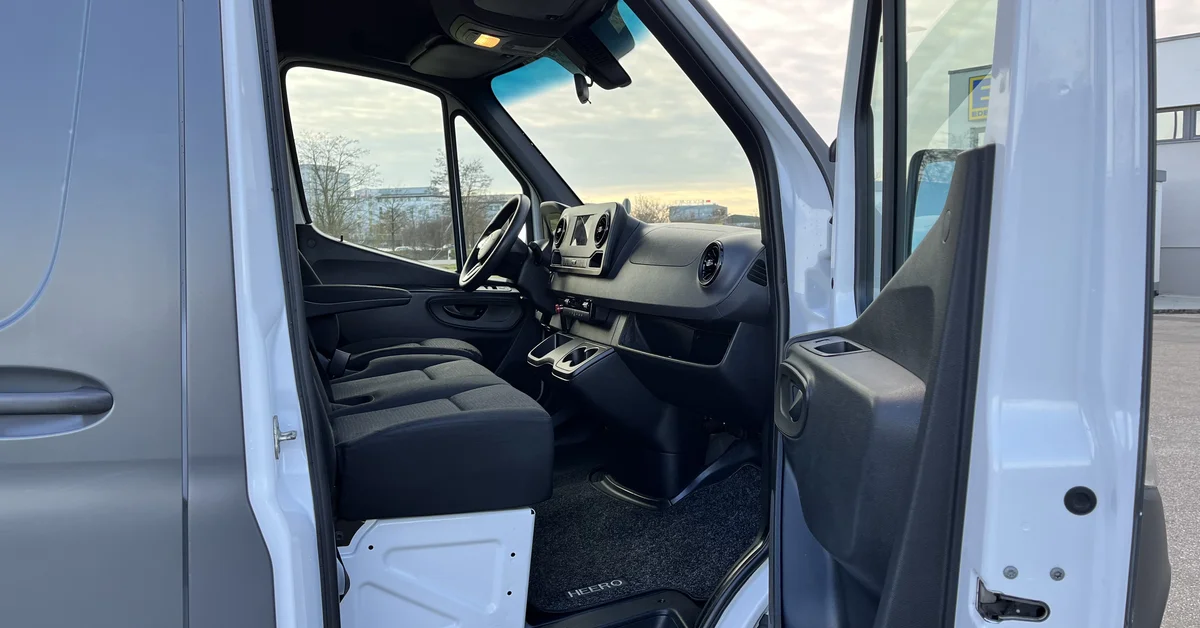
Adaptation of the onboard electronics and the cockpit.
Comprehensive quality control and TÜV approval.
This means your electrified Sprinter chassis is immediately ready for use again.
Industry-specific solutions: Success stories from municipalities and logistics
The advantages of conversion are evident in many industries. A municipality operating a Sprinter with an expensive sweeper body costing €80,000 can continue to use this body completely. Instead of spending over €150,000 on a new special-purpose electric vehicle, the conversion enables savings of over 50%. A furniture transporter with a box body and tail lift protects their €30,000 investment in the body and benefits from lower operating costs. For craft businesses with expensive shelving systems in the vehicle, the continued use of the interior fitting is a decisive factor. Conversion is therefore not a niche solution, but a pragmatic strategy for dozens of use cases. It secures the functionality for which the vehicle was originally designed.
Your advantage with HEERO: More than just a vehicle
The decision for a HEERO conversion is a decision for cost-effectiveness, sustainability, and performance. You protect your investments in expensive special bodies, significantly reduce your operating costs, and meet future environmental requirements with a powerful vehicle. With a range of up to 425 km and robust technology, your converted Sprinter is equipped for all tasks. HEERO is your innovative partner putting the principles of the circular economy into practice and offering you a customized solution for the electrification of your fleet. Experience the advantages for yourself. Request your personal consultation now or book a free trial under everyday conditions.
More useful links
Bundesamt für Logistik und Mobilität (BALM) provides information on the Climate Protection and Innovation funding program for commercial vehicles (KSNI).
Kraftfahrt-Bundesamt (KBA) provides monthly statistics on new vehicle registrations in Germany.
Umweltbundesamt publishes an analysis of the environmental footprint of motor vehicles.
Verband der Automobilindustrie (VDA) provides information on the circular economy in the automotive industry.
Wikipedia provides an overview of electromobility.
International Council on Clean Transportation (ICCT) provides a factsheet on the total cost of ownership (TCO) of battery-electric vehicles (BEVs) in Europe.
Bundesministerium für Verkehr (BMV) provides information on battery-powered electromobility.
Verband der Automobilindustrie (VDA) provides information on the powertrain strategy for commercial vehicles.
Deutsche Energie-Agentur (dena) provides information on electromobility as an opportunity for power grids.
Öko-Institut publishes a publication on the electrification of heavy-duty commercial vehicles and the development of charging infrastructure.