Towing Capacity in Electric MiniBuses vs. Transporters: TCO and Performance Without Compromise

Towing Capacity in Electric MiniBuses vs. Transporters: TCO and Performance Without Compromise

Fleet operators are facing a major challenge: legally mandated electrification is clashing with e-transporters that often have an insufficient towing capacity of only 1,500 kg. This threatens the value retention of specialized trailers and severely limits operational capabilities.
Topics on this page
The topic briefly and concisely
Full towing capacity: HEERO D2E conversions retain the full 3,500 kg towing capacity of the Sprinter base vehicle, whereas many OEM e-transporters...
Range when towing: A high towing capacity can significantly reduce the range; a large 110-kWh battery is therefore essential for...
CVD Compliance: Fast Diesel-to-Electric conversion and new vehicles with high towing capacity enable legally compliant fulfillment of CVD quotas (38.5% LCV, 45.
The electrification of commercial vehicle fleets is no longer an option, but an economic and regulatory necessity. The Clean Vehicles Directive (CVD) mandates quotas of 38.5% for light commercial vehicles and 45% for buses by 2025. However, many standard electric vans fail to meet a key requirement: a practical towing capacity. Often, the limit is reached at 1,500 kg, which is unacceptable for municipalities, construction, and logistics. This article analyzes the technical and economic differences in the towing capacity of electric minibuses and vans and demonstrates how fleet managers can achieve full performance and compliance without expensive compromises.
Standard e-transporters on the market fail to meet critical towing capacity limits
For many commercial fleets, a towing capacity of 3,500 kg is the essential foundation for transporting construction machinery, materials, or specialized equipment. However, the reality of the market for new electric commercial vehicles paints a different picture. Many models only offer a towing capacity of between 1,500 kg and 2,000 kg, such as the Mercedes-Benz eSprinter with 2,000 kg. This limitation represents a direct operational hurdle and devalues existing investments in heavy trailers.
This discrepancy between requirements and what is available on the market leads to significant losses in efficiency. Landscaping businesses, municipalities with aerial work platforms, or logistics companies in the event sector cannot use their existing trailers. The forced purchase of smaller trailers or the deployment of an additional internal combustion engine vehicle undermines the TCO advantages of electromobility. The conversion of a proven electric Sprinter offers a direct solution here. The technological challenge for manufacturers lies in the stress placed on the battery and drivetrain, which leads to the aforementioned limitations. This highlights why a different approach to electrification is necessary.
The impact of trailers on real-world range and operating costs
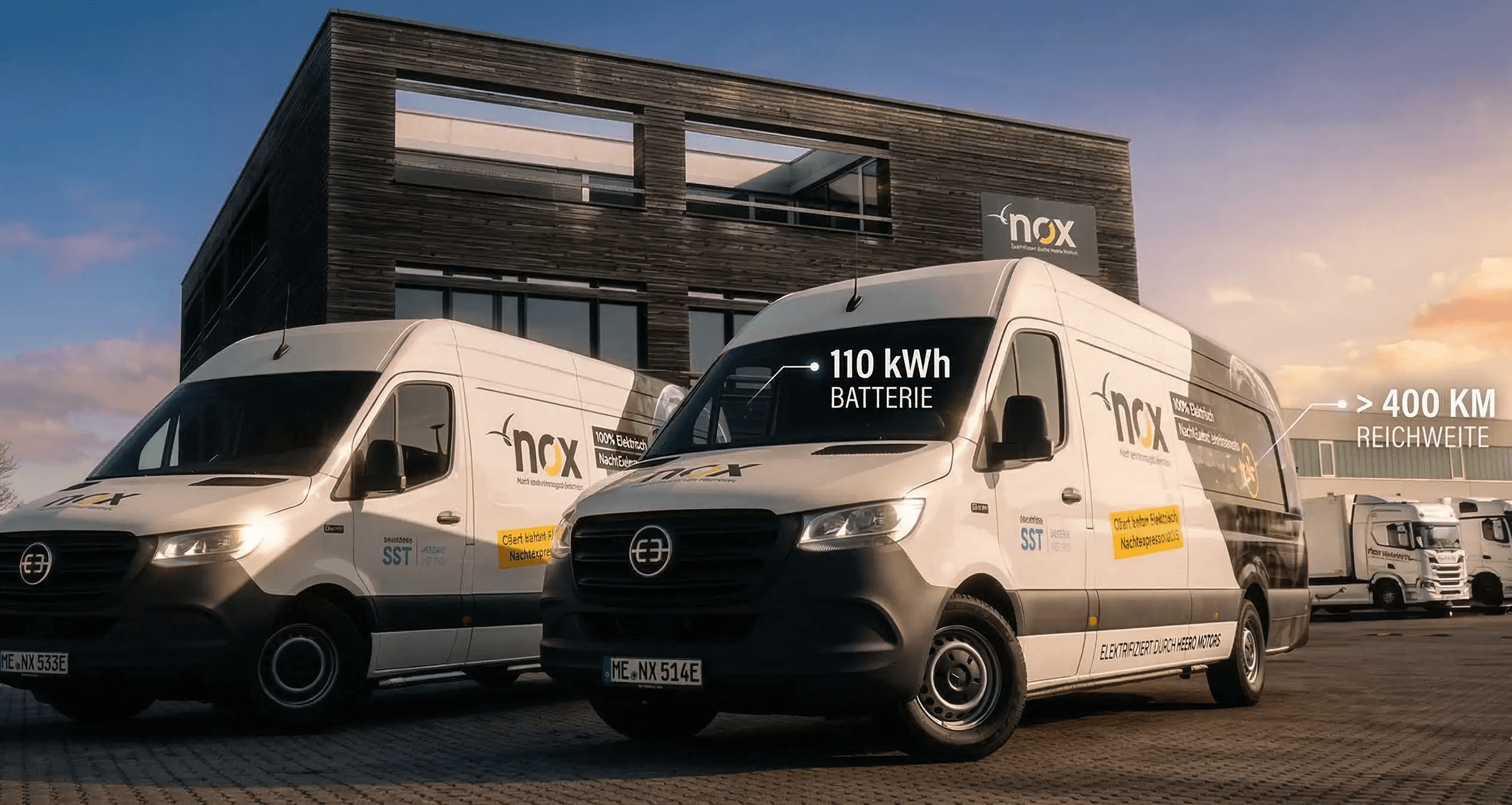
The towing capacity has the greatest external influence on the range of an electric vehicle. As a rule of thumb, operating with a heavy trailer can significantly reduce the range. A HEERO eTransporter with a WLTP range of up to 500 km thus offers a practical distance of around 250 km even when towing a trailer. This is crucial for daily planning without unproductive charging stops.
Energy consumption increases due to two main factors: the higher total weight and the increased aerodynamic drag. A 3.5-ton trailer can increase the energy requirement by 20-30 kWh per 100 km. To handle this requirement, large batteries like the 110 kWh battery from HEERO are essential. The following points are relevant for the TCO consideration:
Higher energy consumption means higher "fuel costs" per kilometer.
Charging planning must take the reduced range into account in order to minimize downtime.
The load on the battery's thermal management increases, which requires a robust system design.
The recuperation performance can compensate for part of the additional consumption with a proactive driving style.
An accurate analysis of the WLTP range of commercial vehicles is therefore only the first step; the calculation must include trailer operation.
Secure full towing capacity through D2E conversion based on the Sprinter platform
The technological solution to overcoming the towing capacity limitation lies in the conversion of proven base vehicles. HEERO focuses on the Mercedes-Benz Sprinter (model 907), as its chassis and braking system are already designed for high loads of up to 3,500 kg. In contrast to many e-vans developed from scratch, the conversion fully preserves the originally homologated towing capacity, which is entered in the vehicle registration documents (field O.1).
This approach offers fleet operators decisive advantages that go beyond pure pulling power. It protects investments made and maintains the full functionality of the fleet. The key advantages are:
Value retention: Existing special bodies and trailers can continue to be used without restrictions.
No compromises: The towing capacity of 3,500 kg enables the transport of heavy loads just like a diesel.
Fast implementation: The conversion of a Sprinter 907 takes a maximum of 10 working days (only model series 907) and accelerates fleet electrification.
TCO optimization: The continued use of an existing vehicle significantly reduces the total cost of ownership compared to purchasing a new one.
This method, as applied to the most powerful electric transporter, ensures that electrification does not become an operational disadvantage.
Legally compliant fulfillment of CVD quotas for Electric MiniBuses and vans
The Clean Vehicles Directive (CVD) creates significant pressure on public contracting authorities and their service providers. By the end of 2025, 45% of all newly procured buses and 38.5% of light commercial vehicles had to be classified as "clean". From 2026, the rules will tighten further, with the quota for buses in particular rising to 65%. Failure to meet these quotas can lead to legal consequences.
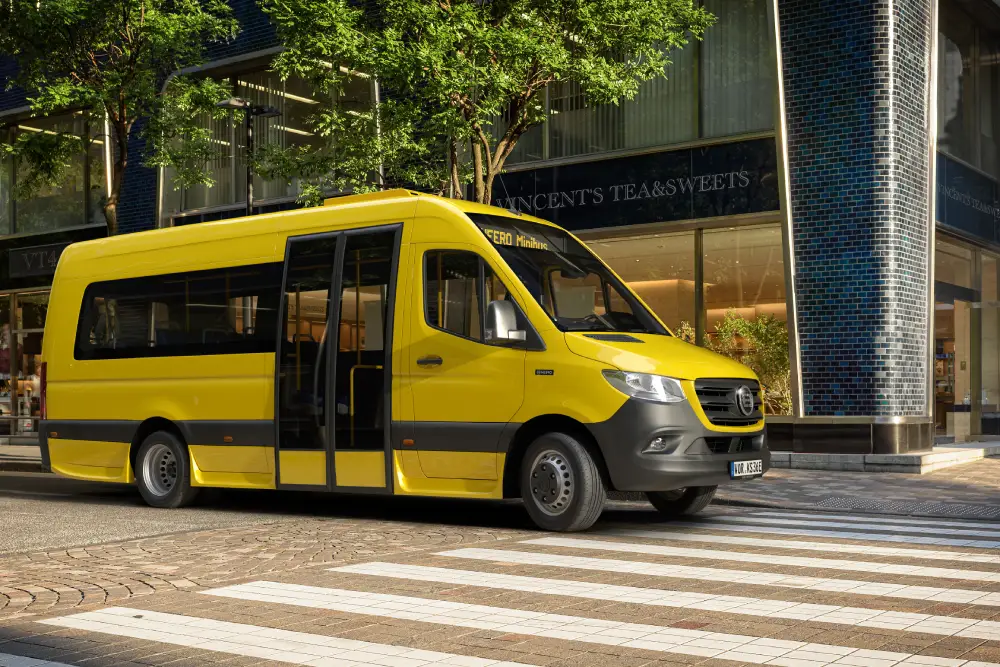
HEERO offers practical solutions for both vehicle classes. A HEERO eBus based on the Sprinter meets the requirements for passenger transport and helps to achieve the 45% quota. For freight transport, the HEERO eVan with its full towing capacity ensures compliance with the 38.5% quota without restricting operational capability. The conversion is often the fastest way to meet the CVD requirements on time. The regulation that electric vans up to 4.25 tonnes can be driven with a category B driving license also lowers the hurdles for driver deployment. This makes compliance with legal requirements a predictable process.
FAQ
What is the difference in towing capacity between a HEERO Electric MiniBus and an eTransporter?
Technically speaking, both vehicle types are based on the Mercedes-Benz Sprinter and can therefore achieve the same maximum towing capacity of up to 3,500 kg. However, the actual registered towing capacity may vary depending on the body type and the gross vehicle weight rating. A fully equipped Electric MiniBus typically has a higher curb weight than an Electric BoxVan, which can affect the calculated towing capacity. The final specification is usually determined individually for each vehicle.
Does a D2E-converted Sprinter retain the full towing capacity approved by the manufacturer?
Yes, this is one of the core advantages of the HEERO D2E conversion. We retain the original braked towing capacity of up to 3,500 kg, which was homologated by the vehicle manufacturer and entered in the vehicle registration certificate. This is possible because we utilize the robust original chassis of the Sprinter 907 and our electric powertrain is designed for these loads. Many other e-vans on the market do not offer this.
How much does the vehicle's payload decrease due to the D2E conversion?
The additional weight of the 110 kWh battery reduces the available payload compared to the original diesel vehicle. However, thanks to the legal exemption in Germany allowing electric vans with a gross vehicle weight of up to 4.25 tons to be driven with a class B driver's license, this effect is significantly mitigated. The exact payload depends on the specific model and body configuration, which will be precisely determined as part of a fleet analysis.
What warranty does HEERO offer on the powertrain under high towing capacity?
HEERO offers a comprehensive warranty on all of the components of the electric drivetrain that we install, including the battery. This warranty is designed for operation with the full, registered towing capacity. Our system is tested and validated for the high demands of trailer towing. For service, our mobile team, the Flying HEEROs, is at your disposal.
Do I need a special truck driver's license to tow a 3,500 kg trailer?
Operating a vehicle combination consisting of a transporter up to 4.25 t and a trailer, where the combined gross vehicle weight rating exceeds 3,500 kg, generally requires a class BE driver's license. The 4.25-tonne regulation for the towing vehicle alone does not alter the driver's license requirements for the combination. Fleet managers must ensure that their drivers possess the appropriate qualifications.
How long does it take to charge a HEERO eTransporter with a trailer?
The charging time is not affected by the trailer. At a 165 kW DC fast-charging station, the 110 kWh battery typically charges from 10% to 80% in 60-90 minutes. However, a practical challenge is that many public charging stations are not designed for vehicle-trailer combinations. Often, the trailer must be uncoupled before charging. We therefore provide comprehensive consulting to help you plan an efficient depot charging infrastructure.
More useful links
The ADAC provides comprehensive information and buying guides on electric cars, including models with trailer hitches.
On Buzer.de you will find the complete Section 34 of the Road Traffic Licensing Regulations (StVZO), which contains important provisions on vehicle parts and their operation.
The NOW GmbH provides a data finder and a study overview on the Total Cost of Ownership (TCO) of climate-friendly commercial vehicles.
The Kraftfahrt-Bundesamt (KBA) publishes current statistics on electromobility in Germany.
The Umweltbundesamt (UBA) provides a detailed analysis of the environmental performance of motor vehicles, including electric vehicles.
Strategy& from PwC publishes press releases and analyses on the breakthrough and development of electric trucks.
The Fraunhofer ISI provides information on the deployment planning of electric trucks, their potentials and the associated costs.
The e-mobil BW GmbH reports on the increasing importance and dissemination of electric commercial vehicles.