Electric Sprinter: Reduce TCO, preserve specialized bodies, and meet CVD quotas

Rising cost pressures and the Clean Vehicles Directive are challenging your fleet. Upfitting your Sprinter with a Diesel-to-Electric (D2E) eDrive is the pragmatic solution: it lowers the total cost of ownership (TCO), secures the value of your custom bodies, and efficiently meets regulatory quotas.
Topics on this page
The topic briefly and concisely
Significantly reduce your fleet TCO with substantially lower maintenance and energy costs compared to the diesel Sprinter.
Meet CVD quotas (38.5% for light commercial vehicles) quickly and predictably through a Diesel-to-Electric conversion in just 10 working days (907 model series only).
Retain the full value of your expensive specialized bodies (refrigerated boxes, tippers) by continuing to use your proven Sprinter 907.
In 2025, fleet managers in municipalities and logistics companies face a dual challenge: total cost of ownership (TCO) must be reduced, while the statutory requirements of the Clean Vehicles Directive (CVD) mandate electrification. Purchasing new electric vehicles often involves high capital expenditure and the loss of valuable specialized bodies. A D2E (Diesel-to-Electric) conversion for proven Mercedes-Benz Sprinter 907 series vehicles offers a direct solution here. This approach transforms your existing vehicles into powerful electric Sprinters, preserves their functionality, and sustainably optimizes your balance sheet.
Significantly reduce TCO through electrification
The Total Cost of Ownership (TCO) is the decisive key metric for the profitability of a fleet. An electric Sprinter, created through a D2E conversion, offers significant advantages here compared to its diesel counterpart. Operating costs can typically be reduced significantly, as electricity costs per kilometer are generally lower than diesel costs. In addition, cost-intensive maintenance items such as oil changes or exhaust system repairs are eliminated. Maintenance costs for electric commercial vehicles can be considerably lower.
These savings often amortize the initial conversion costs within a few years. A detailed analysis of your fleet will reveal the concrete savings potential. Conversion is therefore not a pure expense, but an investment in the future cost efficiency of your vehicle fleet. Electrification optimizes your balance sheet sustainably and predictably.
Switching to an electric Sprinter also protects you from unpredictable fluctuations in diesel prices. Electricity prices for depot charging are more stable, allowing for more reliable cost planning. In this way, electrification becomes a strategic advantage in the market.
Ensure CVD compliance through rapid Diesel-to-Electric conversion
The Clean Vehicles Directive (CVD), implemented through the Clean Vehicles Procurement Act (SaubFahrzeugBeschG), is putting public contracting authorities under pressure. By the end of 2025, 38.5% of purchased light commercial vehicles and 45% of buses must be classified as "clean". Half of the bus quota must even be fulfilled completely emission-free. These quotas are not a recommendation, but a legal obligation. Non-compliance can lead to procurement law consequences.
The D2E conversion is the fastest way to meet these requirements. Instead of waiting for long delivery times for new electric vehicles, you can use your existing fleet. The conversion of a Mercedes-Benz Sprinter (Model 907) to an electric Sprinter takes Heero a maximum of 10 working days (only 907 model series). This speed enables flexible and demand-oriented planning to achieve CVD targets.
The following points make conversion the ideal CVD solution:
Fast availability: Within 10 working days (only 907 model series), your vehicle is ready for use again.
Quota fulfillment: A converted electric Sprinter counts as a zero-emission vehicle.
Planning security: You are independent of the supply chains of the vehicle manufacturers.
Protection of existing assets: You meet the quota without having to give up your proven fleet.
With this approach, the legal obligation becomes a strategic opportunity to future-proof your own fleet. Learn more about the possibilities for your Electric BoxVan.
Value creation through circular economy and technology preservation
A key advantage of D2E conversion lies in the principle of the circular economy. Instead of scrapping a fully functional vehicle with an expensive specialized body – such as a refrigerated box or a tipper bed – its life cycle is extended. The vehicle value, which is often more than 50% tied up in the body, is fully preserved. This not only protects your budget, but also saves valuable resources and reduces waste. The conversion is an active contribution to sustainability that pays off directly in economic terms.
The technological core of the HEERO D2E conversion for the Sprinter 907 is precisely tailored to the requirements of commercial fleets. The technical specifications ensure high suitability for daily use:
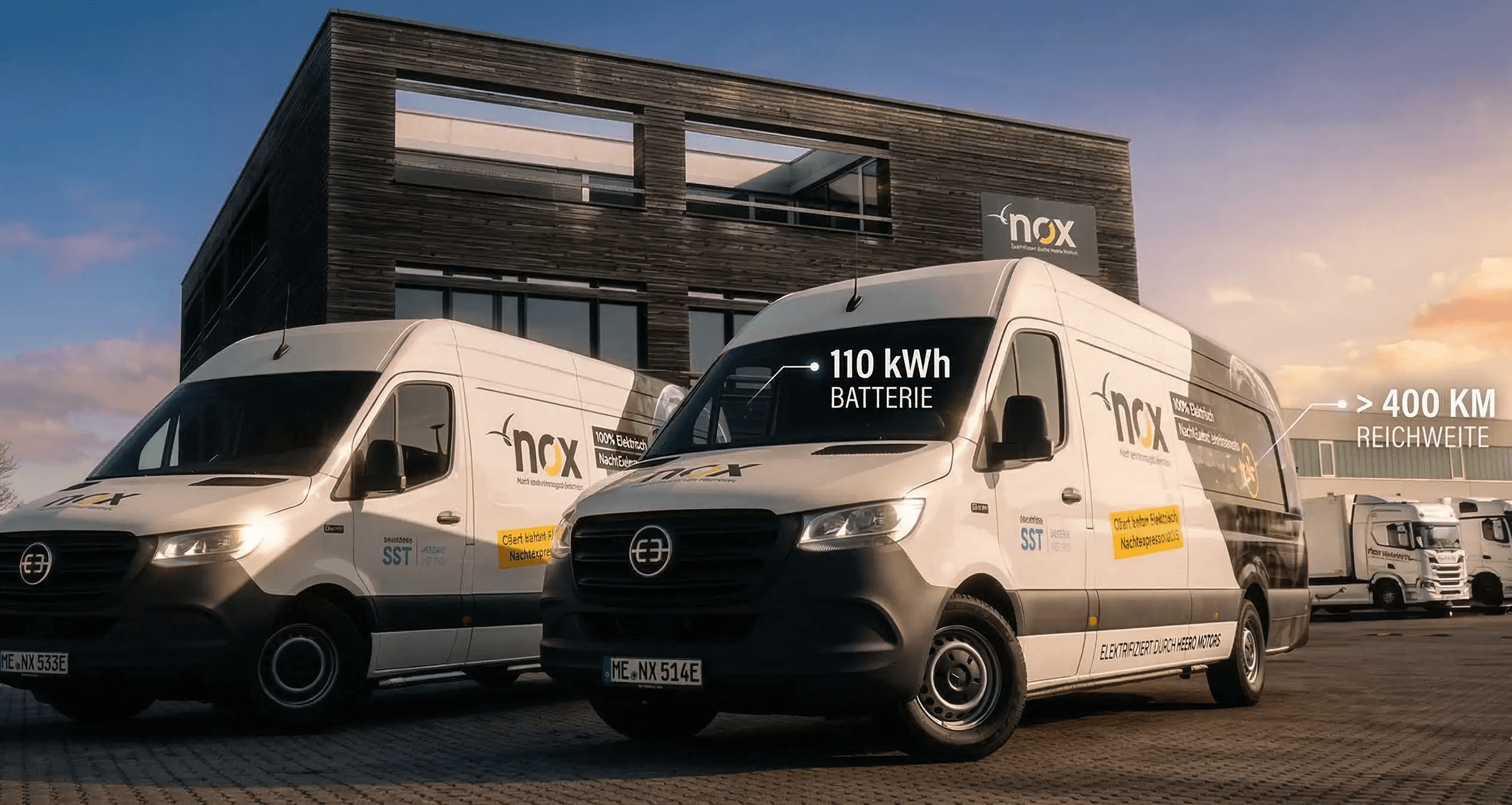
Battery Capacity: 110 kWh (gross) for long ranges.
Range: Up to 300 km (WLTP), ideal for distribution transport and the last mile.
DC Fast Charging: With 165 kW charging power, the battery is charged to 80% in 60-90 minutes.
AC Depot Charging: 22 kW charging power for scheduled charging overnight.
These performance figures make the converted electric Sprinter a fully-fledged replacement for diesel vehicles, without compromising on usability. The combination of value retention and modern e-technology makes conversion the smartest form of fleet modernization. Discover the benefits for specialized applications like electric refrigerated vehicles.
Practicality in Fleet Operations: Range and Load Capacity
Range anxiety is a common concern when transitioning to electromobility. The HEERO Electric Sprinter addresses this with a WLTP range of up to 300 km. In real-world operation, influenced by factors such as payload, driving style, and ambient temperature, this is more than sufficient for most daily routes in urban and regional distribution transport. In winter, the range can typically drop noticeably by up to 30%, which is compensated for by intelligent charging management in the depot.
The battery is the heart of the vehicle. Modern lithium-ion batteries in commercial vehicles are designed for longevity. On average, degradation is only about 1.8% per year. This means that even after many years and hundreds of thousands of kilometers, a large part of the original capacity is still available. HEERO provides a comprehensive warranty on the core components. Reliability is additionally ensured by our mobile service units, the "Flying HEEROs".
Its suitability for daily use is also reflected in its load capacity. The D2E conversion only minimally alters the payload and towing capacity of the base vehicle. Your Electric Sprinter thus remains the robust and versatile workhorse you know. Arrange a non-binding test drive to experience the performance for yourself.
More useful links
The International Council on Clean Transportation (ICCT) offers a fact sheet on the total cost of ownership (TCO) of battery-electric commercial vehicles (BETs) in Europe.
NOW GmbH provides a study overview on the total cost of ownership (TCO) of climate-friendly commercial vehicles.
Fraunhofer ISI presents a feasibility study on delivery traffic with battery-electric trucks.
European Commission provides information on the Clean Vehicles Directive.
Federal Ministry for Digital and Transport (BMDV) provides information on climate-friendly mobility within the framework of EU transport policy.
Statista delivers statistics and forecasts on the electric van market in Germany.
Dataforce analyzes the transformation of the van market driven by electrification.
NOW GmbH highlights use cases for climate-friendly commercial vehicles.
FAQ
Which Sprinter models can be converted into an electric Sprinter using our Diesel-to-Electric (D2E) technology?
HEERO focuses exclusively on the D2E (Diesel-to-Electric) conversion of the Mercedes-Benz Sprinter 907 series. This includes common base vehicles such as the 313, 316, 319, and 324 models. The focus on this specific series enables a highly efficient and standardized conversion process of a maximum of 10 working days (907 model series only).
How realistic is the 300 km range in everyday operation?
The specified range of up to 300 km is a value determined according to the WLTP cycle. In real-world fleet operations, the range is influenced by factors such as payload, topography, driving style, and particularly the ambient temperature. In winter, a reduction of 10-30% is typically to be expected. However, for most urban and regional applications, the range is more than sufficient.
What happens to the value of my custom body during the Diesel-to-Electric conversion?
The value of your special bodywork is fully preserved. This is one of the greatest economic benefits of D2E conversion. Since the Sprinter's chassis and body remain untouched, you can continue to use your expensive and often custom-made equipment (e.g., refrigeration units, shelving systems, tippers) without any loss. You only modernize the eDrive powertrain.
How long is the battery lifespan, and what is the warranty coverage?
Modern batteries for commercial vehicles are designed for a long service life of 15 years and more, with an annual degradation of less than 2%. HEERO offers a comprehensive warranty on the battery and all conversion components. This safeguards your investment and typical reliability of your Electric MiniBus in daily operation.
How long does it take to charge a converted electric Sprinter?
Charging times depend on your charging infrastructure. Using a 165 kW DC fast charger, the 110 kWh battery can be charged from 10% to 80% in approximately 60 to 90 minutes. For scheduled overnight charging at your depot, we recommend a 22 kW AC charge, which enables a full charge in around 5 to 6 hours while protecting battery health.
Does a retrofitted electric Sprinter meet the requirements of the Clean Vehicles Directive?
Yes, absolutely. An electric Sprinter resulting from a D2E conversion is classified as a zero-emission vehicle under the Clean Vehicles Procurement Act (SaubFahrzeugBeschG). It therefore counts fully toward meeting the procurement quotas applicable to public contracting authorities and their service providers.