Electric BoxVan: Lower TCO and meet CVD quotas with D2E conversion

The Clean Vehicles Directive requires a 38.5% quota for clean commercial vehicles by 2025. Instead of expensive new purchases, the D2E conversion of your Mercedes-Benz Sprinter (Model 907) with BoxVan body offers a fast and economical solution. Secure your specialized bodies and sustainably reduce your TCO.
The topic briefly and concisely
Meet the 38.5% CVD quota for light commercial vehicles by converting existing box vans to a zero-emission eDrive.
Protect your investment in expensive specialized bodies by having your proven Sprinter 907 electrified in just 10 working days (model series 907 only).
Reduce your fleet's Total Cost of Ownership (TCO) through significantly lower energy, maintenance, and tax costs per kilometer.
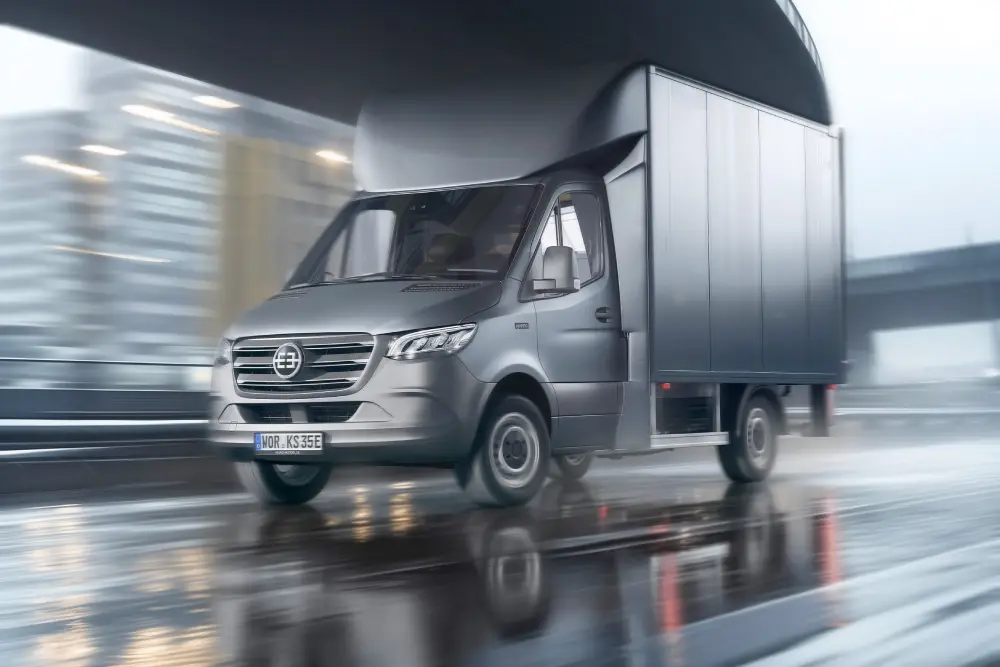
Fleet managers in logistics and municipalities face a double challenge: operating costs for diesel vehicles are rising, while the Clean Vehicles Directive (CVD) mandates binding quotas for low-emission vehicles. A new box van as an electric model often means the loss of expensive, specialized bodies and high capital commitment. HEERO offers a pragmatic alternative with the D2E (Diesel-to-Electric) conversion. Within a maximum of 10 working days (model series 907 only), we transform your proven Sprinter 907 into a powerful electric commercial vehicle with a range of up to 300 km, while fully preserving your valuable box body.
Legal pressure to act: Understanding the Clean Vehicles Directive
The era of pure diesel fleets is coming to an end. Since August 2021, the "Clean Vehicles Procurement Act" (SaubFahrzeugBeschG) has transposed the EU-wide Clean Vehicles Directive (CVD) into German law. For public authorities and their service providers, this translates into concrete, binding minimum quotas for vehicle procurement. By the end of 2025, 38.5% of all newly procured light commercial vehicles, such as box vans or flatbeds, must be "clean."
This regulation aims to significantly reduce CO2 and pollutant emissions in the transport sector and to establish a market for zero-emission vehicles. For fleet operators, this means an immediate necessity to adapt their procurement strategy. Failure to meet these quotas can lead to legal and financial consequences. Converting existing vehicles is a recognized method to meet these quotas efficiently. A BoxVan converted to an electric drive counts as a zero-emission vehicle and thus contributes fully to quota fulfillment. This strategic step not only ensures legal compliance but also positions your company as future-proof in a competitive market.
Preserving value over buying new: The potential of D2E conversion
A box van is more than just a transporter; its body is often a highly specialized and expensive investment. Purchasing a new electric transporter inevitably leads to the loss of this customized body. The HEERO D2E conversion for the Mercedes-Benz Sprinter (Model 907) solves this problem. We preserve your box body 100% and only replace the drivetrain. This process not only conserves significant resources but also protects your invested capital.
Our conversion process is designed for maximum efficiency and typically takes no longer than 10 working days for a Sprinter 907 (Model 907 series only). This minimizes your vehicle's downtime. The following steps ensure quality:
Vehicle analysis and planning of the conversion
Removal of the diesel drivetrain (engine, transmission, exhaust system)
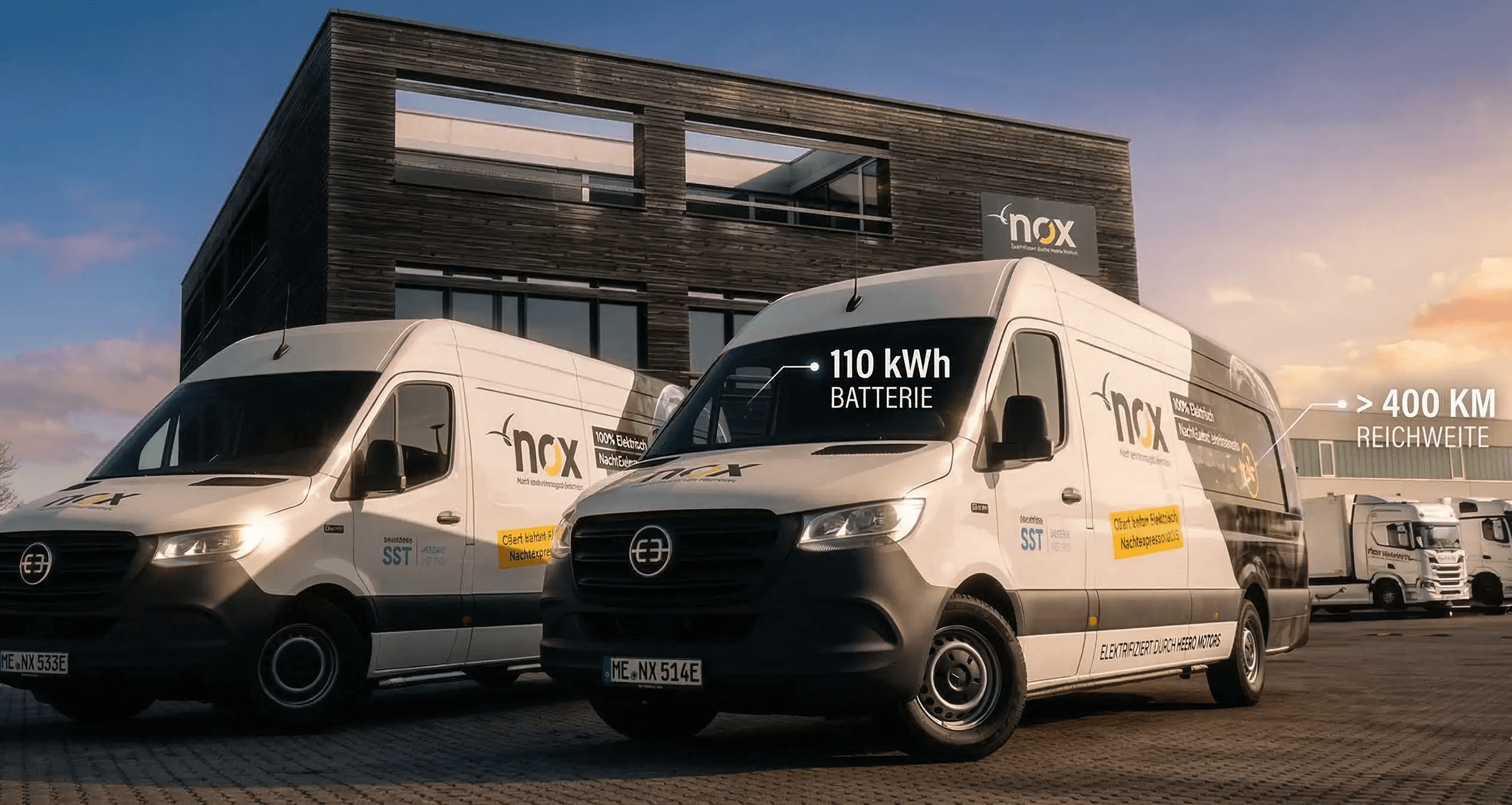
Integration of the HEERO eDrive with 110 kWh battery
Adaptation of software and on-board systems
Quality assurance and final acceptance
Through this approach, you extend the lifespan of your proven vehicles by many years. With an efficient D2E conversion, you make a clear statement for a circular economy. Instead of scrapping functional vehicles, we modernize them for an emission-free future.
Performance in Practice: Focus on Range and Charging Capacity
The practicality of an electric box van is significantly determined by its range and charging capacity. The D2E Sprinter converted by HEERO sets new standards here. With a gross battery capacity of 110 kWh, the vehicle achieves a WLTP range of up to 425 km. This range more than covers typical daily routes in distribution transport and last-mile logistics, even when fully loaded and under demanding conditions. This makes the so-called range anxiety a thing of the past.
The charging capacity is also optimized for professional use. At a DC fast-charging station, the vehicle charges at up to 165 kW. A charging process from 20% to 80% therefore only takes about 60-90 minutes. This time frame fits perfectly into the driver's legally prescribed steering and rest periods. A 22 kW AC onboard charger is available for planned overnight charging at the depot. This charging capacity is perfectly tailored to the requirements of depot charging and protects the battery. The combination of a high range and flexible charging options ensures maximum availability in daily fleet operations.
Profitability recalculated: The Total Cost of Ownership (TCO)
The decision to opt for an electric box van is, above all, an economic one. While the initial investment for a conversion is required, the true benefits lie in the drastically reduced operating costs. A TCO analysis shows that e-transporters are more cost-effective in the long run than their diesel counterparts. The Total Cost of Ownership analysis clearly proves the potential for savings.
The cost advantages are made up of several factors:
Energy costs: The cost per mile/kilometer for electricity is significantly lower than for diesel, often by more than 50%.
Maintenance and repair: An electric motor has significantly fewer wear parts than an internal combustion engine. Oil changes, exhaust system repairs, and clutch replacements are completely eliminated, which significantly reduces maintenance costs.
Taxes and duties: Converted e-vehicles are exempt from vehicle tax for 10 years. In addition, the steadily rising CO2 tax on diesel is eliminated.
Longevity: The robust battery technology and the simple design of the eDrive ensure a longer vehicle service life.
As a rule, the investment in the D2E (Diesel-to-Electric) conversion already pays off within a few years. Fleet operators who switch to electric box vans now secure a decisive cost advantage over the competition.
Operational Reliability: Service and Warranty
The operational safety of your fleet is our top priority. That is why the HEERO D2E conversion includes a comprehensive service concept. We provide a solid warranty on all of our installed components of the electric drivetrain, including the battery. This gives you the security of receiving a reliable and tested technology. Our quality promise is based on intensive testing and the exclusive use of high-quality components.
Should a service case nevertheless arise, our mobile service team, the "Flying HEEROs", is ready. These specialized technicians are trained to perform maintenance and repair work directly on-site at your depot. This approach reduces your vehicle downtime to an absolute minimum. You do not need to take the BoxVan to a distant specialized workshop. Our goal is to ensure the maximum availability of your electrified fleet and to make the transition to e-mobility as smooth as possible for you.
More useful links
Statista offers statistics on the stock of trucks with alternative drivetrains in Germany.
The Federal Motor Transport Authority (KBA) provides detailed statistics on vehicles in its product catalog.
The Federation of German Consumer Organisations (vzbv) offers a summary of a TCO study (Total Cost of Ownership) on the subject of vehicles.
Strategy& (PwC) publishes a press release on the breakthrough of e-trucks.
The Federal Ministry for the Environment provides information on EU regulations for reducing CO2 emissions from road vehicles.
The Federal Office for Logistics and Mobility (BALM) offers information on the Climate Protection and Mobility (KSNI) funding program.
DEKRA provides information on Diesel-to-Electric conversion for trucks.
The German Association of the Automotive Industry (VDA) provides information on the drivetrain strategy for commercial vehicles.
FAQ
Which Mercedes-Benz Sprinter models are eligible for our Diesel-to-Electric (D2E) conversion?
Our D2E conversion process is currently specialized for the Mercedes-Benz Sprinter 907 model. We focus on common variants such as the 313, 316, 319, and 324 as base vehicles. This specialization allows us to deliver a highly efficient and standardized conversion process, which is completed in a maximum of 10 working days (907 model series only) while ensuring the highest German quality standards.
How does the payload of my BoxVan change after the Diesel-to-Electric conversion?
Payload is a critical factor in commercial operations. By eliminating the heavy diesel engine, transmission, and exhaust system, weight is saved. This partially compensates for the weight of the battery system. As a rule, the Diesel-to-Electric (D2E) conversion results in only a minimal change in payload, which we calculate precisely in advance for your specific vehicle model. Practical usability is fully maintained.
Is the 300 km range realistic in winter conditions as well?
The specified range of up to 300 km is a value determined according to the WLTP cycle. As with any electric vehicle, the real-world range may vary depending on driving style, payload, topography, and ambient temperature. In winter, a reduction of 20-30% is typically to be expected. Nevertheless, the remaining range reliably covers the vast majority of daily operational scenarios in urban and regional distribution transport.
What warranty does HEERO offer on the conversion and the battery?
HEERO offers a comprehensive warranty on all components of the electric drivetrain installed by us. This includes the electric motor, the power electronics, and particularly the core element, the 110-kWh battery. The exact conditions and terms of the warranty are transparently detailed in our offer documents, securing your investment for the long term.
What happens to the removed diesel engine?
In line with the circular economy, we pursue a sustainable approach. The removed diesel engines and components are not simply discarded. They are professionally reconditioned and returned to the spare parts market. This extends the service life of these components and conserves valuable resources. This is part of our mission to shape mobility in a holistic and sustainable way.
Do I need a special charging infrastructure at my depot?
For optimal utilization and battery life, we recommend installing an AC charging station (wallbox) with 22 kW capacity in your depot. This enables a complete and gentle charge overnight. Our team at HEERO Services provides comprehensive advice on the planning and implementation of the appropriate depot charging infrastructure, including load management, to run your electric fleet efficiently.