WLTP Range for Commercial Vehicles: How Fleet Operators Achieve Over 400 km and Cut Costs

The official WLTP range of electric commercial vehicles often differs from real-world conditions, presenting fleet managers with operational challenges.
Topics on this page
The topic briefly and concisely
The WLTP range is a laboratory value; real-world ranges are often 20-40% lower due to payload, temperature, and driving style.
A high range of over 400 km is crucial to economically meet the CVD procurement quota of 38.5% for commercial vehicles.
A longer range directly reduces TCO through fewer charging cycles, minimal downtime, and significantly higher vehicle utilization.
The WLTP range specification is the key metric for fleet operators when electrifying commercial vehicles. However, the laboratory value alone typically does not translate to efficiency in demanding daily operations. Factors such as payload, ambient temperature, and route profile often reduce the actual range by more than 30%. To achieve an economical and legally compliant fleet transition, bridging the gap between theory and practice is crucial. HEERO vehicles, offering a WLTP range of up to 300 km, are systematically designed for maximum practical utility in order to optimize TCO and reliably meet the requirements of the Clean Vehicles Directive (CVD).
WLTP Range for Commercial Vehicles: The Official Standard Decoded
The "Worldwide harmonized Light vehicles Test Procedure" (WLTP) has been the mandatory test procedure for light commercial vehicles in the EU since September 1, 2018. It replaced the outdated NEDC cycle and, through more dynamic driving profiles and higher average speeds, provides approx. 22% more realistic consumption data. The test cycle is carried out under laboratory conditions on a chassis dynamometer and simulates four speed phases to represent various application scenarios. For fleet managers, the WLTP value is a standardized basis of comparison, but not a guarantee of the real range in daily operations. The results serve as a basis for compliance with CO2 limit values and are crucial for vehicle type approval. Understanding this standard is the first step towards a valid calculation of electric range and planning fleet efficiency. The deviations from real-world practice arise because the standardized test cannot depict real-world variables.
From Standard to Reality: These 4 Factors Determine Your Real-World Range
The actual range of an electric commercial vehicle is influenced by four key factors that are only partially taken into account in the WLTP cycle. Especially in winter, energy consumption can increase significantly because the battery and the interior must be heated. An outdoor temperature of -7 °C can reduce the range significantly, as tests by the ADAC show. Payload is another critical point: every additional kilogram increases rolling resistance and energy demand, which can significantly reduce the range. Conversely, a proactive driving style can significantly reduce energy consumption by up to a high percentage. The topography with uphill and downhill gradients also plays a decisive role in efficiency and the possibilities of recuperation during electric driving. An analysis of these factors is essential.
Temperature: At 0 °C, the range drops by an average of 20-30% compared to the optimum operating temperature of 20 °C.
Payload: An increase in payload of 250 kg can increase energy consumption by 5-10 kWh/100 km.
Driving Speed: Reducing motorway speed from 120 km/h to 100 km/h can increase the range by over 15%.
Tyre Pressure: A tyre pressure that is 0.5 bar too low increases rolling resistance and can reduce the range by up to 5%.
These parameters show how important holistic fleet management is for maximising range.
Secure CVD compliance with practical, real-world ranges
The EU's Clean Vehicles Directive (CVD) sets clear targets for public procurement, forcing fleet operators to take action. By the end of 2025, 38.5% of all newly procured light commercial vehicles in Germany must be classified as "clean vehicles". This quota intensifies the pressure to switch quickly and economically to emission-free drives. A high and reliable WLTP range is not a luxury here, but a strategic necessity to meet legal requirements. Vehicles with a short range often require the use of more units to handle the same workload, which dilutes the procurement quota in percentage terms. With the D2E conversion of existing Sprinters, HEERO enables rapid fulfillment of the CVD quota in just 10 working days (model series 907 only) (model series 907 only) per vehicle. This is a decisive advantage compared to the long delivery times for new vehicles. Conversion is often the only way to meet legal targets on time, as the comparison between purchasing and electrifying vans shows. In this way, the legal obligation becomes an economic opportunity.
HEERO D2E Conversion: Over 400 km WLTP Range as a Strategic Advantage
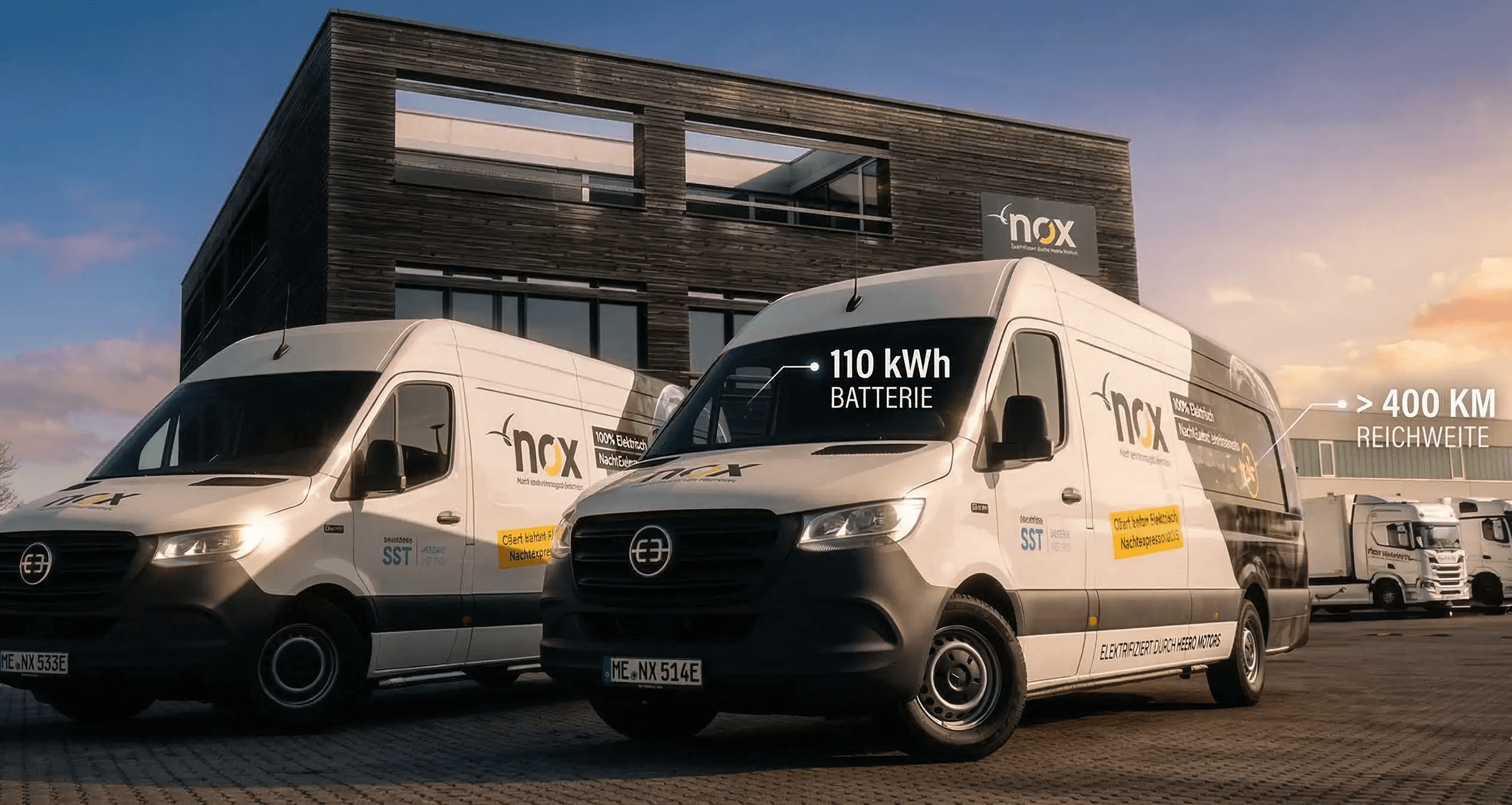
HEERO has specifically developed its drive technology for the requirements of fleet operators who depend on maximum operational reliability. The result is a field-proven WLTP range of up to 300 km for the D2E-converted Mercedes-Benz Sprinter (Model 907). This range exceeds that of many production vehicles and offers the necessary flexibility for demanding daily routes without intermediate charging. Even with a full payload and adverse weather conditions, a high remaining range is maintained, ensuring a range of over 250 km in the electric commercial vehicle. The basis for this is a 110 kWh battery, which can be charged to 80% in just 60-90 minutes at a 165 kW DC fast charging station. These performance specifications are crucial for high vehicle availability. The technical advantages of the HEERO systems include:
High energy density: The 110 kWh battery enables a long range without compromising on payload.
Efficient thermal management: This ensures stable battery performance at temperatures from -20 °C to +40 °C.
Fast charging performance: The 165 kW DC charging capability minimizes downtime and maximizes the vehicle's operational time.
Durability: The system components are designed for over 3,000 charging cycles and a long service life.
This technological superiority forms the basis for the economic and operational efficiency of the fleet.
TCO Optimization: How a High Range Directly Lowers Operating Costs
A high WLTP range is directly linked to a reduction in Total Cost of Ownership (TCO). Vehicles with a longer range, such as the HEERO D2E Sprinter (up to 425 km), require less frequent charging, which reduces charging costs and, above all, unproductive downtime by at least 15%. This can gain an additional operating hour per day. The ability to complete longer or multiple routes without intermediate charging significantly increases vehicle utilization. This allows fleet operators to potentially reduce the number of required vehicles. In addition, a large battery enables better use of inexpensive night-time electricity at the depot, rather than relying on expensive public fast chargers. The investment in a longer range therefore often amortizes within the first 24 months alone through increased operational efficiency and lower energy costs. This is particularly relevant when considering the towing capacity of electric commercial vehicles, which further increases consumption. The TCO analysis clearly demonstrates the economic advantage of a superior range.
More useful links
The German Environment Agency (Umweltbundesamt) provides detailed information on emission standards for passenger cars and light commercial vehicles.
The Federal Ministry for Digital and Transport offers comprehensive information on the WLTP tests (Worldwide harmonized Light vehicles Test Procedure).
The Federal Motor Transport Authority (Kraftfahrt-Bundesamt) publishes up-to-date statistics on electromobility in Germany.
The Federal Office for Logistics and Mobility provides information on the Climate Protection and Sustainability funding program (KSNI).
A detailed analysis of the environmental balance of motor vehicles can be found in a publication by the German Environment Agency.
The German Association of the Automotive Industry (VDA) offers insights into the drive strategy for commercial vehicles.
The German Energy Agency (dena) highlights electromobility as an opportunity for the grids.
FAQ
How realistic is the 300 km WLTP range for a Diesel-to-Electric converted Sprinter under real-world conditions?
The 300 km range is a standardized WLTP value. In practice, the actual range depends heavily on your driving profile. For typical urban distribution cycles with average payloads, ranges of 300-350 km are realistic. Our fleet analysis helps you calculate the precise range for your specific routes.
How does my existing custom body affect the range after the D2E conversion?
A custom body can affect aerodynamics and weight. A BoxVan body increases aerodynamic drag more than a FlatBed. We take the weight and type of your body into account during the TCO and range forecasting. However, the large 110 kWh battery provides enough buffer to ensure a high daily range even with heavy bodies.
Does the range of HEERO vehicles decrease as sharply in winter as it does with other e-commercial vehicles?
A reduction in range during winter is physically determined and affects all electric vehicles. However, HEERO utilizes an advanced thermal management system for the 110-kWh battery, which keeps the cells within the optimal temperature range. This reduces winter-related range loss and ensures more reliable performance in the cold compared to systems without active temperature control.
Why is a high WLTP range so crucial for complying with the Clean Vehicles Directive (CVD)?
The CVD requires a quota of 38.5% of "clean" vehicles in new procurements. High-range vehicles can often replace two older diesel vehicles or cover more demanding routes. This makes achieving the quota operationally and economically more viable, as it allows you to optimize your fleet size rather than having to perform simple 1:1 replacements.
How quickly can my Mercedes-Benz Sprinter (Model 907) be converted with a Diesel-to-Electric (D2E) retrofit to start benefiting from the high-range eDrive?
The D2E (Diesel-to-Electric) conversion of a Mercedes-Benz Sprinter (model series 907 only) is completed in a maximum of 10 working days. This rapid turnaround ensures the swift electrification of your fleet, compliance with CVD deadlines, and immediate TCO advantages thanks to a high range of up to 300 km.
Does HEERO also offer support with charging infrastructure for long-range vehicles?
Yes, HEERO offers comprehensive depot charging consulting. We analyze your energy requirements, plan the optimal charging infrastructure with 22 kW AC charging points, and integrate intelligent load management. This ensures that your vehicles are charged cost-effectively and reliably overnight for their next deployment with maximum range.