250 km range for electric commercial vehicles: Lower TCO & meet CVD quotas

For electric utility vehicles in urban delivery traffic and municipalities, a practical range of 250 km is often the decisive benchmark.
The topic briefly and concisely
A range of 250 km is the operational standard, but modern e-commercial vehicles like the HEERO D2E-Sprinter offer up to 425 km.
The D2E conversion significantly reduces TCO through lower energy and maintenance costs, protecting investments in specialized bodies.
With a conversion time of just 10 days (907 model series only), our D2E solution is the fastest way to meet statutory CVD quotas or to...
For fleet managers, the transition to e-mobility is a strategic necessity, driven by rising operating costs and the strict requirements of the Clean Vehicles Directive. The demand for a range of at least 250 km for an electric commercial vehicle is a key factor for operational reliability. Modern electrification solutions like D2E (Diesel-to-Electric) conversion go far beyond this. They not only secure daily operational capability with ranges of up to 300 km, but also protect valuable investments in special bodies and sustainably reduce TCO. This approach enables fast and economically viable electrification.
Why a 250 km range is the operational sweet spot
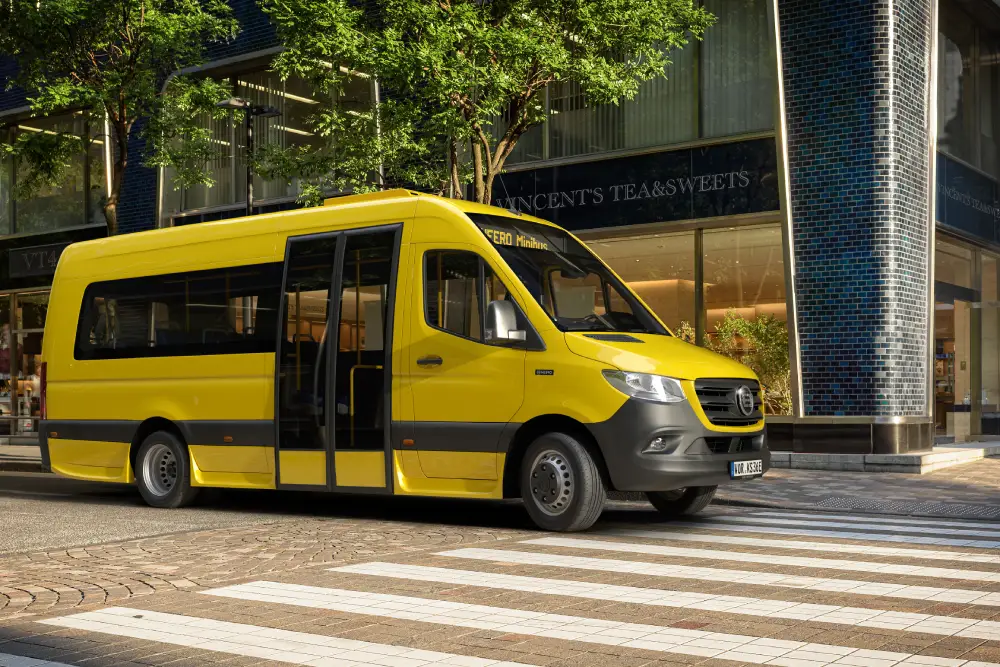
For most urban and regional operations, a range of 250 km is the ideal value. Analyses show that the average daily mileage in urban delivery traffic is often below 150 km. A buffer of 100 km or more is crucial for operational flexibility. It covers unforeseen route changes, traffic-related detours, or the increased consumption caused by heavy payloads and extreme weather conditions. An Electric FlatBed, BoxVan or MiniBus with a 250 km range reliably meets this requirement. It ensures that all trips can be completed without intermediate charging, which maximizes efficiency. Planning reliability increases since the vehicles are fully charged overnight at the depot after their shift. This operational reliability is the foundation for successful fleet electrification, as detailed in our article on the Electric Sprinter. This effectively eliminates range anxiety, which studies show is an obstacle for 50% of fleet managers.
Meet regulatory requirements with a strategic range buffer
The Clean Vehicles Directive (CVD) sets clear electrification quotas for public and private fleets. By the end of 2025, 38.5% of newly procured light commercial vehicles and 45% of buses must be low-emission. An electric commercial vehicle with a range of 250 km is an important building block to achieve these goals. However, an even higher range, such as the up to 425 km of the HEERO D2E Sprinter, offers a decisive strategic advantage. This buffer of over 175 km ensures operational capability even with increasing future demands. It enables fleets to react more flexibly to new business areas or expanded delivery zones without having to invest in additional vehicles. The D2E (Diesel-to-Electric) conversion is the fastest path to compliance here. Instead of waiting for long delivery times for new vehicles, an existing MB Sprinter (907 model) is electrified in a maximum of 10 working days (907 model series only). This allows fleet operators to not only meet the CVD quotas, but to exceed them in a timely and cost-effective manner.
Maximize TCO advantages through Diesel-to-Electric conversion
The Total Cost of Ownership (TCO) is the decisive lever for the economic viability of a fleet. While electric vehicles can be more expensive to purchase, their operating costs are significantly lower. Studies show that operating costs for electric vans in Germany are considerably lower than those of comparable diesel models. The D2E conversion reinforces this effect because the highest costs – purchasing a completely new vehicle and losing the custom body – are eliminated. The key savings result from the following points:
Energy costs: The cost of electricity per 100 km is significantly lower than for diesel, which can lead to substantial savings.
Maintenance: An eDrive motor has fewer moving parts. Oil changes, exhaust system maintenance, and clutch repairs are eliminated, which reduces workshop costs considerably.
Taxes & Levies: Pure electric vehicles are exempt from vehicle tax until the end of 2030.
Value stability: The conversion preserves the value of the existing vehicle and the expensive custom body (e.g., refrigerated box, FlatBed).
By combining these factors, the investment in a D2E conversion typically amortizes faster than purchasing a new electric vehicle. The precise calculation of the range plays an important role in the TCO analysis. Conversion is therefore the economically smartest decision for fleet modernization.
Technical Superiority: More Than Just Range
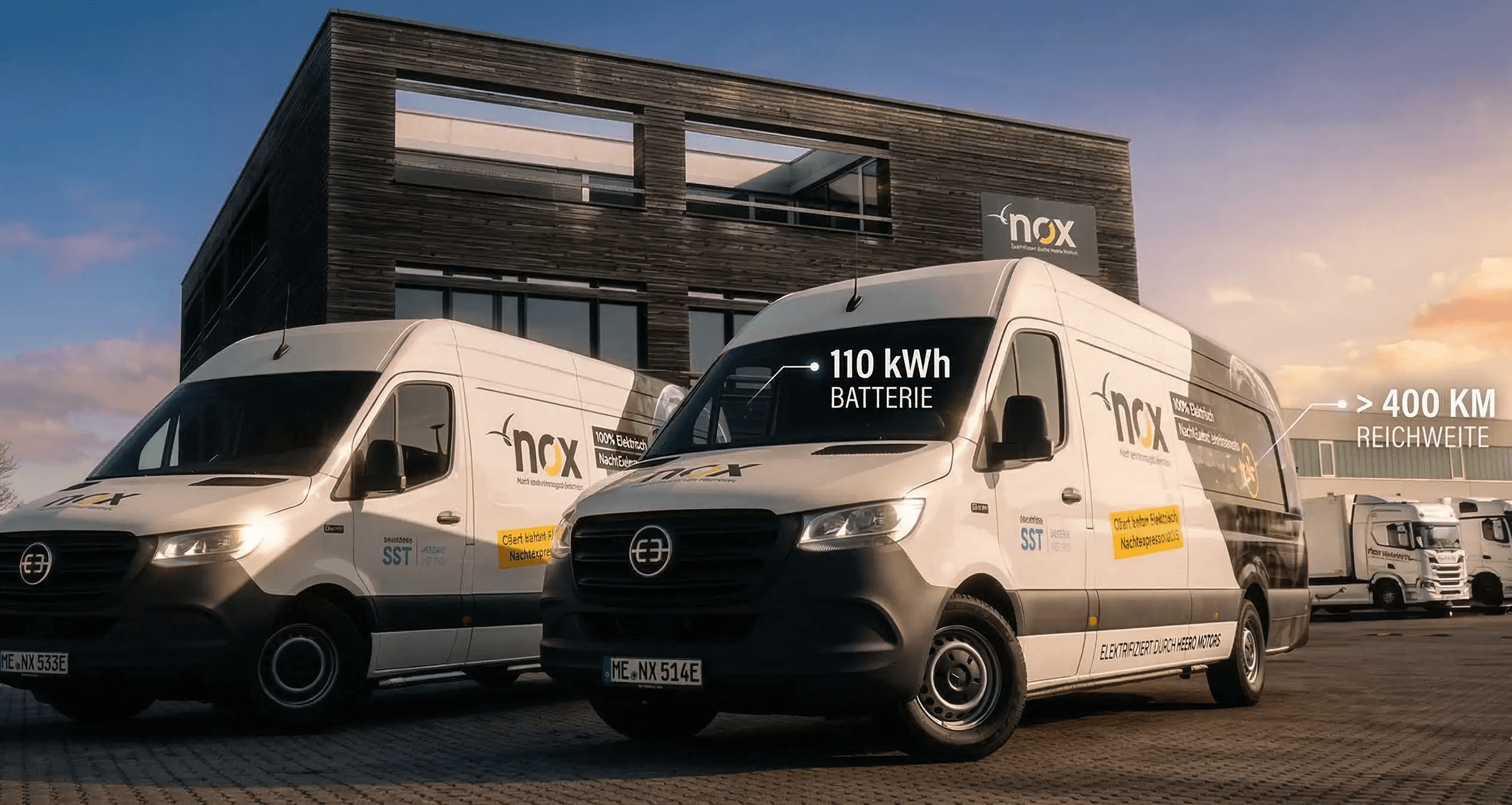
A long range is based on advanced technology. The HEERO D2E Sprinter is equipped with a 110 kWh battery, enabling a real-world range of up to 425 km. This far exceeds the requirement for an electric commercial vehicle with a 250 km range. Charging performance is equally crucial for practical usability. With a DC fast charging capacity of 165 kW, the battery can be charged to 80% in 60-90 minutes. For planned overnight charging at the depot, an AC charging capacity of 22 kW is available. The lifespan of modern lithium-ion batteries in commercial vehicles is designed for over 1.5 million kilometers, which corresponds to the entire lifespan of the vehicle. This ensures long-term investment security. Service is guaranteed by the "Flying HEEROs", a mobile technician team that performs maintenance directly on-site, minimizing downtime. This technological foundation ensures not only range, but typically also reliability and durability in tough everyday fleet operations.
Circular economy as a sustainable and economically viable principle
D2E conversion is a prime example of the circular economy in the automotive industry. Instead of scrapping a fully functional vehicle with an intact custom body, its life cycle is significantly extended. This principle reduces the demand for primary raw materials and lowers the CO₂ emissions that would be generated during the production of a new vehicle. For fleet operators, this means a dual benefit: they act not only in an ecologically responsible manner, but also in an economically smart way. The continued use of the chassis and body is a direct contribution to resource conservation and waste prevention. Companies that rely on the circular economy improve their image and position themselves as forward-looking partners. The electrification of an existing BoxVan is therefore a strategic decision that combines sustainability and profitability.
More useful links
Statista provides a comprehensive outlook on the market for electric commercial vehicles in Germany.
The ICCT (International Council on Clean Transportation) provides a factsheet on the total cost of ownership (TCO) of battery-electric trucks in Europe, focusing on Germany.
NOW GmbH offers an overview of studies on the total cost of ownership (TCO) of climate-friendly commercial vehicles in its data finder.
Transport & Environment presents a summary of a study on the decarbonization of long-haul trucking in Germany.
The VDE (Association for Electrical, Electronic & Information Technologies) offers a dialogue article on the total cost of ownership (TCO) of e-trucks.
The Federal Ministry of Transport (BMV) provides a sub-study on fuel cell trucks as part of a scientific investigation.
The German Environment Agency provides information on emission standards for heavy-duty vehicles.
The Federal Ministry for the Environment answers frequently asked questions about CO2 fleet targets.
The Federal Office for Logistics and Mobility (BALM) provides information on the KSNI (Climate Protection and Sustainability in Transport) funding program.
FAQ
Is a range of 250 km realistic for my electric utility vehicle in winter?
Yes, a nominal range of 250 km is designed to remain practical even at low temperatures. HEERO vehicles with a range of up to 300 km offer an additional buffer of over 60%, which reliably covers the increased energy demand for heating and colder batteries.
Which Mercedes Sprinter models can be converted using Diesel-to-Electric?
HEERO focuses exclusively on the D2E (Diesel-to-Electric) conversion of the Mercedes-Benz Sprinter 907 series. This applies to the base models 313, 316, 319, and 324. Older models or other vehicle types are currently not being converted to ensure maximum efficiency and quality.
How does the payload affect the range of my eDrive commercial vehicle?
The range is influenced by the payload; a higher load increases energy consumption per kilometer. The range of up to 300 km specified by HEERO is a realistic value that already takes typical loading conditions into account, thus providing a reliable planning basis for daily operations.
What happens to the removed diesel engine after the Diesel-to-Electric (D2E) conversion?
In line with the circular economy, the removed diesel engine is not disposed of. HEERO ensures the professional remanufacturing of the engines and returns them to the market as spare parts. This conserves resources and prevents waste, which is a core principle of our sustainable corporate philosophy.
What warranty do I receive on the D2E conversion and the battery?
HEERO offers a comprehensive warranty on all components installed during the D2E conversion, including the electric drivetrain (eDrive) and the high-voltage battery. The exact terms and conditions are specifically designed for the heavy demands of commercial use, securing your investment for the long term.
Do I need to visit a specialized workshop for maintenance?
No, maintenance and any necessary repairs are carried out directly at your depot by our mobile service units, the "Flying HEEROs". This concept minimizes your vehicles' downtime and ensures that your fleet always remains ready for operation, without any additional logistical effort for you.