Calculating electric WLTP range: A guide for fleet operators

WLTP range is the official measurement standard, but in day-to-day fleet operations, real-world conditions are what matter. This guide shows you how to accurately calculate the range of your electric commercial vehicles, reduce operating costs and efficiently meet the requirements of the Clean Vehicles Directive (CVD).
Topics on this page
The topic briefly and concisely
The WLTP range is a laboratory value; in practice, fleet operators need to allow for reductions of 15–35% to account for payload, temperature and topography.
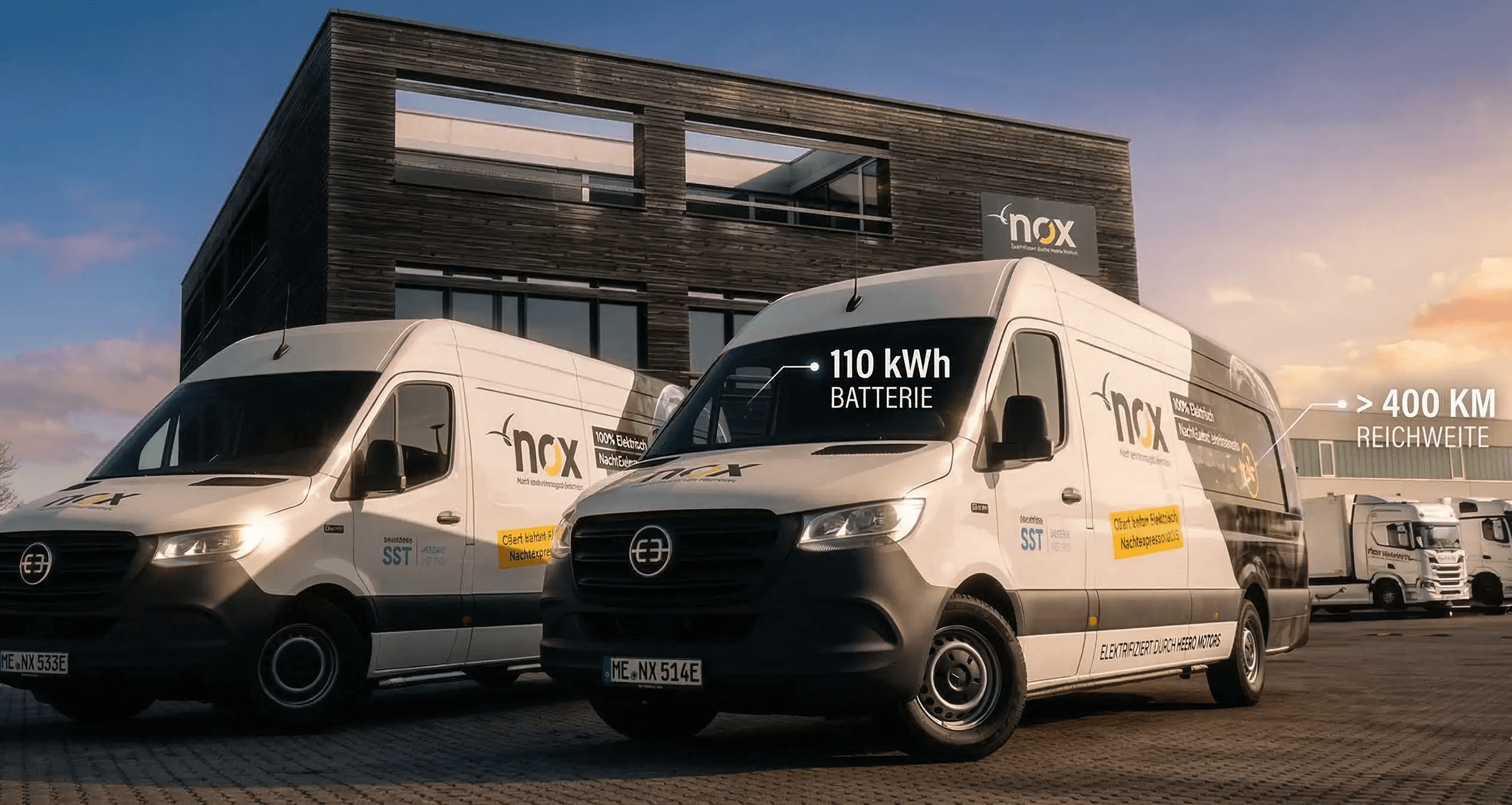
A large battery capacity, such as the 110 kWh of the HEERO eDrive system, provides a buffer for real-world conditions and ensures practical suitability.
D2E conversion of existing commercial vehicles as a fast way to meet the quotas of the Clean Vehicles Directive (CVD) and secure TCO advantages.
For fleet managers, accurately calculating the range of electric commercial vehicles is crucial for operational efficiency and reducing the total cost of ownership (TCO). The official WLTP range provides a standardised basis for comparison, but often differs from real-world operation. Understanding how to correctly calculate the WLTP range for electric vehicles and adapt it to your own operational requirements is the key to successful electrification. It enables reliable route planning, optimises charging logistics and ensures compliance with statutory quotas such as the Clean Vehicles Directive.
Fundamentals of WLTP range measurement for commercial vehicles
The "Worldwide harmonised Light Vehicles Test Procedure" (WLTP) has been the mandatory test procedure in the EU since September 2018 for determining consumption and emissions values. It replaced the outdated NEDC cycle and, thanks to a more dynamic test setup, provides more realistic comparative data. The test cycle lasts exactly 30 minutes and simulates a distance of 23.25 kilometres on a test bench. It takes four different speed phases into account, from urban traffic to motorway driving. For light commercial vehicles up to 3.5 tonnes, this procedure is the basis for all official range figures. The calculation is carried out by dividing the battery's usable energy by the average consumption determined in the test. This standardised procedure creates important, cross-manufacturer comparability. Knowledge of the test parameters is the first step towards correctly interpreting the official figures.
From theory to practice: calculating real-world range
The WLTP range determined in the laboratory typically differs from the values achievable in day-to-day operation. Several factors significantly reduce the actual distance per charge. Anticipatory driving and the use of efficient recuperation can positively influence range. For realistic planning, fleet managers must, however, apply targeted deductions to the WLTP figure. The deviation can, depending on the operating profile, be between 15% and 35%. Especially in winter, range can fall significantly due to the energy demand of heating and the lower battery efficiency. A precise analysis of your own operations is therefore essential. The following factors are crucial for the calculation:
Payload: Every additional kilogram of weight increases energy consumption per 100 kilometres.
Route profile: Frequent gradients demand significantly more energy from the battery than flat routes.
Driving speed: Reducing the average speed by 10 km/h can increase the range considerably.
Outside temperature: At 0 °C, battery heating and cabin climate control require considerable amounts of energy.
Tyres and bodywork: Special bodies and tyres with higher rolling resistance reduce the range by a further 5-10%.
These parameters form the basis for a precise, fleet-specific range calculation.
Strategic planning with high-capacity batteries and D2E conversion
Reliable range planning starts with sufficiently sized battery capacity. The HEERO D2E Sprinter is equipped as standard with a 110 kWh battery, enabling a WLTP range of up to 425 km. This high capacity acts as a buffer to offset the range losses that occur in real-world operation. This ensures a practical range of over 300 km, even with a full load and in winter conditions. The D2E conversion (Diesel-to-Electric) of existing Mercedes-Benz Sprinter vehicles of model 907 offers a decisive advantage here. Expensive specialist bodies, such as refrigerated box bodies or workshop equipment, remain in place, which can significantly reduce investment costs compared with buying new. The familiar vehicle type makes the transition easier for drivers and the integration into existing processes. The conversion of a model 907 takes a maximum of 10 working days (model series 907 only) and makes electrification predictable and efficient. This combination of value retention and technical performance is the core of an economical fleet strategy.
Achieve CVD compliance faster through retrofitting
The Clean Vehicles Directive (CVD) of the EU is creating considerable pressure to act for public contracting authorities and their service providers. By the end of 2025, 38.5% of newly procured light commercial vehicles in Germany must be classified as “clean”. The D2E conversion is a pragmatic way to meet this target quickly and cost-effectively. Instead of waiting for long delivery times for new electric vehicles, existing fleet vehicles such as the Sprinter models 313, 316 or 319 can be electrified promptly. This not only protects the budget, but also accelerates CO2 reduction across the fleet by years. The conversion is a direct investment in the fleet’s future resilience and compliance with statutory requirements. With a range that goes far beyond the typical requirements in distribution transport, HEERO vehicles offer the operational security required. Safety of the battery systems is given the highest priority. In this way, electrification becomes a predictable component of corporate strategy.
More useful links
Federal Motor Transport Authority provides statistics on vehicle stock and environmental aspects.
Federal Environment Agency publishes information on the energy consumption of electric cars.
Federal Ministry for Transport provides information on e-mobility in Germany.
NOW GmbH offers a practical guide to e-mobility in fleets.
Federal Statistical Office contains information on new car registrations.
Fraunhofer ISI covers the topic of e-mobility.
PwC discusses zero-emission vehicle fleets and electric cars in company fleets.
FAQ
How exactly do I calculate the real-world range for my electric commercial vehicle?
Start with the vehicle’s WLTP range. Then deduct percentage values for the largest consumers: around 10–20% for average payload, 10–15% for winter temperatures below 5 °C, and a further 5–10% for a demanding route profile with many gradients. Anticipatory driving can offset part of this.
Is the WLTP range a guaranteed minimum range?
No, the WLTP range is not a guaranteed value, but the result of a standardised test cycle carried out under optimal laboratory conditions. It is primarily used to compare different vehicle models. The range actually achievable generally depends on the specific operating conditions.
What impact does a special body have on the range?
A special body affects range through two main factors: weight and aerodynamics. A heavier body increases rolling resistance and energy consumption. A tall or angular body, such as a box van body, worsens aerodynamic drag, which noticeably reduces range, especially at speeds above 60 km/h.
Why is a large battery such as HEERO's 110 kWh battery beneficial for fleets?
A large battery capacity provides operational security. It ensures that even under unfavourable conditions — such as cold weather, a high payload, or unforeseen detours — the planned route can be completed without an intermediate charge. This maximises vehicle availability and minimises the risk of downtime.
How does the D2E conversion help with compliance with the Clean Vehicles Directive?
The D2E retrofit converts an existing diesel vehicle into a zero-emission vehicle. As such, it fully counts towards meeting CVD procurement quotas. Because the retrofit is very fast at around 10 working days (model series 907 only), fleets can achieve their quotas significantly more quickly than by waiting for the delivery of new electric vehicles.
Does HEERO provide support with fleet analysis and TCO calculations?
Yes, HEERO supports fleet operators with a detailed analysis of your existing routes and vehicles. On this basis, we prepare a precise TCO calculation that highlights the savings potential through lower energy and maintenance costs. Arrange a no-obligation consultation to start your fleet analysis.