Battery Safety in Electric Commercial Vehicles: Facts Rather Than Myths for Your Fleet

The discussion around the battery safety of electric vehicles is often marked by uncertainty. For fleet managers, however, facts are what matter most.
The topic briefly and concisely
Statistically, the fire risk in electric vehicles is 61.2 times lower than in vehicles with internal combustion engines.
Intelligent battery management systems (BMS) continuously monitor over 100 parameters such as temperature and voltage to actively prevent risks.
The binding UN standard ECE R100 ensures the battery’s highest possible passive safety level through rigorous tests (fire, crash, short circuit).
The electrification of commercial vehicle fleets is indispensable for local authorities and businesses, not least because of the Clean Vehicles Directive (CVD) with particularly high quotas for buses. Concerns regarding battery safety in electric vehicles persist, but are rarely based on valid data. In fact, statistics and stringent standards such as UN ECE R100 demonstrate a level of safety that is equal to, or even exceeds, that of diesel vehicles. For fleet operators, this means that electrifying the fleet is not only a financially sound decision for reducing TCO, but also a technologically mature and secure investment in the future of the vehicle fleet.
Fact check: Fire risk of electric vehicles in fleet operations
Public perception of vehicle fires is often distorted. However, statistics from a US insurer paint a clear picture: out of 100,000 registered vehicles, only 25 electric cars caught fire. By comparison, 1,530 vehicles with internal combustion engines were in flames. The risk of a fire in a combustion vehicle is therefore 61.2 times higher. These data clearly refute the myth of an increased fire risk in electric vehicles.
The design of high-voltage batteries is engineered for maximum safety. The electrical components are "intrinsically safe", which means that in the event of a fault or accident the current flow, for example in the 137 kWh battery in the HEERO minibus, is immediately interrupted. Crash tests by organisations such as the ADAC regularly confirm that the high-voltage systems are reliably switched off even in severe collisions. The structural integrity of the battery packs is therefore of the highest priority.
A crucial factor is the phenomenon of "thermal runaway". Here, a single cell overheats and triggers a chain reaction. Modern battery management systems (such as the HEERO-BMS), however, are designed precisely to prevent this. They continuously monitor over 100 parameters in order to keep the operating temperature within the optimum range of 20 to 40 degrees Celsius. You can find out more about the intelligent protective mechanisms in the next section, which examines the battery management system in detail.
The Battery Management System (BMS): Intelligent Protection for Every Cell
The battery management system (BMS) is the central control unit of the entire high-voltage system. It acts as an intelligent brain, ensuring the battery's performance, service life and, above all, safety. Its main task is the continuous monitoring of voltage, current and temperature for each individual battery cell. If even one parameter deviates from the target value, the BMS intervenes within milliseconds.
The core functions of the BMS for ensuring battery safety in the electric vehicle include several protective mechanisms. These systems are crucial for reliable operation over many years. A central element is protection against overcharging and deep discharge, which could permanently damage the cell chemistry. The BMS ends the charging process at 100% capacity and prevents discharge below a critical threshold.
An advanced BMS also performs active "cell balancing". It ensures that all cells in the battery pack have an identical state of charge. This balancing is crucial in order to use the full capacity and maximise the battery's service life. The key tasks include:
Permanent monitoring of over 100 individual cell voltages
Precise temperature control of the entire battery pack
Calculation of the state of charge (SoC) for an accurate range display
Protection against external short circuits
Communication with the vehicle and charging infrastructure via CAN bus
This active monitoring is the first line of defence, but the physical robustness of the battery is equally crucial, as certification to international standards demonstrates. Learn more about the possibilities of bidirectional charging.
Passive safety and certified robustness in accordance with UN ECE R100
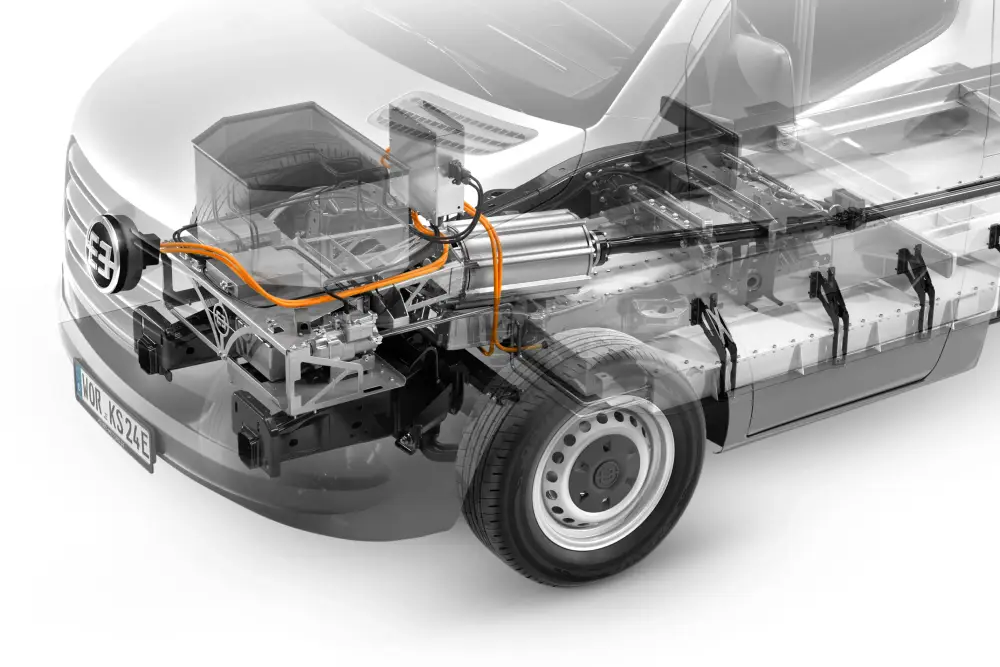
In addition to active monitoring by the BMS, the passive safety of the battery design is a decisive factor. The 137 kWh battery packs installed by HEERO are housed in an extremely robust casing. This protects the cells from mechanical damage caused by accidents or foreign objects on the road. Positioning in the underfloor also ensures a low centre of gravity and protects the system within the vehicle structure.
All high-voltage batteries for road vehicles in Europe must pass the demanding tests of UN Regulation ECE R100. This standard is not optional, but a mandatory requirement for type approval. It ensures that the battery systems remain safe even under extreme conditions. Certification to ECE R100 is a guarantee of tested and reliable battery safety.
The tests under Annex 9 of ECE R100 are extensive and simulate the entire life cycle of a battery under load. The process ensures that the battery is equipped to handle every conceivable scenario in day-to-day fleet operation. The tests include, among others:
Vibration test: Simulation of 100,000 kilometres on poor roads.
Thermal shock: Rapid changes between -40 °C and +60 °C.
Short-circuit test: Verification of protective shutdown in the event of an external short circuit.
Overcharge and deep-discharge protection: Test of the BMS safety functions.
Fire resistance: Direct flame exposure of the battery enclosure for 70 seconds.
Mechanical integrity test: Simulation of impact forces.
Compliance with these standards ensures that the technology is robust and reliable. However, safety does not end with the vehicle itself; it must also be guaranteed in day-to-day operation, such as charging at the depot.
Safety in the charging and service process: from depot to deployment
The operational safety of an electric fleet depends to a large extent on professional charging infrastructure. Charging from unsuitable domestic sockets is not recommended, as these are not designed for continuous loads of up to 3.7 kW. HEERO therefore relies on holistic depot charging consultancy with selected partner companies. Experts analyse the conditions on site and design a charging infrastructure with 22 kW AC wallboxes tailored to the needs of your fleet.
Intelligent load management is a key component. It prevents overloading of the grid connection by intelligently distributing the available power to the vehicles being charged. This not only ensures grid stability, but also reduces operating costs by avoiding expensive load peaks. A professionally installed charging system is the basis for safe and efficient charging operations.
Safety also comes first in the event of servicing. High-voltage systems may only be maintained by qualified personnel. Our mobile technicians, the "Flying HEEROs", are specially trained and equipped for work on electric drive trains. They ensure that all maintenance and repair work on all HEEROs is carried out to the highest safety standards. The warranty on the overall system gives you additional peace of mind.
More useful links
German Social Accident Insurance (DGUV) provides information and guidelines on lithium-ion batteries, including safety aspects and handling.
NOW GmbH provides a study assessing the safety of lithium-ion batteries.
Fraunhofer ISI provides a policy brief with a fact check and a call for action regarding batteries in electric cars.
Employers’ Liability Insurance Association for Transport (BG Verkehr) informs about accident risks during the transport of lithium batteries.
German Electrical and Electronic Manufacturers’ Association (ZVEI) provides a fact sheet on the safe transport of lithium-ion batteries.
German Insurance Association (GDV) provides up-to-date statistics on electric car fires.
Federal Institute for Materials Research and Testing (BAM) provides comprehensive information on lithium-ion batteries and their properties.
TÜV Association provides information and guidelines on the safety of lithium-ion batteries.
DEKRA provides detailed information on battery tests for electric cars and their safety aspects.
FAQ
What happens if a battery is damaged in an accident?
In the event of an accident, crash sensors disconnect the high-voltage system from the rest of the vehicle within milliseconds to ensure electrical safety. The robust battery enclosure, tested to UN ECE R100, protects the cells from mechanical damage. Emergency responders can use a standardised rescue card to see where they can work safely.
How safe is the charging process, especially overnight at the depot?
Very safe when professionally installed charging infrastructure is used. The battery management system (BMS) in the vehicle communicates continuously with the wallbox. It monitors the charging process, prevents overcharging and regulates the temperature. Additional load management in the depot protects the power grid from overload and ensures efficient operation.
How long does a HEERO battery last, and how safe is it towards the end of its lifecycle?
The 137 kWh batteries are designed for a long service life of over 3,000 charge cycles, which corresponds to a typical fleet operating life of more than 10 years. The BMS ensures minimal ageing through intelligent charging and cell balancing. Even towards the end of service life, all BMS safety functions and the passive protective effect of the housing remain fully intact.
Do my drivers need special training to handle electric vehicles?
Operating a HEERO is just as intuitive as operating a diesel vehicle. No special driver training is required. However, a short briefing on the specifics of the charging process and the displays in the cockpit is part of our vehicle handover and ensures a smooth start to operations.
Are the batteries used in HEERO new and certified?
Yes, HEERO uses exclusively brand-new high-voltage batteries from tier-1 suppliers. Each battery system meets the strict requirements of UN Regulation ECE R100 and undergoes a comprehensive quality and functional test before installation. This typically means the highest standards of safety and performance.