Regenerative braking in electric driving: lower TCO and maximise fleet range

Regenerative braking is a key technology for improving the efficiency of electric fleets. It converts braking energy that would otherwise be lost into usable range.
Topics on this page
The topic briefly and concisely
Regenerative braking can significantly increase the range of electric commercial vehicles, especially in urban traffic, and thus enhance operational reliability.
Thanks to energy recovery, brake wear is significantly reduced, which directly lowers maintenance costs and therefore the TCO.
The efficiency of recuperation is a predictable factor that, through analysis of the driving profile, optimises route planning and fleet efficiency.
For fleet operators, total cost of ownership (TCO) and maximum vehicle uptime are key metrics. When switching to electric mobility, the efficiency of each individual vehicle comes into focus. A core technology for this is regenerative braking in electric driving. This principle of recovering braking energy has existed for over 100 years and is more important than ever today. It makes it possible to significantly increase the range of electric vans while at the same time substantially reducing maintenance costs, which directly contributes to TCO optimisation.
Basics of Regenerative Braking: More Than Just Braking
Regeneration refers to the technical recovery of energy. In an electric vehicle, the electric motor acts as a generator during this process. When the driver lifts their foot from the accelerator pedal, the vehicle's kinetic energy is not simply converted into unused heat at the brake discs. Instead, the motor reverses its function and feeds a significant portion of the braking energy back into the vehicle's battery as electrical current.
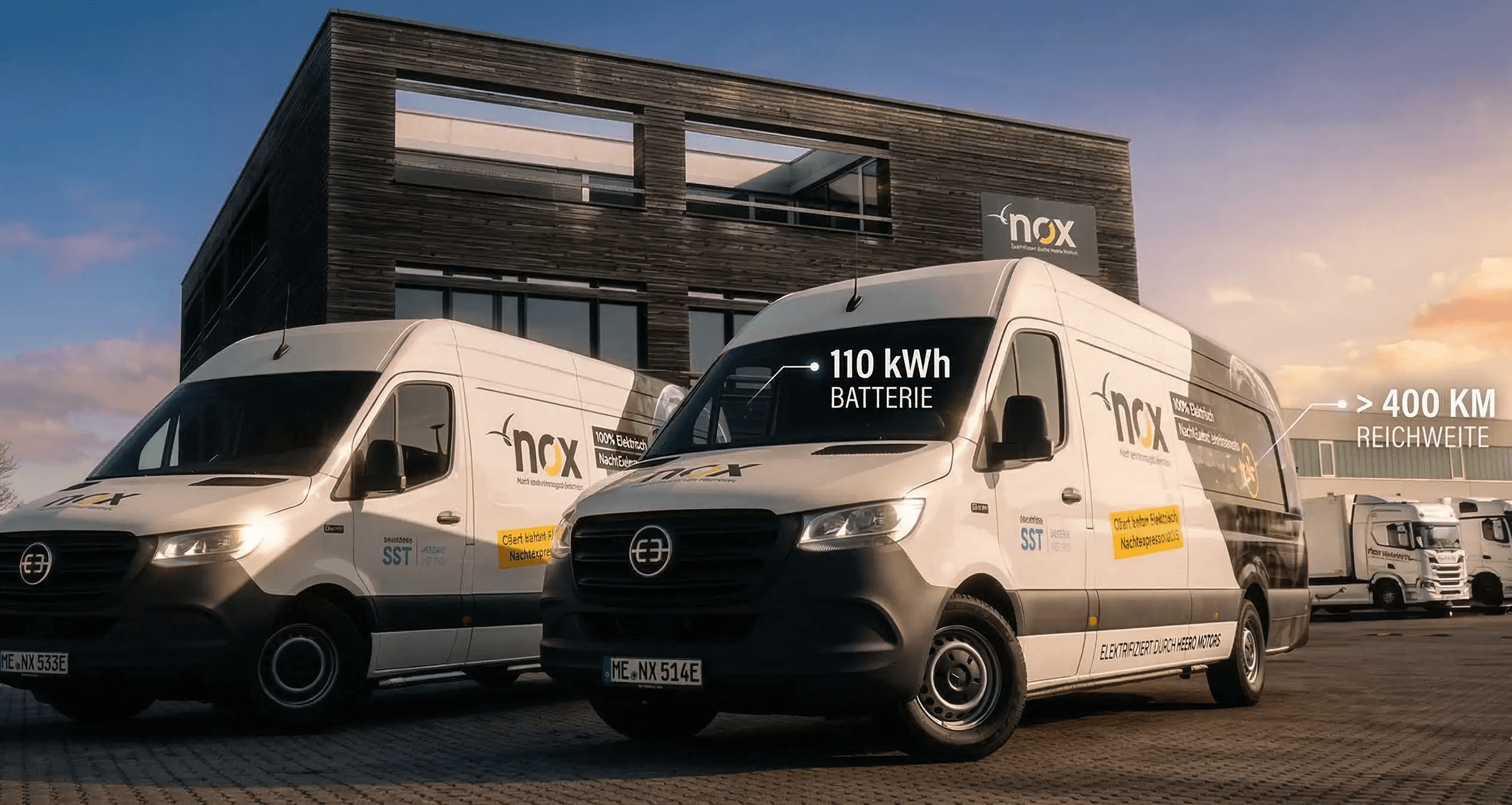
This process significantly increases the overall efficiency of the system. This advantage is particularly effective in urban delivery traffic with its hundreds of stops and starts per day. This technology is an essential building block for maximizing the real-world range of e-vehicles. Each braking maneuver thus becomes a small charging process for the 137 kWh battery.
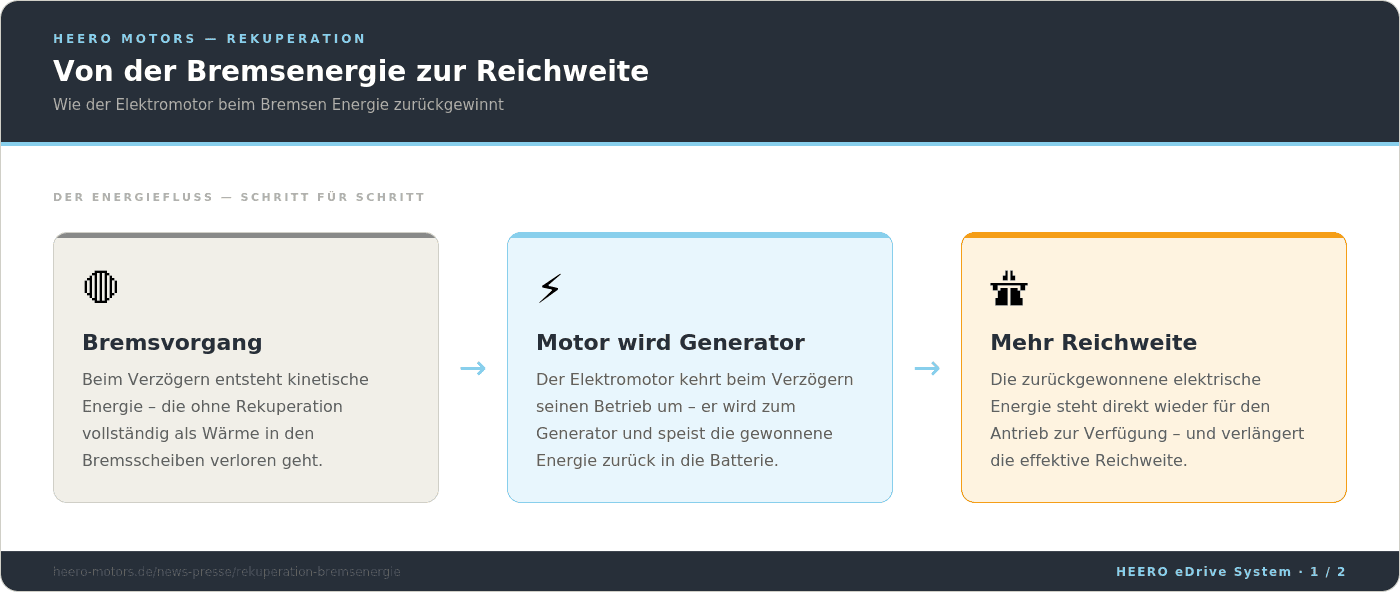
The intensity of regeneration can be adjusted in several levels on many vehicles. A high setting enables so-called one-pedal driving, where the vehicle decelerates strongly as soon as the foot is lifted from the pedal. This maximizes energy recovery and protects the mechanical braking system, which can extend maintenance intervals by thousands of miles.
Efficiency in practice: where regenerative braking reaches its full potential
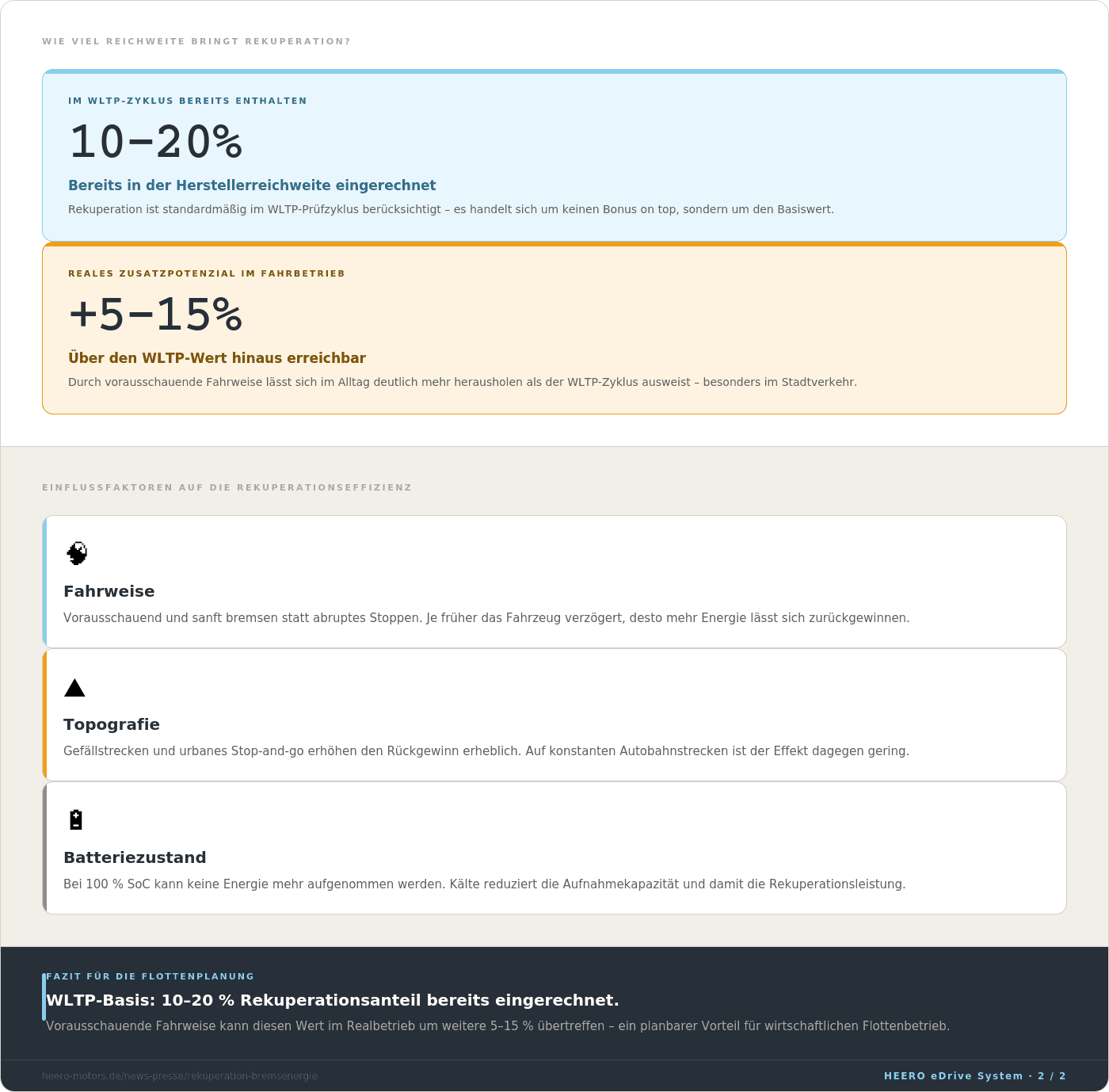
The effectiveness of recuperation depends heavily on the driving profile and topography. In city traffic with speeds below 50 km/h and frequent braking maneuvers, the potential for energy recovery is greatest. Here, fleet vehicles can typically increase their range by 15-20 %, which can mean an additional buffer of almost 100 km for a HEERO eTransporter with a range of up to 500 km.
On highway drives at constantly high speeds, the effect is smaller as braking occurs less frequently. Nevertheless, recuperation still contributes to efficiency here, for example in stop-and-go traffic or on downhill slopes. Modern systems intelligently adapt the recuperation performance to the driving situation. The technical limit of recuperation power is often between 50 and 90 kW in order to ensure the safety of the vehicle battery.
For fleet operators, analyzing the deployment profile is crucial. A typical deployment analysis highlights the following advantages:
Urban passenger transport and delivery services: Maximum recuperation, range increase is substantial.
Municipal services (e.g. waste collection): High potential due to constant stopping, significantly more efficiency.
Regional distribution transport: Moderate potential, range gain of around 10-15 %.
Long-distance and highway driving: Lower potential, approx. 5-8 % energy recovery.
This data is essential for precise route planning and calculating the WLTP range of commercial vehicles. In this way, recuperation becomes a calculable factor for cost-effectiveness.
TCO Reduction: Direct cost benefits through regenerative braking
Regenerative braking in electric driving lowers total cost of ownership (TCO) in two ways. The first and most obvious benefit is the reduction in energy consumption. A noticeably higher efficiency through recuperation means annual savings of several thousand euros in electricity costs for a fleet of 20 vehicles.
The second, often underestimated benefit, is the massive reduction in wear and tear on the mechanical braking system. Since the electric motor does most of the deceleration work, brake discs and pads are subjected to significantly less stress. This leads to much longer maintenance intervals and lower costs for replacement parts. For a single vehicle, savings on brakes can add up to over 1,500 euros over a 5-year holding period.
The Diesel-to-Electric (D2E) conversion from HEERO is designed to maximize these benefits for demanding fleet operations. The system tuning for the Sprinter (models 313, 316, 319, 324) ensures that regenerative braking is optimally matched to the vehicle weight and typical usage profiles. The potential of bidirectional charging will play an even greater role in the future. The energy recovered through recuperation can potentially contribute to grid stabilization.
More useful links
NOW GmbH offers a practical guide to electromobility in fleets.
Fraunhofer ISI presents a study on the topic of 'Get eReady', which probably deals with electromobility.
The Federal Ministry for Economic Affairs and Climate Action has published an efficiency study for passenger cars.
Strategy& (PwC) examines the breakthrough of electric lorries in an article.
dena (German Energy Agency) provides a dossier on expanding the charging infrastructure for electric lorries.
The Federal Environment Agency has published a paper on fleet target values.
Fraunhofer LBF reports in a press release on hybrid storage systems to maximise charging efficiency and range for articulated lorries.
The VDA (German Association of the Automotive Industry) has submitted a statement to the Bundestag.
FAQ
How much additional range do I really gain through recuperation?
The actual increase in range depends heavily on the operating profile. In urban passenger transport or delivery operations with many stops, significantly higher gains are realistic. For pure motorway driving at a constant speed, the figure is typically 5-8%. Anticipatory driving maximises the effect in every scenario.
Does regenerative braking completely replace the mechanical brake?
No, the mechanical brake remains fully in place as a safety-critical system and is generally activated during heavy braking or emergency braking. Regenerative braking, however, handles the majority of everyday deceleration processes up to a certain limit, which helps protect the mechanical components.
Does regenerative braking also work when the battery is fully charged?
When the battery is charged to 100%, no further energy can be absorbed. In this case, the vehicle management system reduces the regenerative braking output and primarily uses the mechanical brake to slow the vehicle. After a few kilometres of driving, full regenerative braking output is available again.
Can I adjust the level of regenerative braking in a HEERO vehicle?
Yes, the HEERO systems generally allow different recuperation levels to be set. This enables the driver to adapt the driving behaviour to the respective situation – from strong deceleration for maximum energy recovery in city traffic to freewheeling "sailing" on interurban journeys for the highest level of comfort.
How does recuperation affect my fleet’s maintenance planning?
Recuperation significantly extends the service life of brake discs and pads. Fleet managers can expect much longer maintenance intervals for the braking system, which not only reduces costs but also cuts vehicle downtime, thereby increasing vehicle availability by several days per year.
What is the difference between regenerative braking and 'one-pedal driving'?
Regenerative braking is the underlying technology behind energy recovery. 'One-Pedal Driving' is a driving style made possible by a very high regenerative braking setting. In this mode, deceleration when lifting off the accelerator is so strong that the brake pedal is hardly needed in normal traffic flow.