Towing Capacity in Electric Utility Vehicles: TCO Benefits and Facts for 2025

For many fleets, towing capacity is a dealbreaker when it comes to electrification. For a long time, high tractive power and range seemed incompatible. A D2E conversion for the Mercedes-Benz Sprinter 907 solves this problem and secures the value retention of your custom bodies with 100% CVD compliance.
Topics on this page
The topic briefly and concisely
Legal regulations (§ 42 StVZO) permit a towing capacity of up to 3,500 kg for e-transporters; the limitation is purely of a technical nature.
Towing a trailer can significantly reduce the range of an e-utility vehicle, which demands a large battery capacity.
The D2E conversion retains the full towing capacity of the base vehicle and lowers the TCO by allowing the continued use of the existing trailer fleet.
For fleet managers in municipalities and logistics companies, the towing capacity of commercial vehicles is an indispensable factor for operational efficiency. The transition to e-mobility presents them with a challenge: many new e-transporters offer only an insufficient towing capacity of less than 2,000 kg. This jeopardizes the use of special trailers and drives up costs. The D2E (Diesel-to-Electric) conversion of existing fleet vehicles, such as the MB Sprinter 907, offers a pragmatic solution that combines a high towing capacity with the TCO advantages of the eDrive while complying with the Clean Vehicles Directive.
Legal Framework for Towing Capacities in Germany
The legal requirements for the towing capacity of electric commercial vehicles are clearly regulated in Germany and do not differ from those for combustion engines. In accordance with Section 42 of the Road Traffic Licensing Regulations (StVZO), the towed load for trucks must not exceed 1.5 times the permissible gross vehicle weight of the towing vehicle. For vans in the 3.5-tonne class, the passenger car regulation generally applies, according to which the towing capacity must not exceed the gross vehicle weight of the vehicle (1:1 ratio), with an upper limit of 3,500 kg.
For fleet operators, this regulation means that an electric commercial vehicle registered for 3.5 tonnes may theoretically tow up to 3,500 kg, provided the manufacturer technically approves this. The challenge is therefore not in the law, but in the technical homologation by the manufacturers. The HEERO D2E conversion ensures that the tested towing capacity of the base vehicle, such as a Sprinter 316 or 319, is maintained and that all legal requirements are 100% met. This enables the seamless continued operation of existing trailer fleets.
Range Loss: The Decisive Factor in Trailer Operations
The greatest operational difference when towing loads with an electric commercial vehicle is the impact on the range. Tests by the ADAC show that energy consumption increases drastically when towing a trailer, and the range can be significantly reduced depending on the weight and aerodynamic drag of the trailer. A combination with a 1,500 kg trailer can increase consumption from 25 kWh/100 km to over 40 kWh/100 km. This factor must be calculated precisely during route planning to avoid unplanned charging stops.
The reasons for the increased consumption are diverse:
Increased rolling resistance: Every additional kilogram of weight increases the friction of the tires on the road.
Aerodynamic drag: A high trailer body increases the drag coefficient of the combination by more than 60%.
Continuous load for the drive: The electric motor must constantly deliver higher performance, which challenges the battery's thermal management.
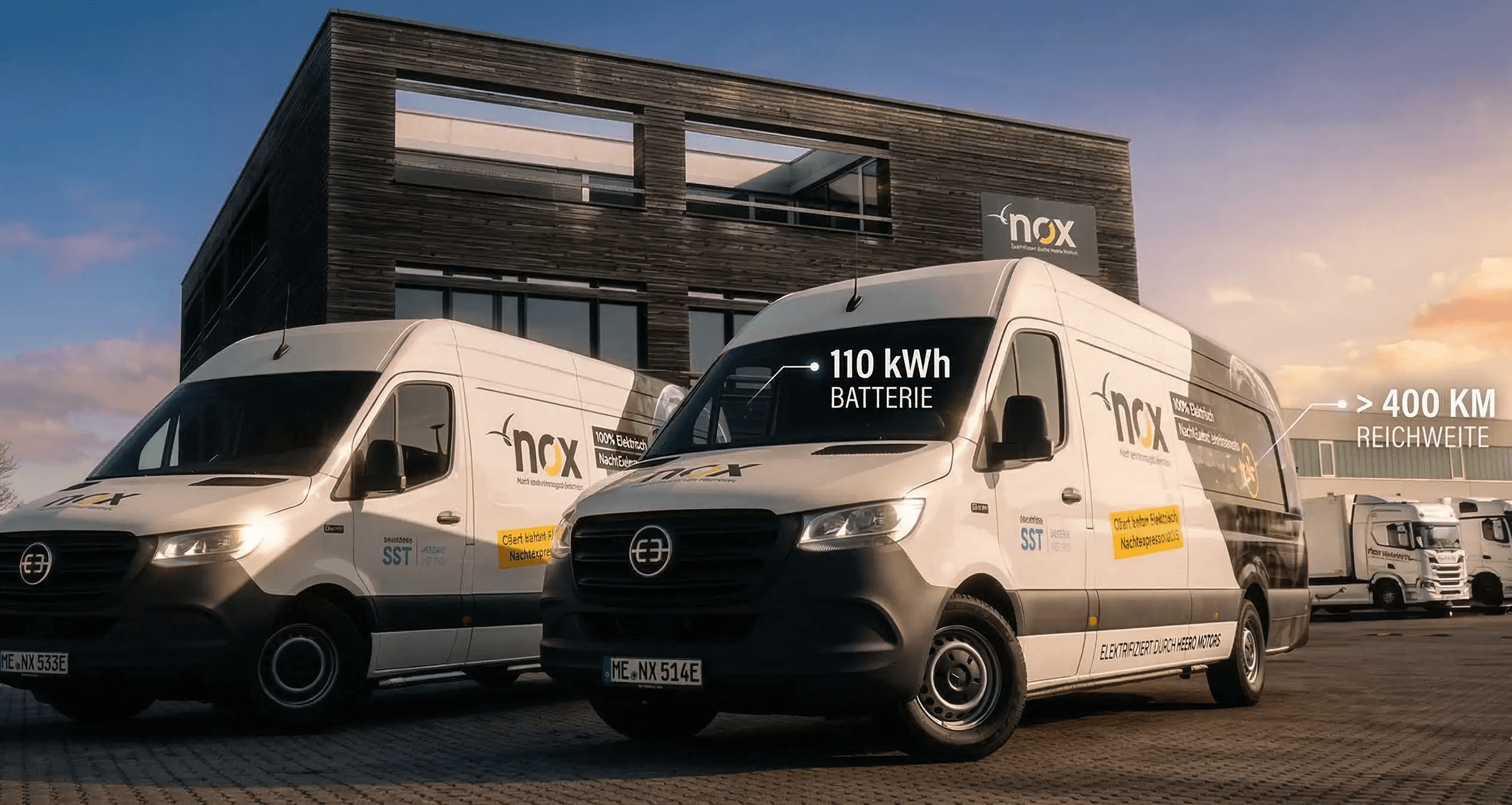
A HEERO D2E Sprinter with its 110 kWh battery offers a decisive advantage here. Even with a noticeable reduction, a practical remaining range of over 250 km remains, which is sufficient for most regional operations. Find out more about the realistic WLTP range for commercial vehicles in our blog.
Market Overview 2025: OEM Vehicles vs. D2E Conversion
The market for new electric vans is growing, but the available towing capacities remain a limiting factor for many trades. Numerous 2025 models often only reach values between 1,500 kg and 2,500 kg. For instance, the Mercedes-Benz eSprinter offers 2,000 kg ex works, while a Ford E-Transit Custom is allowed to tow up to 2,300 kg. For operators of heavy work trailers, as are common in landscaping or municipalities, this is often not sufficient.
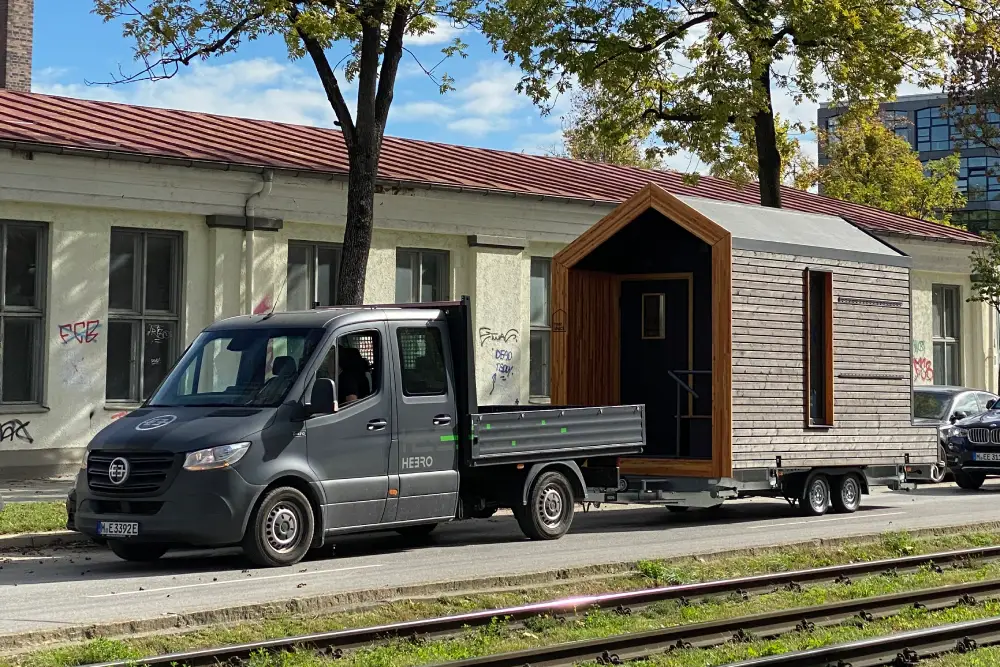
This is where the strategic advantage of the HEERO D2E conversion comes into play. Instead of making a compromise with a new vehicle, the proven basis of a Mercedes-Benz Sprinter (model 907) is utilized. Its robust ladder frame design is already engineered for high towing capacities of up to 3,500 kg. Our conversion maintains this full towing capacity and combines it with an eDrive that delivers over 165 kW of power. This allows you to easily move even a heavy tipper trailer without having to replace your existing fleet. The conversion of a Sprinter takes a maximum of 10 working days (model series 907 only).
TCO Analysis: How Towing Capacity Influences Total Cost of Ownership
The decision for or against an electric commercial vehicle is significantly determined by the Total Cost of Ownership (TCO). A sufficient towing capacity plays a decisive role in this. If a new, lighter trailer also has to be purchased for a new electric vehicle, additional costs of over 15,000 euros quickly arise. The D2E conversion avoids this follow-up investment, as the existing infrastructure can continue to be used 100%. This not only protects the budget, but is also in line with the circular economy.
The TCO advantages continue in operation:
Lower energy costs: Electricity costs per 100 km are typically 40-60% below diesel costs.
Reduced maintenance: The elimination of oil changes, exhaust systems, and clutch wear reduces maintenance costs significantly.
No loss of value for specialized bodies: Expensive refrigerated boxes or flatbed bodies remain in use.
By continuing to use the base vehicle and the trailers, the total cost of ownership can be reduced by over 30% compared to purchasing a new electric transporter along with a new trailer. Calculate your individual TCO now with our fleet analysis tool.
More useful links
ADAC offers a comprehensive buying guide for electric cars with a trailer hitch.
ICCT provides a factsheet on the total cost of ownership (TCO) of battery-electric commercial vehicles in Europe.
NOW GmbH offers a study overview on the total cost of ownership (TCO) of climate-friendly commercial vehicles.
Transport & Environment presents a summary of a study on the decarbonisation of long-haul road transport in Germany.
Federal Motor Transport Authority (KBA) provides general tables on vehicle registrations.
Federal Motor Transport Authority (KBA) publishes press releases on current vehicle registrations.
Federal Office for Logistics and Mobility (BALM) provides information on the Climate-friendly Commercial Vehicles and Infrastructure (KsNI) funding programme.
Federal Ministry of Transport (BMV) provides the guidelines for the Climate-friendly Commercial Vehicles and Infrastructure (KsNI) funding programme.
FAQ
What is the towing capacity of a HEERO Sprinter converted to an electric vehicle?
The towing capacity of the HEERO D2E Sprinter corresponds to the towing capacity of the base vehicle (Model 907) approved by the original manufacturer and entered in the vehicle registration document. Depending on the configuration of the Sprinter 313, 316, or 319, this is typically between 2,000 kg and 3,500 kg. The conversion does not alter this tested and approved capacity.
Does the trailer hitch require a new inspection after the D2E conversion?
No, a separate approval is not required. The HEERO D2E conversion has its own type approval, which includes the continued use of the original trailer hitch and the associated towing capacity. All modifications are entered into the vehicle documents as part of the conversion, ensuring that the vehicle is 100% compliant.
How significantly does the range of up to 300 km decrease when towing a trailer?
The reduction depends heavily on the weight, frontal area of the trailer, and the driving speed. As a rule of thumb, you can expect 30-50% higher energy consumption. For a tour with a 2-tonne trailer, a realistic range of 200-250 km is a reliable planning figure. Our depot charging consulting helps you to optimally align the charging cycles for these types of deployments.
Doesn't the instant torque of an electric motor cause damage to the trailer?
No, this concern is unfounded. Our specially developed vehicle control unit ensures a smooth and controlled power delivery. Starting on a hill is actually subject to less wear and tear with our eDrive than with a conventional clutch of a diesel vehicle. The high torque of over 400 Nm is intelligently regulated to protect both the material and the cargo.
Can Sprinter models with custom bodies and towing hitches also be converted?
Yes, this is one of the core advantages of the HEERO D2E conversion. We focus on preserving the entire body, including the trailer hitch. Whether it is a FlatBed, tipper, or BoxVan – the vehicle retains 100% of its functionality. You only electrify the drivetrain, saving you the expensive new purchase of a complete special-purpose vehicle.
Does HEERO also offer service for the converted vehicle when operating with a trailer?
Of course. Our mobile service, the "Flying HEEROs", supports your vehicle throughout its entire life cycle. The warranty on our conversion components remains fully intact, even under maximum load during towing operations. We ensure that your fleet remains ready for operation with an availability of over 95%.