Electric BoxVan (Cold Chain): Significantly reduce TCO while preserving your high-value specialized body

Electric BoxVan (Cold Chain): Significantly reduce TCO while preserving your high-value specialized body

Rising diesel costs and the Clean Vehicles Directive are putting pressure on refrigerated fleets. A D2E (Diesel-to-Electric) conversion for your MB Sprinter 907 significantly reduces operating costs and preserves the value of your specialized body. This is how successful electrification is achieved in just 10 working days (model series 907 only).
The topic briefly and concisely
Significantly reduce the total cost of ownership (TCO) of your refrigerated vehicle through lower energy and maintenance costs.
Preserve 100% of your valuable specialized bodywork and avoid a bad investment by converting to eDrive in just 10 days (only applicable for the 907 series).
Meet the statutory CVD quota of 38.5% for clean vehicles quickly and economically without purchasing new vehicles.
In 2025, refrigerated fleet operators face a dual challenge: total cost of ownership (TCO) is skyrocketing due to rising CO₂ levies, while the Clean Vehicles Directive (CVD) mandates a procurement quota of 38.5% for clean vehicles. Purchasing a new electric refrigerated vehicle often means the total loss of the expensive refrigerated body. HEERO solves this dilemma through a D2E (Diesel-to-Electric) conversion of the base vehicle. This strategy secures your investment, reduces TCO, and makes your fleet future-proof in a maximum of 10 working days (model series 907 only) (model series 907 only).
TCO Reduction: Reduce operating costs by a third
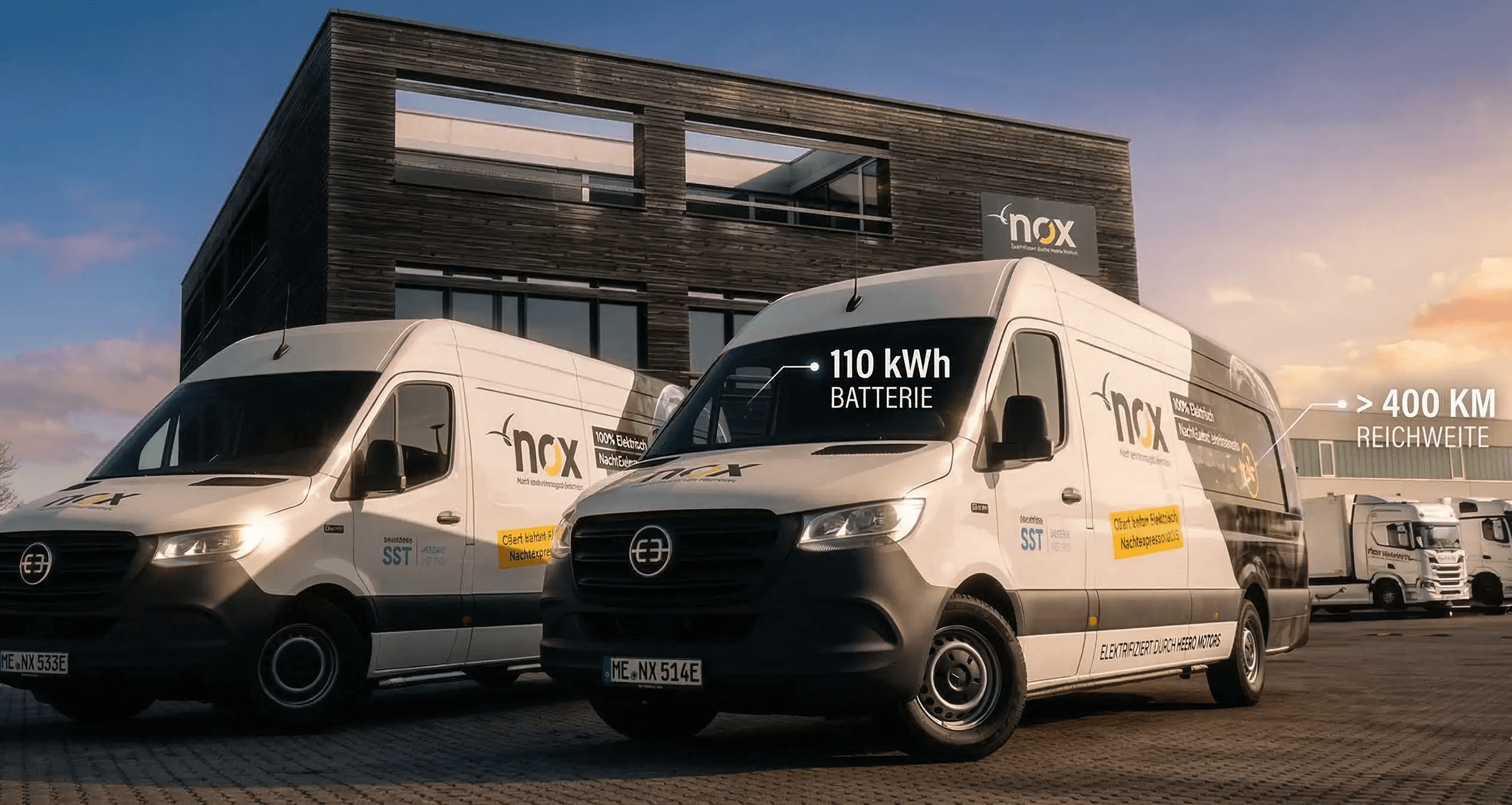
The Total Cost of Ownership (TCO) is the decisive lever for the cost-efficiency of your refrigerated fleet. Studies show that operating costs for electric vans in Germany are around 33% lower than for comparable diesel models. A HEERO D2E Sprinter with a 110 kWh battery typically requires only 26 kWh for 100 km. This results in energy costs of often under 8 EUR per 100 km, whereas a diesel equivalent easily exceeds 15 EUR.
Maintenance costs also drop significantly by over 40%. An electric motor has far fewer wear parts than an internal combustion engine – oil changes, exhaust system repairs, and clutch wear are completely eliminated. These savings often amortize the conversion costs in less than 4 years. The economic analysis of the conversion shows clear advantages compared to buying new. This direct reduction in running costs improves the margin on every single tour and strengthens the competitiveness of the entire fleet.
Investment protection: 100% preservation of special conversions
A refrigerated box body often costs more than EUR 20,000 and is designed for a service life of over 10 years. When purchasing a new e-transporter, this investment is usually fully written off. The HEERO D2E conversion focuses exclusively on the base vehicle of the MB Sprinter 907. Your existing refrigerated body, often only a few years old, remains untouched and fully functional. The entire process takes a maximum of 10 working days (model series 907 only).
This method not only saves capital, but also valuable resources in terms of the circular economy. The following components are retained:
The entire refrigerated box including insulation
The powerful cooling unit
The existing tail lift or other attachments
Specific shelving systems and load securing devices inside
Reusing the body avoids delivery times of over 12 months for new electric special-purpose vehicles. This ensures your fleet remains fully operational without long downtimes and guarantees the continuity of your logistics processes.
CVD Compliance: Efficiently meeting statutory quotas
The Clean Vehicles Directive (CVD), implemented through the Clean Vehicles Procurement Act, is not a recommendation but a statutory requirement. For light commercial vehicles like the Sprinter, a mandatory minimum procurement quota of 38.5% for "clean" vehicles applies until the end of 2025. This quota affects all public contracting authorities and their service providers. Non-compliance jeopardizes future contracts and market reputation.
Retrofitting existing vehicles is the fastest way to meet this quota without having to completely replace your fleet. A retrofitted vehicle counts as "zero-emission" and is credited 100% towards the quota. Instead of waiting for new vehicles with long delivery times, you can act proactively with the D2E conversion. This is how you ensure the CVD compliance of your refrigerated fleet in just a few weeks and position yourself as a sustainable partner for municipal and commercial clients.
Real-world performance: reliably securing range and the cold chain without compromise
Range anxiety is particularly critical in temperature-controlled transport. The HEERO D2E-Sprinter, with its 110 kWh battery, offers a practical WLTP range of up to 425 km. However, the energy supply for the cooling unit is crucial for an electric refrigerated vehicle. Unlike many systems, the cooling system in the HEERO is not powered by the traction battery. A separate energy system ensures full cooling capacity without reducing the vehicle's range.
The key performance data at a glance:
Range: Up to 425 km (WLTP), ideal for the last mile and regional routes.
Battery: 110 kWh gross capacity for high energy reserves.
DC Fast Charging: With 165 kW charging power, the battery is charged to 80% in approx. 60 minutes.
AC Depot Charging: 22 kW for a full charge overnight.
Even in winter conditions with a range loss of 10-20%, a high level of operational reliability remains guaranteed. The reliable range of electric commercial vehicles is essential for route planning and is secured by our technology.
Operational Integration: Depot charging and service from a single source
Switching to an electric fleet requires more than just vehicles. HEERO offers a holistic system solution. Our experts will advise you on the planning and implementation of an efficient 22 kW AC charging infrastructure at your depot. Intelligent load management ensures that your fleet is charged reliably and cost-effectively overnight without overloading the power grid. This enables a smooth start to the day with 100% battery capacity.
Our decentralized service ensures maximum operational safety. The "Flying HEEROs" are specialized technicians who perform maintenance and service work directly on your premises. This concept minimizes downtime, as vehicles do not need to be taken to a distant workshop. 95% of all service cases are resolved within 48 hours. With this comprehensive approach, the transition to an eDrive becomes a predictable and secure process for your company.
More useful links
NOW GmbH offers a study on climate-friendly cooling systems in road freight transport.
The German National Library of Science and Technology (TIB) provides a relevant document.
The Fraunhofer ISI offers a cost analysis comparing electric cars and combustion engine vehicles.
The Federal Office for Logistics and Mobility (BALM) provides information on the Climate Protection and Mobility (KSNI) funding program.
The Federal Motor Transport Authority (KBA) provides statistics on monthly new vehicle registrations.
The Circular Economy Germany platform provides information on the national strategy in the field of vehicles, batteries, and mobility.
The German Environment Agency (UBA) confirms the climate advantage of e-cars in a press release.
The Fraunhofer IML provides information on the topic of e-mobility.
FAQ
What happens to my existing cooling unit during the D2E conversion?
Your refrigeration unit and the entire box body remain completely intact. The HEERO D2E conversion relates exclusively to the drivetrain of the base vehicle (MB Sprinter 907). We replace the diesel engine with our eDrive. After the conversion, your body is remounted onto the chassis.
How does operating the cooling system affect the vehicle's range?
Not at all. HEERO uses an intelligent energy management system where the cooling unit is powered by an autonomous system. The 110 kWh main battery is used exclusively for driving. This ensures that the full WLTP range of up to 300 km remains available to you, regardless of the cooling capacity.
Which Mercedes Sprinter models can be converted using Diesel-to-Electric?
Our D2E conversion kit is specifically designed for the Mercedes-Benz Sprinter 907 series. This includes popular models such as the 313, 316, 319, and 324 CDI. We will be happy to verify compatibility with your specific vehicle as part of a free fleet analysis.
How long does the Diesel-to-Electric (D2E) conversion of a refrigerated vehicle take?
Converting a Sprinter 907 to our eDrive is a standardized process and takes a maximum of 10 working days (907 model series only). This efficiency minimizes your vehicle's downtime, ensuring it is quickly back in operational use for your temperature-controlled transport needs.
Does the warranty remain valid after the Diesel-to-Electric conversion?
Yes, of course. HEERO provides a comprehensive warranty on all components of the electric drivetrain installed by us, including the battery. The exact terms are transparently detailed in our conversion contracts, securing your investment for the long term.
Is the D2E conversion more cost-effective than a new electric refrigerated vehicle?
In most cases, yes. You save the high acquisition costs of a completely new vehicle and avoid the depreciation of your existing specialized body. Combined with the significantly lower Total Cost of Ownership (TCO), our Diesel-to-Electric (D2E) conversion is typically the more economically viable decision for fleet operators.