Refrigerated Vehicle E-Conversion: Lower TCO & Maintain Custom Bodies

The electrification of refrigerated fleets is inevitable, yet purchasing new electric vehicles often means losing expensive specialized bodies. A D2E (Diesel-to-Electric) conversion for your Mercedes-Benz Sprinter 907 preserves your capital, lowers the TCO, and ensures compliance with the Clean Vehicles Directive.
The topic briefly and concisely
Meet the 38.5% CVD quota for light commercial vehicles quickly and cost-effectively by retrofitting existing refrigerated vehicles.
Reduce your Total Cost of Ownership (TCO) through considerably lower maintenance costs and significantly reduced energy costs per kilometer.
Secure your investment by continuing to use your expensive, specialized refrigerated body on the proven Mercedes-Benz Sprinter 907.
Fleet managers in temperature-controlled logistics face a double challenge: the regulatory requirements of the Clean Vehicles Directive (CVD) demand rapid electrification, while the high investment costs for new electric refrigerated vehicles and the associated loss of the valuable refrigerated body threaten profitability. The HEERO D2E (Diesel-to-Electric) conversion for models such as the Sprinter 313, 316, 319, and 324 offers a pragmatic solution. It enables the continued use of your proven vehicle and specialized body, significantly reduces total cost of ownership (TCO), and ensures compliance with procurement quotas of 38.5% for light commercial vehicles.
Regulatory pressure: The Clean Vehicles Directive as a driver
The Clean Vehicles Directive (CVD), implemented in Germany through the Clean Vehicles Procurement Act (SaubFahrzeugBeschG), forces public contracting authorities and their service providers to take action. By the end of 2025, 38.5% of all newly procured light commercial vehicles must be classified as "clean", which in practice often means electric vehicles. This quota affects not only municipalities directly, but also private logistics companies operating on behalf of the public sector, for example in waste management or passenger transport. Failure to comply with these requirements can lead to severe consequences and jeopardize participation in future tenders. D2E conversion of existing refrigerated vehicles is the fastest way to meet this quota without disrupting operations through lengthy new vehicle ordering processes. Converting a Sprinter 907 takes HEERO a maximum of 10 working days (907 model series only). This efficiency enables a timely adaptation of the fleet to the legal framework.
TCO Analysis: Why Retrofitting Outweighs New Purchase
The decision between a new purchase and conversion is largely determined by the Total Cost of Ownership (TCO). A new e-transporter with a refrigerated body represents a capital investment that is often 50% higher than that of a D2E conversion. The decisive factor is the preservation of the value of the specialized body, which would be completely lost in a vehicle replacement. The operating costs of a converted e-transporter are significantly lower than those of a diesel. Maintenance costs can drop substantially, as maintenance-intensive components such as the exhaust system and oil changes are eliminated. In addition, energy costs per 100 kilometers for electricity are typically 40% cheaper than for diesel. Another benefit is the exemption from vehicle tax until 2030. Taking all factors into account, the investment in a D2E conversion often pays off within 3 to 5 years.
Your Advantages at a Glance:
The conversion offers clear economic and operational benefits:
Preservation of Capital: Your expensive and often custom-made refrigerated body remains fully intact and functional.
Lower Investment: The costs for the conversion are significantly lower than purchasing a completely new electric refrigerated vehicle.
Minimal Downtime: The conversion of a Sprinter 907 is completed in a maximum of 10 working days (907 model series only), while delivery times for new vehicles often take several months.
Reduced Operating Costs: You benefit immediately from lower energy, maintenance, and tax costs.
These factors make conversion the strategically smarter choice for future-oriented fleet operators.
Technical Implementation: Performance and Reliability for the Cold Chain
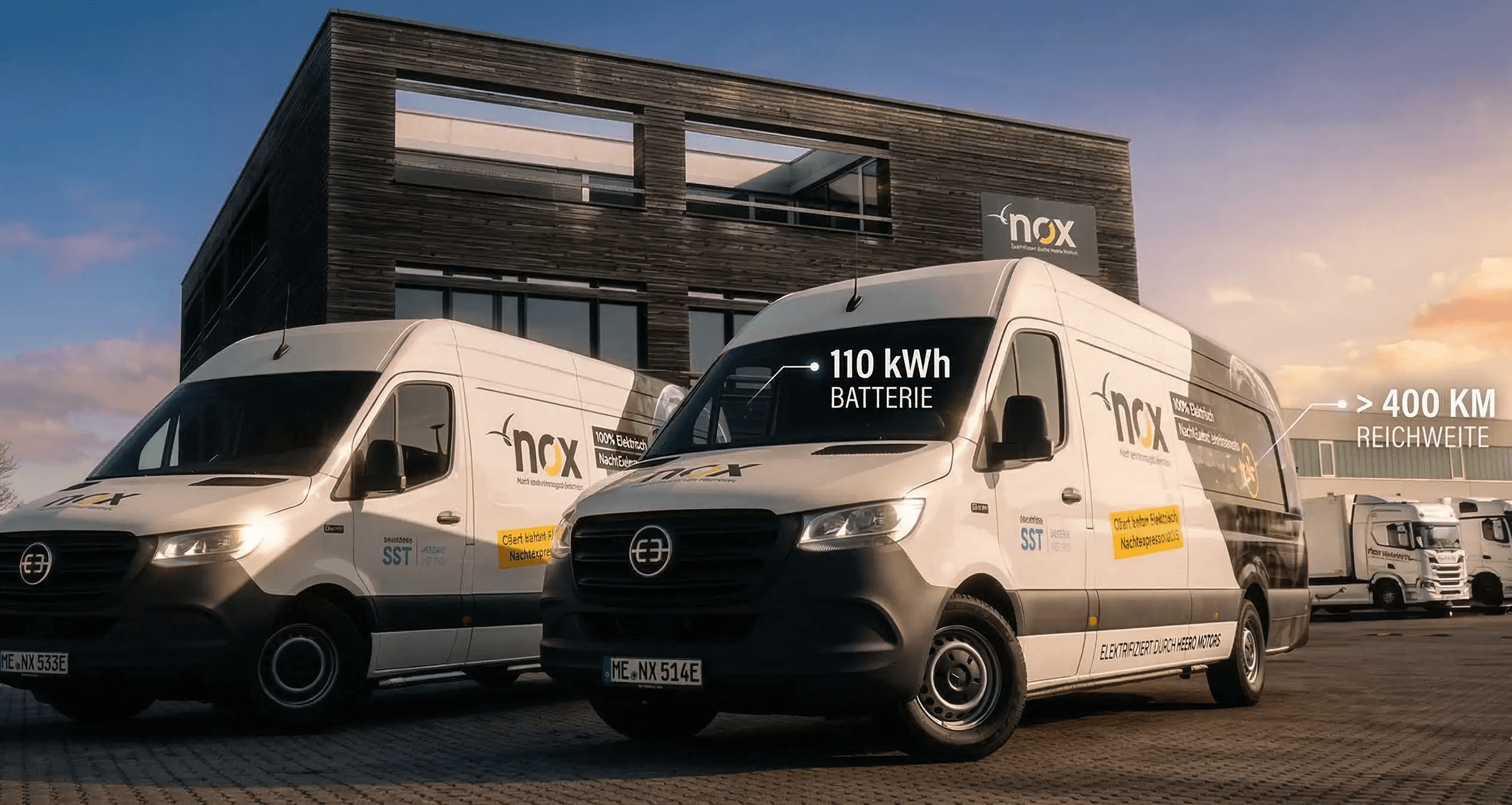
The technical performance of a converted refrigerated vehicle must meet the demanding conditions of cold chain logistics. The HEERO D2E system for the Mercedes-Benz Sprinter 907 is based on a 110-kWh battery, which enables a practical WLTP range of up to 300 km. Crucially, the operation of the refrigeration unit does not unpredictably compromise the range. Our system integration ensures that the energy supply for the cooling system is self-sufficient and efficient, maintaining the cold chain seamlessly even during long stops or in urban traffic. The charging capacity of 165 kW at a DC fast-charging station allows charging to 80% in just 60-90 minutes, fitting perfectly within the legally prescribed driving and rest times. A 22-kW AC charger is available for plannable depot charging overnight. The performance of the eDrive ensures a dynamic and quiet drive, which is particularly advantageous in urban delivery traffic. With our solutions for specialized vehicles, we guarantee that the specific requirements of your operations are fully met.
Operational Excellence: Fleet Integration and Service
Successful electrification goes beyond the vehicle and requires a well-thought-out integration into fleet processes. HEERO supports fleet managers in planning and implementing the necessary depot charging infrastructure and offers intelligent load management to avoid costly peak loads. Our mobile service technicians, the "Flying HEEROs," ensure high vehicle availability through maintenance and service directly on your premises. This minimizes downtime and keeps your logistics processes running smoothly. The range of up to 300 km easily covers typical daily routes in distribution transport and last-mile delivery, even in winter operation. By combining a proven vehicle platform, reliable e-technology, and a comprehensive service concept, the Diesel-to-Electric conversion of your BoxVan becomes a secure and sustainable investment.
More useful links
e-mobil BW highlights the growing importance of electric commercial vehicles.
Transport & Environment presents a study showing that electric vans are overall more cost-effective compared to diesel vehicles.
The Federal Office for Logistics and Mobility (BALM) provides detailed information on the Climate Protection and Mobility (KSNI) funding program.
Circular Economy Germany provides information on the national circular economy strategy, specifically in the areas of vehicles, batteries, and mobility.
The German Environment Agency (UBA) provides an analysis of the environmental impact of motor vehicles.
The Federal Statistical Office (Destatis) provides current data and information on freight transport in Germany.
The German Energy Agency (dena) offers a dossier on the expansion of charging infrastructure for eDrive trucks.
The Fraunhofer ISI publishes a press release on emission-free trucks and their decreasing costs.
FAQ
How long does a refrigerated vehicle Diesel-to-Electric (D2E) conversion take?
The D2E conversion of a Mercedes-Benz Sprinter (model 907) is typically completed by HEERO within a maximum of 10 working days (model series 907 only). This significantly minimizes your vehicle's downtime compared to the often months-long delivery times for new vehicles.
What is the real-world range of a Diesel-to-Electric converted refrigerated vehicle?
A Sprinter converted with the HEERO system achieves a WLTP range of up to 300 km. The power supply for the cooling unit is integrated in such a way that the range remains predictable, and the requirements of cold chain logistics are reliably met, even in winter.
What happens to the warranty on my vehicle?
HEERO assumes the warranty for the entire electric drivetrain and all components installed by us. The warranty for the untouched parts of the base vehicle remains unaffected. Our service team of "Flying HEEROs" is at your disposal for all matters.
Is the Diesel-to-Electric conversion more cost-effective than purchasing a new electric refrigerated van?
Yes, in most cases, retrofitting is the more economical solution. You avoid the depreciation of your expensive refrigerated body and benefit from a significantly lower initial investment. Lower operating and maintenance costs lead to an attractive TCO and rapid amortization.
Which Mercedes-Benz Sprinter models are eligible for our Diesel-to-Electric (D2E) conversion?
Our D2E conversion system is specifically designed for the Mercedes-Benz Sprinter 907 series. This includes common base models such as the 313, 316, 319, and 324, which are frequently used as the basis for refrigerated vehicles. Contact us for an analysis of your specific fleet.
Does HEERO also support you with planning the charging infrastructure?
Yes, we offer comprehensive consulting for depot charging infrastructure. Our service includes analyzing your requirements, planning the charging infrastructure with 22 kW AC charging points, and implementing intelligent load management to optimize your operations and reduce costs.