Electrify your fleet: Lower TCO and meet CVD quotas with D2E conversion

Rising cost pressures and the Clean Vehicles Directive demand urgent action from fleet managers.
The topic briefly and concisely
Meet the CVD quota of 38.5% for light commercial vehicles on time through a fast conversion in just 10 working days (only model series 907) (for model series...
Reduce your fleet's operating costs by approximately 33% thanks to lower energy and maintenance costs compared to diesel engines.
Protect your investments by retaining 100% of your expensive, custom-built bodies and extending the service life of your proven vehicles.
The electrification of commercial vehicle fleets is no longer an option, but a commercial and legal necessity. According to the Clean Vehicles Directive (CVD), 38.5% of all newly procured light commercial vehicles had to be low-emission by the end of 2025. At the same time, high operating costs for diesel vehicles are a burden on budgets. With the D2E (Diesel-to-Electric) conversion, HEERO Motors offers a solution that directly addresses these challenges. By converting your proven Sprinter fleet (model 907) within just 10 working days (model series 907 only), you protect your investment in expensive special bodies and benefit from significantly lower total cost of ownership (TCO).
Ensure CVD compliance by 2025
The EU's Clean Vehicles Directive sets clear deadlines for public fleet operators. By December 31, 2025, 38.5% of newly procured light commercial vehicles and 45% of buses had to be classified as clean vehicles. This requirement creates significant pressure to act, as procurement cycles for new vehicles take a long time. Failure to meet these quotas can lead to legal and financial consequences. The D2E-Umrüstung is a strategic lever to achieve this quota quickly. Instead of waiting for long delivery times for new electric vans, you can have your existing fleet converted in just 10 working days (model series 907 only) (model series 907 only) per vehicle. This enables a predictable and rapid electrification of your fleet and ensures full compliance with legal requirements. In this way, a regulatory obligation becomes a calculable competitive advantage.
Significantly reduce Total Cost of Ownership (TCO)
Cost-effectiveness is the decisive factor in fleet modernization. Electric vans have a clear advantage here. Studies show that the operating costs for an e-van in Germany are around 10 cents per kilometer, whereas a comparable diesel costs 15 cents – a noticeable reduction. This advantage results from several factors that must be taken into account in the TCO analysis. Here are the four most important levers:
Lower energy costs: Electricity costs per 100 kilometers are typically 40-50% lower than diesel costs.
Reduced maintenance effort: Maintenance costs can decrease significantly because components such as the exhaust, clutch, or oil filter are eliminated.
Tax benefits: Electric vehicles benefit from an exemption from vehicle tax for several years.
Less wear and tear: Recuperation protects the braking system, which significantly reduces the replacement of pads and discs.
The conversion enables access to these TCO advantages without the high acquisition costs of a new vehicle. By continuing to use your vehicle chassis, the investment is focused solely on the drivetrain. A detailed comparison between conversion and purchasing a new vehicle highlights the financial advantages. This lower initial investment significantly accelerates the payback period.
Fully preserve the value of specialized vehicle bodies
Your fleet consists of more than just vans; it consists of specialized working equipment. Whether refrigerated box, tipper, or workshop installation – these bodies often represent a value of over 50,000 euros per vehicle. A new purchase of an electric van would mean the loss of this substantial investment. The conversion of HEERO for the Sprinter models 313, 316, 319, and 324 (series 907) solves this problem. We preserve 100% of the vehicle frame and the specialized body. The conversion process focuses exclusively on replacing the diesel drivetrain with our powerful electric drive featuring a 110 kWh battery. This means that you fully retain your proven vehicles and their functionality. This approach is a key building block of the circular economy in the commercial vehicle sector, as it extends the service life of high-value assets by many years. Instead of scrapping functional technology, it is modernized and upgraded for a locally emission-free future.
Practical everyday use through high range and charging capacity
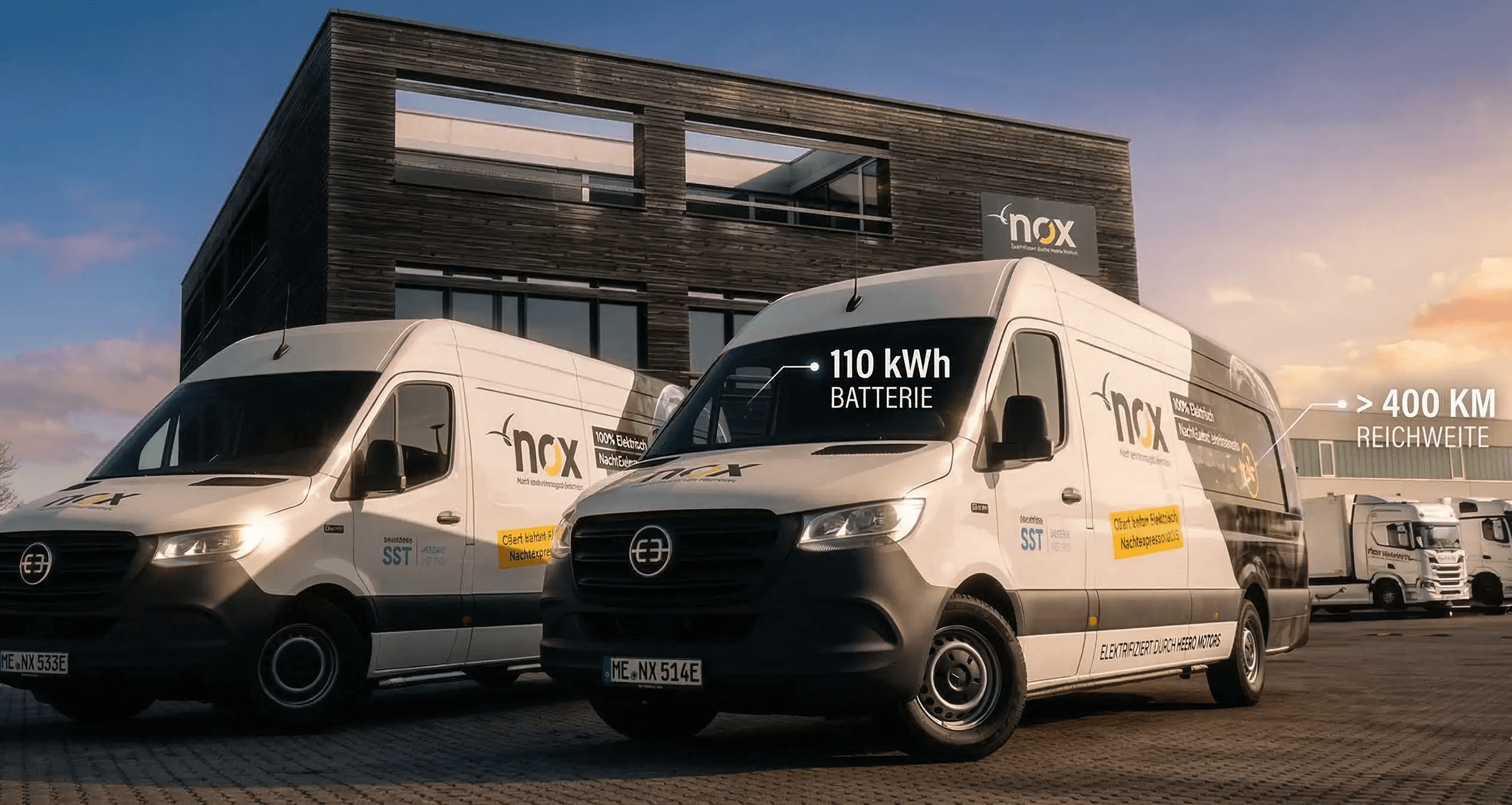
The concern about insufficient range is one of the biggest hurdles in electrification. HEERO has solved this challenge with practical technical equipment. The converted HEERO Sprinter achieves a WLTP range of up to 425 km. This range fully covers typical daily routes in last-mile delivery, trade, and municipal services. The installed 110 kWh battery can be charged with up to 165 kW at DC fast-charging stations. A charging process from 20% to 80% thus only takes about 40-60 minutes. This charging capacity makes it possible to efficiently use the driver's legally required driving break for recharging. For planned overnight charging at the depot, an AC charging capacity of 22 kW is available. The key performance data at a glance:
Range: Up to 425 km (WLTP) for maximum operational flexibility.
Battery capacity: 110 kWh (gross) as standard for all Sprinter conversions.
DC charging power: 165 kW for fast charging to 80% in under 60 minutes.
AC charging power: 22 kW, optimized for cost-effective overnight depot charging.
The combination of high range and fast charging capability ensures that your electrified fleet operates without operational compromises.
Reliable service and warranty as standard
The transition to electromobility requires a reliable partner who is also there for you after the conversion. HEERO offers a comprehensive warranty on all components of the electric drivetrain. This secures your investment in the long term and gives you the same security as with a new vehicle. Our service concept is based on the "Flying HEEROs", a mobile service team that can carry out maintenance and repairs directly on-site at your location. This minimizes your vehicle downtime to less than 24 hours. Since an electric drive has significantly fewer parts requiring maintenance, the service effort is already considerably reduced. We understand that the availability of your fleet is crucial. That is why we combine robust technology with an agile service that is oriented towards your operational needs. A well-thought-out planning of load management in the depot complements this approach. In this way, we ensure a smooth transition and operation of your electrified fleet.
FAQ
Which Mercedes-Benz Sprinter models are eligible for our Diesel-to-Electric (D2E) conversion?
We focus exclusively on the electrification of the Mercedes-Benz Sprinter 907 series. This includes popular base models such as the 313, 316, 319, and 324. Focusing on this specific model allows us to deliver a highly efficient and standardized Diesel-to-Electric (D2E) conversion process, which is completed in a maximum of 10 working days (907 model series only).
How do payload and cargo volume change after the D2E conversion?
Our goal is to preserve the original functionality of your vehicle as much as possible. Since we do not modify the original chassis and body, the cargo volume remains identical. Although the payload may be slightly reduced due to the weight of the battery, it remains fully sufficient for 95% of all typical use cases.
What happens to the removed diesel engine and the old components?
In line with the circular economy, the removed diesel engines and components are not discarded. We feed these components into a professional recycling cycle where they are tested, reconditioned, and reused as spare parts. This reduces waste and conserves valuable resources, reflecting a core part of our corporate philosophy.
What warranty does HEERO offer on the conversion and the battery?
HEERO offers a comprehensive warranty on the entire electric drivetrain, including the 110 kWh battery and the electric motor. The exact terms and conditions comply with vehicle manufacturer standards, reliably safeguarding your investment. Our commitment is to provide you with quality and security that is in no way inferior to that of a new electric vehicle.
How long does the Diesel-to-Electric (D2E) conversion process take for a vehicle?
The entire D2E conversion process for a Sprinter 907 model is designed for maximum efficiency and typically takes no longer than 10 working days (907 series only). This short conversion time minimizes your vehicle's downtime and enables rapid reintegration into your active fleet, allowing you to benefit from the advantages of the eDrive without delay.
Does HEERO also offer support with planning the charging infrastructure?
Yes, we see ourselves as a holistic partner for your fleet electrification. Our team of experts offers comprehensive consulting for depot charging. We analyze your requirements, plan the optimal design of your charging infrastructure, and support you with load management to avoid costly peak loads and further optimize your operating costs.
More useful links
The International Council on Clean Transportation (ICCT) offers a fact sheet on the total cost of ownership (TCO) of battery electric vehicles (BEVs) in Europe, with a focus on Germany.
The Kraftfahrt-Bundesamt (KBA) provides statistics on vehicles, which include information on registration figures, among other things.
The Umweltbundesamt (UBA) publishes an analysis of the environmental balance of motor vehicles.
The Bundesministerium für Wirtschaft und Klimaschutz offers a dossier on the topic of electromobility.
The Statistische Bundesamt (Destatis) provides information on new registrations of electric passenger cars.
Strategy& (PwC) publishes a press release on the E-Mobility Sales Review (EVSR) for the first quarter of 2023.
The Verband Deutscher Verkehrsunternehmen (VDV) offers information on the topic of e-mobility.
The Fraunhofer ISI provides press information on deployment planning for electric trucks, potentials, and costs.