14-seater Electric MiniBus: lower TCO & meet CVD quotas

The Clean Vehicles Directive demanded a 45% quota for clean buses by the end of 2025. This poses enormous challenges for fleet managers. Discover how a 14-seater bus as an electric model—through conversion or new purchase—not only lowers the TCO but also preserves the value of your special bodies.
The topic briefly and concisely
The Clean Vehicles Directive (CVD) required a quota of 45 percent clean buses by the end of 2025, thereby increasing the pressure on fleet operators to act.
A 14-seater electric minibus significantly reduces operating costs (TCO) compared with diesel, thanks to lower energy and maintenance costs.
The D2E Diesel-to-Electric conversion of an MB Sprinter (model 907) takes just 10 days, protects expensive body conversions and is a cost-effective alternative to diesel.
The electrification of passenger transport fleets is no longer an option, but a business and legal necessity. The EU requirements of the Clean Vehicles Directive (CVD) set clear deadlines and quotas that had to be met by 2025. For operators of 14-seater buses, this means acting strategically now. It is not just about purchasing new vehicles, but about a holistic approach that focuses on Total Cost of Ownership (TCO), value retention of existing vehicles, and operational efficiency. HEERO Motors offers pragmatic solutions for this, tailored precisely to these requirements.
CVD 2025: Legal pressure is forcing fleets to electrify
For bus fleet operators in Germany, the pressure to act remains high. The Clean Vehicles Procurement Act (Saubere-Fahrzeuge-Beschaffungs-Gesetz), the German implementation of the Clean Vehicles Directive, mandates clear targets. By December 31, 2025, 45% of all newly procured buses had to be classified as "clean". Half of these, meaning 22.5%, even had to be completely emission-free. These quotas are not recommendations, but a legal obligation for public contracting authorities and their service providers.
This regulation directly affects the procurement strategy for vehicles such as the 14-seater electric bus. Ignoring the requirements leads to legal consequences and excludes companies from public tenders. The transition is therefore a critical factor for the future viability of the operation. The challenge lies in making this transformation economically and operationally intelligent. The focus must be on solutions that both ensure CVD compliance and optimize total cost of ownership. The strategic decision between purchasing new and retrofitting thus becomes the central question for every fleet manager.
TCO analysis: significantly reduce the operating costs of electric buses
The higher acquisition costs of an electric bus are more than compensated for by significantly lower total cost of ownership (TCO). Studies show that electric vans in Germany have operating costs of only around 10 cents per kilometer, compared to 15 cents for diesel models. This represents a saving of over 30%. Savings result from several factors:
Energy costs: Electricity is generally significantly cheaper than diesel, the price of which continues to rise due to CO2 pricing.
Maintenance and repair: An electric motor has significantly fewer moving parts than an internal combustion engine. This reduces maintenance requirements considerably, as oil changes, exhaust system repairs, and clutch wear are eliminated.
Tax benefits: Electric vehicles often benefit from an exemption from vehicle tax.
Experience from practical operations confirms this potential. A transport company in rural areas was able to halve the operating costs of its electric buses compared to diesel buses. These savings typically amortize the initial investment within a few years. A well-thought-out Strategie für Elektro-Sprinter and buses is therefore not a purely environmental expense, but an investment in the financial efficiency of the fleet. The analysis of the TCO shows how electrification reduces the economic pressure on fleet operators.
D2E conversion: The smart alternative to an expensive new purchase
For many fleet operators, the greatest loss of value is not the base vehicle, but the costly specialist body. HEERO has developed a solution with the D2E conversion (Diesel-to-Electric) that addresses exactly this problem. Instead of buying a completely new 14-seat electric bus and losing the proven body, the existing minibus, based on the Mercedes-Benz Sprinter chassis, is converted to a high-performance eDrive within a maximum of 10 working days.
This process preserves the value of your investment and integrates state-of-the-art e-technology into your fleet. The technical specifications of the conversion are designed for demanding fleet operations:
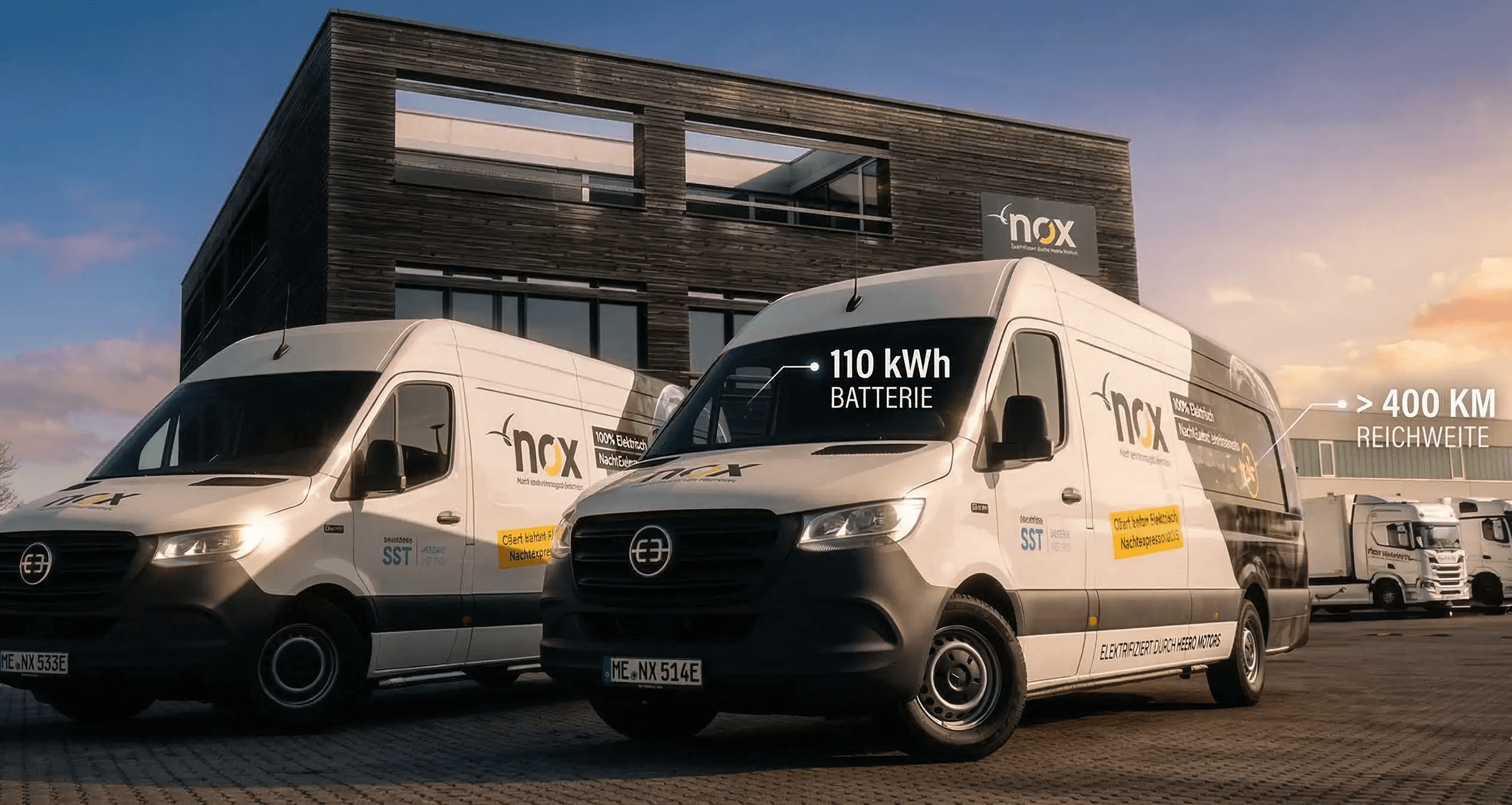
Battery capacity: A 137 kWh battery provides sufficient energy for daily routes.
Range: With a range of up to 300 km (WLTP), most operating profiles are covered.
Charging performance: Thanks to 165 kW DC fast charging, the battery is charged to 80% in 30-40 minutes.
Base vehicles: The conversion is optimised for Sprinter models 313, 316, 319 and 324 (Sprinter model 907).
The D2E conversion is the fastest and most resource-efficient method of achieving CVD compliance while preserving capital. It combines the principle of the circular economy with tangible economic benefits. This decouples technological modernisation from the need for a complete vehicle replacement.
Range and charging infrastructure: practicality in focus
Concern about insufficient range is one of the biggest hurdles in electrification. Modern e-buses, however, offer practical ranges that easily cover day-to-day operations. The HEERO D2E Sprinter achieves up to 425 km, while the HEERO Tourer and other bus models can manage over 300 km. These figures allow flexible route planning without constant charging stops. In winter, range can indeed drop by 10 to 30 per cent, but remains more than sufficient for most daily routes.
A successful transition depends crucially on an intelligent charging strategy. The key lies in overnight Depot Charging. With a 22 kW AC wallbox, the vehicles are prepared cost-effectively and gently on the battery for the next day. For rapid top-ups in between, DC fast charging at 165 kW is available. Together with partners, HEERO supports fleet operators with comprehensive advice on charging infrastructure and load management to avoid costly peak loads. A precise analysis of the WLTP ranges of commercial vehicles shows that the technology is ready for professional deployment. The combination of long range and well thought-through charging planning makes the electric bus a reliable solution.
The HEERO portfolio: Tailor-made e-bus solutions
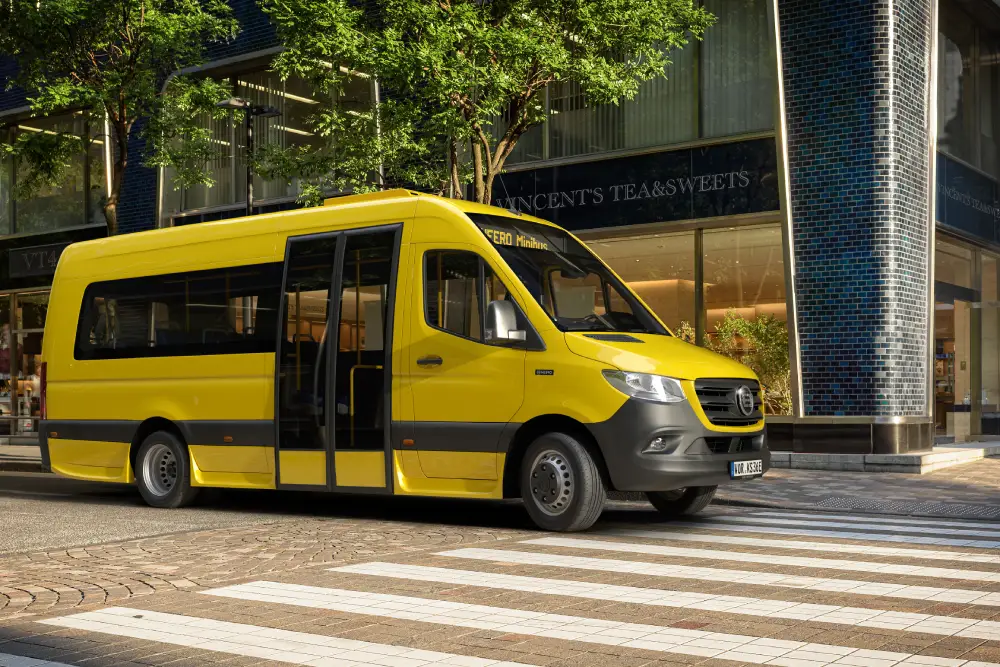
In addition to the conversion, HEERO offers a portfolio of new electric minibuses based on the Sprinter to meet different passenger transport requirements. Each model is optimized for specific purposes and offers the familiar reliability of the Sprinter platform, combined with a locally emission-free drive. These vehicles are an excellent option for fleets planning to expand or renew their vehicle pool.
The range includes specialized bus variants tailored to the needs of municipalities, tourism companies, and transport service providers. Here is an overview of the available models:
HEERO Tourer: Designed for comfort on longer routes, it offers a range of over 300 km. An ideal electric tourer bus for shuttle services and excursions.
HEERO Low-Entry Bus (Middle): With a range of over 300 km and a 137 kWh battery, this electric bus is perfectly suited for low-barrier scheduled services.
HEERO Low-Entry Bus (Rear): Also offers a range of over 300 km and facilitates entry in the rear section of the vehicle, making it flexible for various scheduled routes.
Each of these models can be customized to specific customer requirements to ensure a tailor-made solution for every fleet. This broad portfolio ensures that the right vehicle is available for every application. In this way, the transition to electromobility becomes a strategic decision for greater efficiency and sustainability.
FAQ
How long does a D2E conversion of a 14-seater bus take?
The Diesel-to-Electric conversion of a Mercedes-Benz Sprinter model 907 is typically completed by HEERO within a maximum of 10 working days. This efficient process minimises vehicle downtime and enables rapid reintegration into your fleet, so that statutory requirements can be met promptly.
What real-world range does a converted electric Sprinter offer?
A Sprinter converted with the HEERO D2E system achieves a WLTP range of up to 300 km. In practice, the range depends on factors such as payload, topography and outside temperature. Even in winter, when significantly less range can be expected, the vehicles remain absolutely suitable for most daily routes in urban and regional transport.
What happens to the base vehicle's warranty after the conversion?
HEERO provides full warranty coverage for the entire electric drivetrain and the battery. The original Mercedes-Benz warranty for the unmodified parts of the vehicle, such as the bodywork and interior, remains unaffected. This gives you comprehensive protection for the entire vehicle.
What are the advantages of converting it compared with buying a new electric bus?
The main advantage is value retention. Expensive, specialised body conversions mounted on your existing Sprinter can continue to be used. In addition, the Diesel-to-Electric (D2E) conversion is often more cost-effective and faster than procuring a new vehicle with long lead times. You benefit from a proven base vehicle and conserve valuable resources in the spirit of the circular economy.
How long does the battery last in a HEERO electric bus?
HEERO uses high-quality NMC batteries, designed for a long service life. The manufacturer’s warranty typically covers 8 years or 160,000 kilometres at a minimum of 70% remaining capacity. Experience shows that the batteries often reach, or even exceed, the vehicle’s service life of around 250,000 km.
Does HEERO also support you with planning the charging infrastructure?
Yes, HEERO offers comprehensive advice on depot charging infrastructure together with cooperation partners. These experts analyse your requirements, plan the optimum number and capacity of charging points (e.g. 22 kW AC), and develop intelligent load management. This ensures that your fleet is fully ready for operation every morning, without overloading the power grid.
More useful links
Statista offers statistics and forecasts on the market for electric buses in Germany.
PwC provides analyses and insights on the topic of electromobility in public transport with its E-Bus-Radar.
NOW GmbH provides an overview of studies on the total cost of ownership (TCO) of climate-friendly commercial vehicles.
The Bundesministerium für Verkehr provides information on the Clean Vehicles Directive of the EU.
The Energieagentur Rheinland-Pfalz provides information on the implementation of the Clean Vehicles Directive at the municipal level.
The Umweltbundesamt presents an analysis of the environmental balance of motor vehicles.
The Kraftfahrt-Bundesamt (KBA) provides current statistics.
The Bundesministerium für Verkehr provides comprehensive information on electromobility in Germany.
The Verband Deutscher Verkehrsunternehmen (VDV) provides information about its E-Bus project.