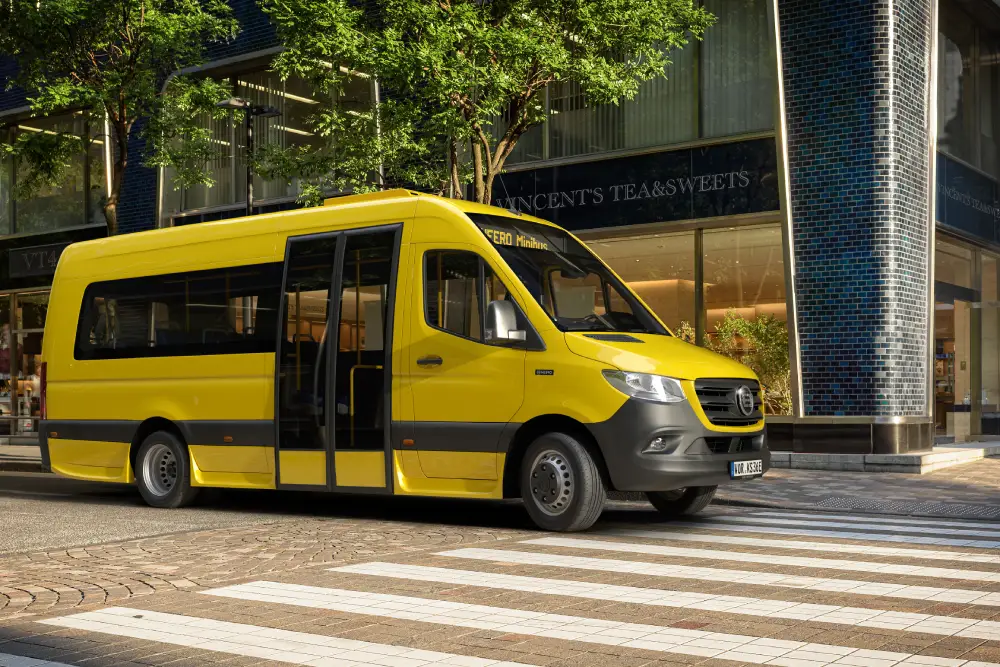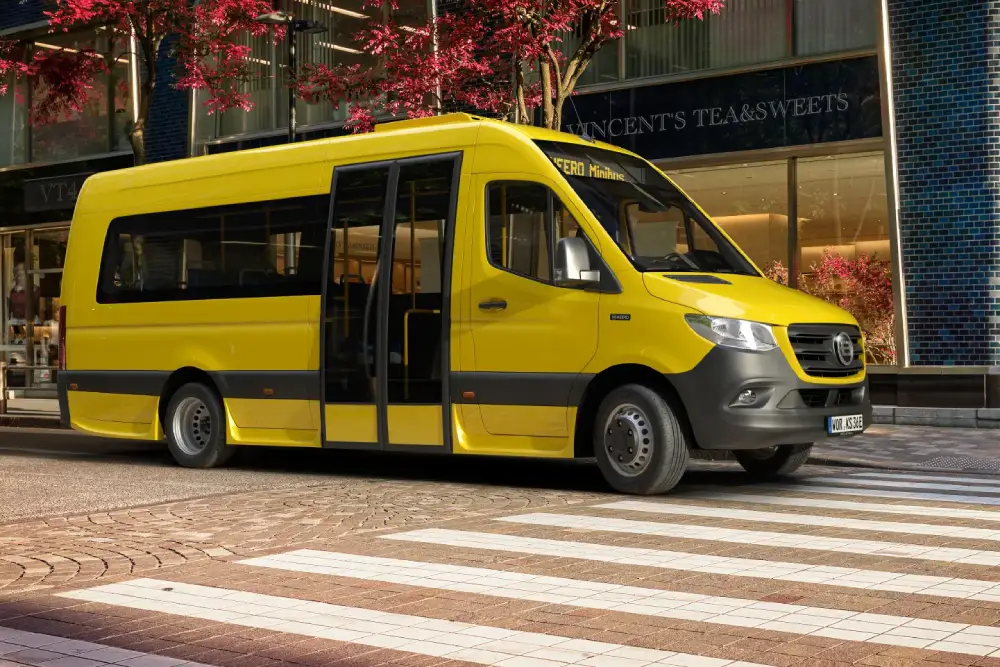
18-seater Electric MiniBus: reduce TCO and meet CVD quotas

The Clean Vehicles Directive requires a 45% quota for clean buses by the end of 2025. For fleets with 18-seater buses, this creates an urgent need to act.
The topic briefly and concisely
Meet the 45% CVD quota for clean buses by 2025 by using an 18-seat electric bus.
Significantly reduce operating costs through lower energy and maintenance costs compared with diesel.
Preserve the value of your fleet with D2E conversion of MB Sprinters (907) in just 10 working days.
Fleet managers in passenger transport face a double challenge: total operating costs (TCO) are rising, while the clock is ticking for implementation of the Clean Vehicles Directive (CVD). Particularly in the minibus segment, such as the 18-seater electric bus, a fast and cost-effective solution is required. The statutory quota of 45% for clean buses by 2025 is forcing action. HEERO offers two pragmatic routes: the D2E (Diesel-to-Electric) conversion for existing Mercedes-Benz Sprinter vehicles of the 907 series, and highly efficient new electric bus vehicles. Both approaches protect the residual value of your fleet, optimise the TCO and ensure full CVD compliance.
CVD pressure: statutory quotas by 2025 are unavoidable
The Clean Vehicles Directive (CVD), implemented through the German Clean Vehicles Procurement Act (SaubFahrzeugBeschG), is no longer a distant vision. For public contracting authorities and their service providers in passenger transport, a binding minimum quota of 45% for the procurement of "clean" buses applied until December 31, 2025. Crucially, half of this quota, i.e., 22.5%, must be met by completely "emission-free" vehicles, which in practice translates to battery-electric drives. This regulation directly affects the new procurement and awarding of transport services, directly impacting fleets with minibuses such as the 18-seater. Failure to meet the quota can lead to legal and contractual consequences. A strategic transition remains necessary, as the next quota level is already in effect. Switching to a HEERO electric bus is a direct response to this regulatory challenge. The next stage of regulation starting in 2026 will further tighten the requirements, making proactive action even more important.
TCO analysis: operating costs as the key lever
While the purchase price of an electric bus can be higher, the TCO analysis over the entire service life reveals the true savings potential. The operating costs for an 18-seater electric bus are significantly lower than for a diesel counterpart. Studies show that energy costs per kilometer for an electric bus are around 0.26 euros, whereas a diesel bus costs about 0.60 euros. Over a period of 10 years and 60,000 km per year, this alone can mean savings of over 50,000 euros. In addition, maintenance costs are significantly lower, as many wearing parts of the combustion engine are eliminated. Maintenance costs can decrease significantly. The TCO consideration includes several factors:
Energy costs (electricity vs. diesel)
Maintenance and repair costs
Tax advantages and lower levies
Insurance classifications
Residual value of the vehicle
This calculation shows that investing in electromobility is not only an emission-related decision, but above all an economic one. A detailed analysis of the WLTP-Reichweite bei Nutzfahrzeugen helps with precise route planning and TCO calculation.
D2E conversion: value creation through value retention
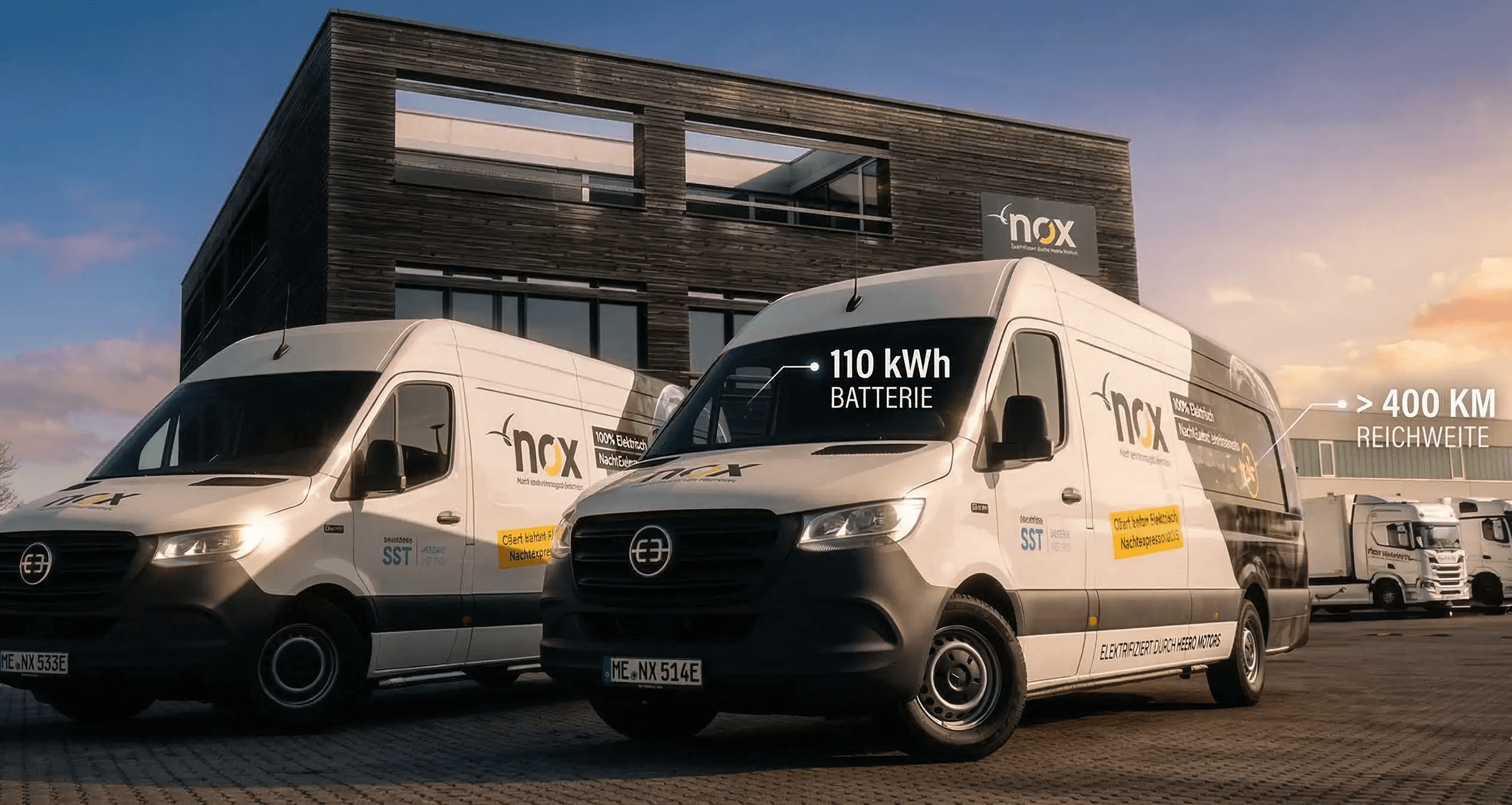
For fleets that already rely on the proven Mercedes-Benz Sprinter series 907, HEERO offers a particularly economical solution: the D2E conversion (Diesel-to-Electric). Instead of replacing a fully functional vehicle with an expensive specialist body, the diesel powertrain is replaced by a highly efficient eDrive within a maximum of 10 working days. This not only preserves capital, but also retains the value of the existing vehicle. The process is standardised and efficient, ensuring rapid reintegration into your fleet. Especially for vehicles with complex bodies, whose value often exceeds 50% of the total vehicle, this is the superior strategy. The HEERO D2E Sprinter achieves a range of up to 425 km, making it ideally equipped for most operating profiles. The conversion is a core competence that underlines our expertise in electric Sprinters and enables rapid CVD compliance.
Performance data in practice: range and charging efficiency
The practicality of an 18-seater electric bus depends on two key figures: range and charging power. The HEERO eBus based on the Sprinter offers a practical range of over 300 km with its 137 kWh battery. This fully covers the typical daily routes in shuttle operations, city tours or transfer services. At a DC rapid charging station with 165 kW charging power, the battery is recharged to 80% in just 30 to 40 minutes. This short charging time enables high vehicle availability even in multi-shift operations. For planned overnight charging at the depot, 22 kW AC charging power is available. This charging infrastructure is a central component of the HEERO offering, which also includes comprehensive advice on depot and load management. This replaces range anxiety with intelligent and predictable charging logistics that integrate seamlessly into operations.
Fleet integration: a holistic solution approach
The electrification of a fleet is more than just replacing vehicles. HEERO sees itself as a partner for the entire transformation process. This begins with the analysis of your existing fleet and routes to determine the optimal electrification mix. Our experts advise you on the conception and implementation of the suitable depot charging infrastructure, including intelligent load management to avoid costly load peaks. After commissioning, our service team, the "Flying HEEROs", ensures maximum availability of your vehicles. This 360-degree approach typically ensures a smooth and economical integration of e-buses into your fleet. We accompany you from the initial TCO calculation to ongoing operations and ensure that your investment delivers the maximum return. We also offer tailored solutions for special requirements such as a high towing capacity for electric minibuses.
FAQ
What range does an 18-seater electric bus from HEERO offer?
The HEERO electric minibus based on the Sprinter — such as the Tourer or rear low-floor bus — achieves a real-world range of over 300 kilometres with the standard 137 kWh battery. A Sprinter electrified through a D2E Diesel-to-Electric conversion can also achieve a range of over 300 km, which is more than sufficient for most daily passenger transport applications.
How long does the D2E conversion of an existing Sprinter take?
The D2E conversion (Diesel-to-Electric) of a Mercedes-Benz Sprinter in the 907 series is a highly efficient process. HEERO requires a maximum of 10 working days for the complete conversion (907 model series only). This ensures minimum vehicle downtime and allows it to be quickly reintegrated into productive fleet operations.
Does a HEERO electric bus fulfil the Clean Vehicles Directive (CVD)?
Yes, without restriction. All battery-electric vehicles from HEERO are regarded as “zero-emission” within the meaning of the CVD, as they emit less than 1 g CO2/km locally. They therefore meet the highest requirement level of the directive and contribute to meeting the binding procurement quotas of 22.5% (up to 2025) and 32.5% (from 2026).
What should be considered when planning the charging infrastructure for an e-bus fleet?
A key component is depot charging. HEERO recommends AC charging stations with 22 kW for scheduled overnight charging. For rapid charging cycles during the working day, DC fast chargers with 165 kW are ideal. It is also important to have intelligent load management to avoid overloading the depot’s power grid and to prevent costly peak loads. HEERO, together with partners, offers comprehensive consultancy on this.
What warranty does HEERO offer for converted vehicles?
HEERO offers a comprehensive warranty on all components of the electric drivetrain installed as part of the D2E conversion. This includes, among others, the battery, electric motor and power electronics. In this way, we ensure that your investment is protected in the long term and that you can rely on the dependability of your electrified vehicle.
Is the retrofit also worthwhile for older Sprinter models?
HEERO's D2E conversion offer focuses exclusively on the Mercedes-Benz Sprinter, series 907. This model focus enables a standardised, fast and high-quality conversion process. Conversion for older models is currently not offered, as technical integration and efficiency cannot be guaranteed to the same standard.
More useful links
The European Commission provides comprehensive information on the European Union's Clean Vehicles Directive, which focuses on clean and energy-efficient vehicles.
The German Environment Agency provides a publication on the analysis of the environmental performance of motor vehicles.
The Federal Ministry for Digital and Transport provides information in an article about electromobility in Germany.
The Federal Motor Transport Authority publishes statistics on the vehicle population in Germany.
The German Association of the Automotive Industry provides monthly figures and data on the automotive industry.