3.5-Ton Towing Capacity Electric: TCO Benefits and CVD Compliance for Fleets

Does your fleet require a 3.5-ton towing capacity, but available e-vans fall short? The D2E (Diesel-to-Electric) conversion for your Mercedes-Benz Sprinter 907 ensures full pulling power, significantly reduces your TCO, and efficiently meets CVD quotas.
The topic briefly and concisely
Full towing capacity: The D2E conversion secures the homologated towing capacity of 3.5 tons for the Mercedes-Benz Sprinter (907).
TCO Reduction: Significantly lower your Total Cost of Ownership through reduced energy and maintenance costs compared to diesel.
CVD compliance: Meet the statutory procurement quota of 38.5% for clean vehicles quickly and without compromising on functionality.
Fleet managers in Germany face a challenge in 2025: The statutory requirements of the Clean Vehicles Directive (CVD) demand an electrification rate of 38.5% for light commercial vehicles, yet the market for new electric vans with a towing capacity of 3.5 tons is minimal. Many businesses with specialized trailers cannot perform their core tasks without this pulling power. HEERO closes this gap through the conversion of the Mercedes-Benz Sprinter 907. This solution not only preserves the value of your specialized bodies, but also significantly reduces the total cost of ownership (TCO) and ensures the full operational readiness of your fleet in just 10 working days (only model series 907).
Market Analysis: The Gap in High-Towing-Capacity Electric Vans
The market for new electric vans is growing steadily in 2025, yet a critical requirement remains unresolved. Most models offer a towing capacity of only 1,000 kg to 1,500 kg. For demanding applications in construction, landscaping, or municipal operations, this is insufficient. Even newer vehicles often only reach a limit of 2,400 kg.
This technological gap leads to an investment backlog in many fleets. Companies that rely on trailers for mini-excavators, green space maintenance, or heavy materials cannot find adequate new vehicles. Buying a new electric van means a compromise in functionality for over 70% of these businesses. The alternative, sticking with diesel, increases operating costs and carries risks due to non-compliance with CVD legislation. This market situation requires a solution that thinks beyond the mere purchase of new vehicles.
Strategic advantage: D2E conversion secures a full 3.5t towing capacity
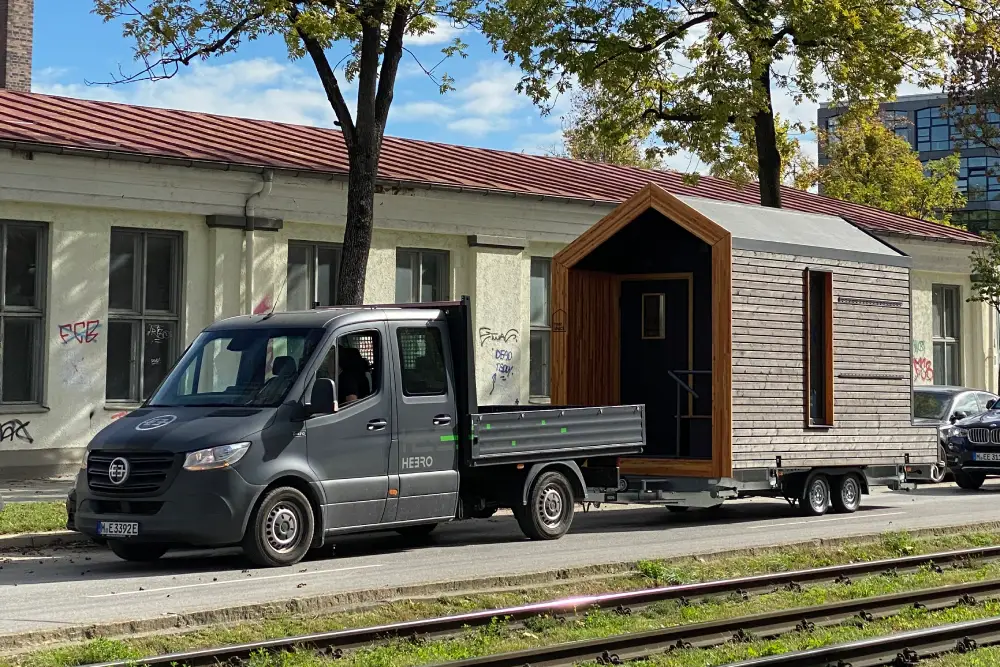
HEERO offers a direct solution to the dilemma of lacking towing capacity with its conversions. Our converted Mercedes-Benz Sprinters (Model 907) retain the full, manufacturer-homologated towing capacity of up to 3,500 kg. This performance is officially entered in the vehicle documents (field O.1) and ensures the unrestricted continued use of your special trailers.
The conversion process is designed for maximum efficiency and takes a maximum of 10 working days for a Sprinter 907 (only model series 907). In contrast to the long delivery times for new electric vehicles of often more than 12 months, our process enables timely electrification. The decisive advantage lies in preserving the value of your existing special bodies, such as tippers or refrigerated boxes. A converted electric Sprinter integrates seamlessly into your existing work processes. This way, the transition does not become an obstacle, but a calculable economic step.
TCO analysis: significantly reduce operating costs
The decision in favor of electrification is primarily an economic one. A study by Transport & Environment proves that the total cost of ownership (TCO) of e-vans in Germany is up to one-third lower than that of comparable diesel models. Operating costs per kilometer drop from typically 15 cents for a diesel to just 10 cents for an e-van.
These savings result from several factors, which we break down for you:
Energy costs: Electricity costs per 100 km are significantly lower than diesel costs, especially when using depot charging electricity.
Maintenance: The elimination of oil changes, exhaust systems, and other wear-prone parts of the combustion engine reduces maintenance costs by over 50%.
Taxes & Levies: Electric vehicles benefit from tax advantages and are exempt from CO2 levies.
Value stability: The continued use of a proven chassis protects against the loss in value of a completely new vehicle.
Through conversion, the TCO reduction becomes effective immediately, without the high acquisition costs of a new special-purpose vehicle. A look at the Anhängelast von Elektro-Nutzfahrzeugen shows that conversion is the only economically sensible option for heavy loads. The analysis of operating costs proves the long-term profitability of this approach.
Practicality in operation: Over 200 km range even with trailer towing
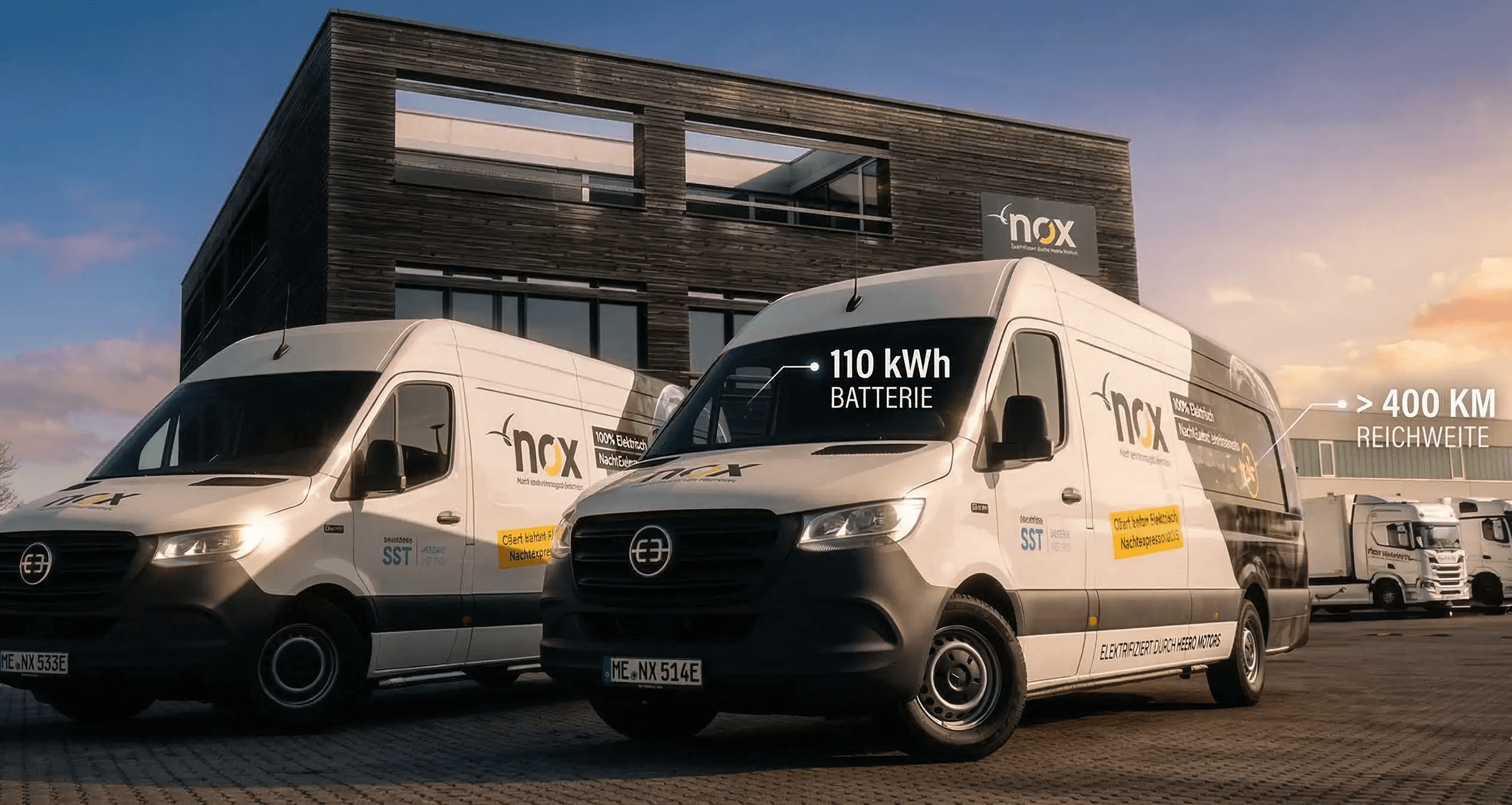
The greatest concern of fleet operators during electrification is range, especially under load. A HEERO Sprinter, equipped with a 110 kWh battery, achieves a WLTP range of up to 425 km. In real-world use with a 3.5-ton trailer, a practical range of over 200 kilometers is achieved.
This range fully covers the typical daily routes of municipal or craft businesses in over 90% of cases. At a 165 kW DC fast-charging station, the battery charges from 20% to 80% in about 60 minutes. A lunch break is therefore sufficient to make the vehicle ready for use for the rest of the day. The combination of sufficient real-world range and fast charging capability eliminates range anxiety as an operational obstacle. The WLTP range of commercial vehicles is a theoretical value; our practical tests provide the reliable data for your planning.
CVD Compliance: Meet statutory quotas quickly and reliably
The Clean Vehicles Directive (CVD), implemented through the German Clean Vehicles Procurement Act (SaubFahrzeugBeschG), puts pressure on public contracting authorities. By the end of 2025, 38.5% of newly procured light commercial vehicles had to be classified as "clean". For heavy trucks, the quota was 10%.
The conversion is the fastest way to meet these legal requirements without sacrificing the full functionality of your fleet. Instead of waiting for new models with a 3.5-tonne towing capacity, you can make your existing fleet compliant within a few weeks. Every converted Sprinter counts 100% towards meeting the CVD quota. This not only protects against potential sanctions, but also positions your company or municipality as a pioneer in the implementation of sustainable logistics solutions. The conversion is therefore a direct investment in the legal and operational future-proofing of your fleet.
FAQ
Can a Sprinter converted to electric really tow 3.5 tons?
Yes, absolutely. Our D2E conversion for the Mercedes-Benz Sprinter 907 retains the full braked towing capacity of 3,500 kg approved by the original manufacturer. This is officially recorded in the vehicle documents after the conversion, ensuring that the full capability for your operations is legally and technically secured.
How much does a 3.5-ton trailer reduce the range in practice?
A HEERO D2E-Sprinter achieves a WLTP range of up to 425 km. In real-world operation with a 3.5-tonne trailer, you can plan with a practical range of over 200 km. This value fully covers typical daily operations in trade or municipal services and is supported by our intelligent recuperation system.
Is the D2E conversion a legally recognized solution for CVD compliance?
Yes. A vehicle electrified through D2E (Diesel-to-Electric) conversion is considered a zero-emission vehicle under the Clean Vehicles Procurement Act (SaubFahrzeugBeschG). It therefore counts fully toward meeting the statutory procurement quotas of the Clean Vehicles Directive and is a recognized measure for decarbonizing your fleet.
What warranty is provided for the conversion and the battery?
HEERO offers a comprehensive warranty on the entire electric drivetrain as well as the high-voltage battery. The precise conditions are designed for the high demands of commercial use and protect your investment over the long term, typically over several years or a defined mileage, to provide you with full planning security.
Why should I convert a Sprinter instead of buying a new electric van?
The D2E conversion is the superior solution when a high towing capacity is required. It secures the 3.5-ton towing capacity that is unavailable in most new electric vans. Furthermore, you protect your investment in expensive customized bodies, avoid long delivery times of over 12 months, and benefit immediately from lower operating costs. It is the fastest and most economical solution.
How long is the vehicle's downtime for the Diesel-to-Electric (D2E) conversion?
Downtime is minimal and clearly plannable. For a Mercedes-Benz Sprinter model 907, the complete conversion in our factory takes a maximum of 10 working days (only model series 907). Compared to the months of waiting for a new vehicle, your van is ready for use again extremely quickly – only much cheaper and locally emission-free.
More useful links
The Federal Motor Transport Authority (KBA) provides detailed tables and statistics on vehicles, including commercial vehicles.
The Federal Environment Agency offers a comprehensive analysis of the environmental balance of various motor vehicles.
firmenauto.de presents a European TCO (Total Cost of Ownership) comparison for electric vehicles as part of the Car Cost Index.
The Federal Ministry of Transport (BMV) provides information on commercial vehicles with alternative drivetrains and their role in climate protection.
The German Association of the Automotive Industry (VDA) explains the strategic approaches for drivetrain technologies in commercial vehicles.
DEKRA sheds light on current developments and challenges of alternative drivetrains for commercial vehicles in an article.
The German Energy Agency (dena) publishes its Monitoring Report 2024, which offers insights into the energy transition.