Charge batteries with care: 7 tips for maximising the TCO of your electric fleet

Battery lifespan is a crucial TCO lever for any electric fleet. Poor charging habits can significantly reduce capacity and drive operating costs up.
The topic briefly and concisely
Keep the state of charge of your fleet vehicles consistently between 20% and 80% to significantly extend battery life.
Prioritise gentle AC charging at the depot overnight and use DC fast charging only selectively on long-distance journeys.
Avoid charging in extreme temperatures and use sheltered parking spaces to keep the battery within the optimal range of 15–25°C.
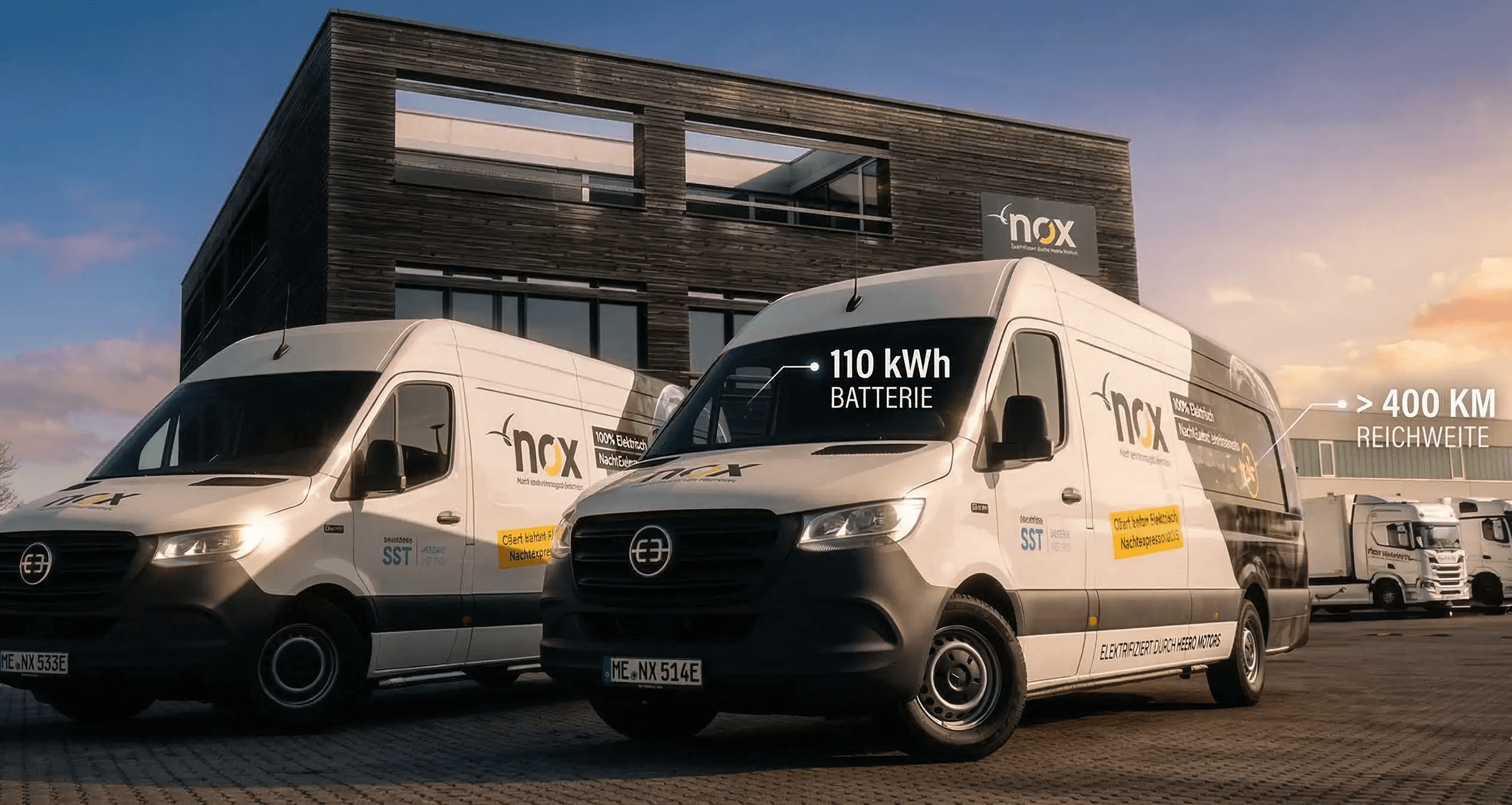
The transition to electromobility presents fleet managers with new challenges, particularly regarding the longevity of vehicle batteries. A degraded battery not only means reduced range, but also a significant loss in value and higher total cost of ownership (TCO). A strategic charging approach is therefore essential. With the right methods for gentle battery charging, you not only secure the performance of your fleet, but also more easily meet the requirements of the Clean Vehicles Directive (CVD). This guide shows you how to targetedly optimize the battery health of your commercial vehicles, such as the HEERO D2E (Diesel-to-Electric)-Sprinter with its 110 kWh battery.
The 20–80% range as the gold standard
The state of charge (SoC) is the most important factor for battery health. Permanent charging to 100% or deep discharge below 20% creates high stress for the battery cells. Studies show that keeping the state of charge in the window between 20% and 80% significantly slows down calendar and cyclic aging. For everyday fleet operations, this typically means a 10-15% longer battery life. Compliance with this corridor is the most effective single measure for preserving value. Intelligent charging planning that takes the State of Charge into account is therefore essential. Modern battery management systems (BMS) help to automatically comply with these charging limits and protect the investment. This approach ensures that the full range is only retrieved when it is required for a specific tour.
AC depot charging as the basis for a long battery life
For daily charging at the depot, AC charging is the gentlest method. Slower charging with lower power, such as the 22 kW AC charging for HEERO vehicles, generates significantly less heat and reduces stress on the cell chemistry. High-power DC fast charging, such as the 165 kW for our conversions, is designed for quick charging on the go to ensure operational readiness. However, frequent DC fast charging can negatively affect battery life. An optimized charging strategy for fleets therefore primarily utilizes overnight idle times for gentle AC charging. The following list shows the typical application:
AC charging (up to 22 kW): Daily overnight charging at the depot for 90% of all operations.
DC fast charging (from 50 kW): Targeted recharging on long-distance journeys or during unforeseen multiple operations.
Charging planning: Plan routes so that DC charging remains the exception in order to protect the State of Health.
Cost factor: Depot charging overnight is usually significantly cheaper than public DC charging.
This distinction between AC and DC charging is fundamental for TCO optimization.
Temperature management to prevent cell damage
The operating temperature has a direct impact on the efficiency and lifespan of lithium-ion batteries. According to TÜV NORD, the ideal temperature range is between 15 and 25 degrees Celsius. Both high heat in summer and extreme cold in winter put a strain on the battery. Charging at temperatures above 35°C or below 0°C can lead to irreversible capacity losses. A sheltered parking space can stabilize the battery temperature by up to 10°C. Fleet operators should therefore take the following measures:
Parking the vehicles in a hall or under a carport to protect them from direct sunlight and frost.
Charging the vehicle directly after driving, when the battery is still at operating temperature, especially in winter.
Using the vehicle's preconditioning to bring the battery to the optimal temperature before charging.
Avoiding rapid charging when the battery is very cold or overheated.
Active thermal management, as installed in HEERO vehicles, is crucial for longevity.
Optimising charging cycles for maximum durability
The lifespan of a battery is often measured in charging cycles. One cycle corresponds to a full discharge and recharge from 0 to 100%. High-performance lithium-ion batteries can withstand at least 1,000 of such full cycles. However, charging in smaller partial cycles, for example four times from 50% to 75%, is far gentler than a single full cycle. Two charging processes from 20% to 70% put less stress on the battery than a single charging process from 0% to 100%. For a fleet with an annual mileage of 40,000 km per vehicle, this means that with proper care, the battery can easily last 8 to 10 years. Intelligent planning of charging processes tailored to daily energy requirements, instead of generally charging to full as a rule, is the key to maximizing cycle stability and thus extending the service life of the vehicle.
Driving behaviour and recuperation as influencing factors
Not only charging, but also driving affects battery health. A predictive and smooth driving style protects the battery. Rapid acceleration and high sustained speeds require high discharge currents, which put a heavy strain on the battery cells. The use of recuperation, i.e. energy recovery during braking, also helps to protect the battery. Efficient recuperation can significantly increase the range while at the same time protecting the mechanical brakes. Driver training in handling electric commercial vehicles is a worthwhile investment. They lead to a reduction in energy consumption by an average of 10% and extend the service life of the battery. A defensive driving style is therefore a direct contribution to reducing the total cost of ownership of your fleet.
FAQ
Why is charging to only 80% better for the battery?
Charging to 100% creates high voltage and temperature in the battery cells, which accelerates chemical ageing. By limiting the charge to 80%, you significantly reduce this stress and can extend the battery’s cycle life by many hundreds of charging cycles, which directly lowers the TCO.
Is frequent DC fast charging really harmful to my fleet's batteries?
While modern battery management systems minimise the risks, the high current during DC charging inevitably leads to more heat and stress on the battery. For occasional use, it is harmless, but as a daily charging method it can accelerate degradation. As a rule, the basis should be gentle AC charging at the depot.
How does cold affect charging my electric fleet in winter?
At low temperatures, the electrochemical processes in the battery slow down. Charging a cold battery, especially at high power, can cause damage. It is therefore advisable to charge the vehicle immediately after a journey, while the battery is still warm, or to use preconditioning.
What charging power is ideal for overnight depot charging?
An AC charging capacity of 11 kW or 22 kW is ideal for overnight charging. This output is sufficient to bring the vehicles to the desired state of charge of 80% over several hours, gently and in full, without overloading the depot’s power grid or placing strain on the batteries.
Does HEERO offer solutions for monitoring battery health?
Yes, our vehicles are equipped with advanced battery management systems (BMS) that continuously monitor the condition of the battery. As part of our depot charging consultancy and fleet analysis, we also offer concepts for intelligent load and charging management that optimise the battery health of your entire fleet.
Won't I lose too much range in everyday use because of the 80% rule?
For most daily routes in urban delivery transport or municipal operations, 80% of the range is perfectly sufficient. A HEERO D2E Sprinter offers a typical range of over 300 km even at 80% charge. The full range of up to 425 km is only needed for planned long-distance journeys and can then be charged specifically when required.
More useful links
The ADAC addresses the topic of how to protect electric car batteries, especially during charging.
A publication by the Umweltbundesamt (Federal Environment Agency) provides information on the energy consumption of electric cars.
The Bundeswirtschaftsministerium (Federal Ministry for Economic Affairs and Climate Action) offers a dossier on the topic of electromobility.
NOW GmbH provides a guide to action for electromobility in fleets.
The Fraunhofer ISI presents market ramp-up scenarios for electric vehicles.
The dena (German Energy Agency) offers a dossier on the expansion of charging infrastructure for electric trucks.
The National Coordination Office for Commercial Vehicles addresses topics relating to commercial vehicles.
Agora Verkehrswende publishes a BCG study on the 15 million target for electric cars in China.
The BMV (Federal Ministry of Transport) presents the Masterplan Ladeinfrastruktur II (Master Plan Charging Infrastructure II).