SOH (State of Health): Lower TCO through maximum battery service life

The State of Health (SOH) of a battery is more than just a technical value; it is a crucial lever for optimising the TCO of your e-fleet. An SOH below 80% can already restrict a vehicle’s operational capability. Find out how you can actively manage the SOH and safeguard the residual values of your vehicles.
Topics on this page
The topic briefly and concisely
The State of Health (SOH) is the decisive KPI for residual value and TCO calculations for electric commercial vehicles.
An intelligent battery management system (BMS) and careful charging routines can extend battery service life by years.
In the HEERO eDrive system, fleets receive a battery that is perfectly matched to the vehicle and ensures a high SOH.
For fleet operators, battery lifespan is a key commercial factor. The State of Health (SOH) indicates how much of its original capacity a battery can still store and directly affects range, performance and resale value. A decline in SOH below 80% is often considered the end of first use. HEERO Motors therefore relies on proactive SOH management through perfectly coordinated hardware and software components and intelligent battery technology. This secures long-term durability and sustainably reduces the total cost of ownership (TCO) of your fleet.
SOH as a central KPI for fleet operations
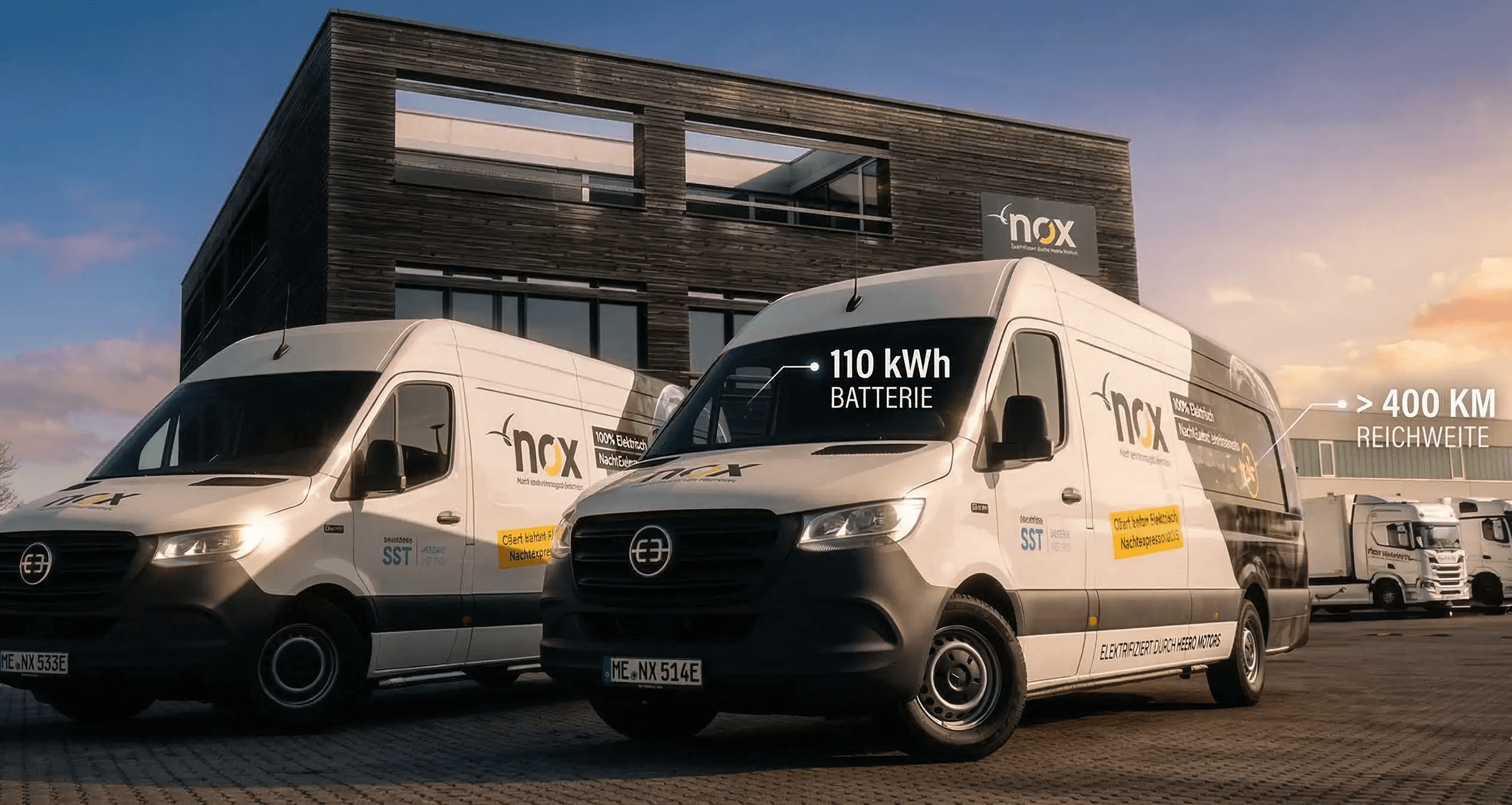
The State of Health (SOH) is the most important key figure for assessing battery condition in electric commercial vehicles. It describes the remaining usable capacity as a percentage compared with the as-new condition. A HEERO system with a 110-kWh battery and an SOH of 90% still has a capacity of 99 kWh, for example. This value is crucial for deployment planning, as it directly affects the maximum range. A high SOH value ensures the predictability of your routes and the vehicle's value over many years. Average degradation is only around 1.8% per year, enabling a long service life. Proactive management of the SOH is therefore not a technical gimmick, but a strategic tool for reducing TCO. It ensures that your vehicles meet the demanding quotas of the Clean Vehicles Directive (CVD) throughout their entire service life.
Operating factors for maximising battery service life
Several factors in day-to-day operation have a significant impact on the SOH of your vehicle batteries. Intelligent management of these aspects can extend service life by several years. Temperature plays an essential role; the optimal operating range is between 15 and 25 degrees Celsius. The battery management system (BMS) from HEERO ensures stable thermal conditions through liquid cooling. Charging behaviour is also crucial. Frequent DC fast charging can place a greater strain on the battery than regular AC charging at the depot. The following points are central to battery longevity:
Minimise charge cycles: Fewer full charge and discharge cycles protect cell chemistry.
Optimal state of charge (SOC): Maintaining a permanent State of Charge between 20 % and 80 % significantly reduces stress on the cells.
Adapted driving style: A predictive driving style without extreme acceleration reduces the load on the battery.
Intelligent thermal management: The in-house developed HEERO BMS actively protects the battery from overheating and undercooling.
By controlling these factors, you secure an SOH of over 80 % for more than 8 years. Conscious management of charging behaviour is the most effective lever for maintaining battery health.
The HEERO BMS as a guarantee of a high SOH
An advanced battery management system (BMS) is the brain of the powertrain and crucial for a stable SOH. The BMS from HEERO continuously monitors over 100 cell parameters such as voltage, current and temperature. It ensures safe operation and optimises the performance of each individual cell in the NMC-based battery. A key function is the so-called “Cell Balancing”, in which charge differences between the cells are actively equalised. This prevents overloading of individual cells and maximises the usable total capacity. The BMS can significantly extend the battery’s service life. In addition, it controls thermal management to keep the battery consistently within the optimum temperature range. Through this precise monitoring, degradation is minimised and the foundation is laid for long-term, reliable use in demanding fleet operations.
Practical measures for SOH optimisation in the fleet
Fleet managers can actively protect the State of Health of their vehicles and maximize TCO benefits through targeted processes. Implementing clear guidelines for drivers and depot staff is an essential step. Even small adjustments in daily operations show measurable effects after just a few months. Here are four directly implementable measures:
Establish depot charging as standard: Primarily use gentle AC charging overnight with 22 kW. This is sufficient for over 90% of all charging processes and protects the battery as much as possible.
Define a 20-80% charging corridor: Instruct your drivers to keep the vehicles within this optimal charging window during regular operations and only charge to 100% for long-distance trips.
Conduct driver training: An energy-efficient driving style not only reduces consumption, but also significantly reduces the strain on the battery.
Use vehicle pre-conditioning: Pre-heating or pre-cooling the vehicle during the charging process protects the battery in extreme outdoor temperatures.
The consistent implementation of these four points can significantly reduce degradation. These measures not only secure the vehicle value, but also ensure compliance with CVD requirements over the entire retention period.
FAQ
What does an SOH of 80% mean in practice?
An SOH of 80% means that the battery still has more than 80% of its original rated capacity. With a 110 kWh battery, that would be 88 kWh. This results in a correspondingly reduced range, but the vehicle remains fully functional for many operating profiles. Many manufacturers define this value as the threshold for the warranty.
How does HEERO measure the batteries' state of health?
The SOH is continuously calculated by the HEERO battery management system (BMS). It analyses a wide range of data points, such as charging and discharging behaviour, cell internal resistance and temperature profiles. This precise analysis enables a reliable assessment of the battery’s state of health and remaining performance capability.
Does DC fast charging usually harm the SOH?
Not necessarily, but excessive use can accelerate battery ageing. The higher currents and temperatures during DC charging place greater stress on the cell chemistry than slow AC charging. The HEERO BMS actively regulates the charging power to minimise stress. For everyday use, we recommend gentler depot charging with 22 kW AC.
What warranty does HEERO offer for the battery’s SOH?
HEERO offers comprehensive warranty cover for the battery and its components. This guarantees you a SOH of typically at least 70% over a period of 8 years or a specified mileage. The exact terms are vehicle-specific and are set out transparently in our quotations.
Can a battery’s SOH be improved again?
No, the ageing process of a lithium-ion battery is an irreversible chemical process. The SOH therefore cannot be restored or improved. However, an advanced BMS and careful handling can significantly slow degradation, so that the SOH remains at a high level for many years. In addition, with HEERO, it is possible to replace individual battery modules, which can be extremely beneficial for the total cost of ownership over a vehicle’s lifespan (TCO).
Why is a high SOH important for CVD compliance?
The Clean Vehicles Directive (CVD) requires compliance with emissions targets over the entire service life. A vehicle whose battery SOH drops sharply may no longer meet the guaranteed range and performance figures and may therefore no longer satisfy the efficiency requirements. A high SOH ensures the long-term compliance and operational readiness of your fleet.
More useful links
The Federal Ministry for Economic Affairs and Climate Action (BMWK) offers a dossier on electromobility in Germany, which contains information on funding programs, political frameworks, and technological developments.
Another dossier from the Federal Ministry for Economic Affairs and Climate Action (BMWK) highlights battery cell production in Germany and initiatives to strengthen the German battery industry.
The Fraunhofer ISE presents research results and services on the aging and lifetime prediction of battery systems.
A press release from Fraunhofer provides information on a real-time measurement method that extends and increases the lifetime and safety of batteries.
The Fraunhofer ISI presents its research priorities and projects in the field of battery research for industrial technologies.
The IÖW (Institute for Ecological Economy Research) offers a study on the efficiency and circular economy potential of batteries in electromobility.
The VDI/VDE Innovation + Technik GmbH presents information on battery cell production, which it supports on behalf of the BMWK.
The TIB (German National Library of Science and Technology) offers an entry in the RENATE portal for a scientific publication or research work in the field of battery technology.