Fast Charging vs. Standard Charging: The strategic TCO decision for your commercial vehicle fleet
Fast Charging vs. Standard Charging: The strategic TCO decision for your commercial vehicle fleet

The choice between AC standard charging and DC fast charging is crucial for the profitability of your EV fleet. It is about more than speed alone – it is about total cost of ownership, battery service life, and compliance with the Clean Vehicles Directive. Find the optimal strategy for your operation.
The topic briefly and concisely
AC standard charging is the TCO-optimal solution for planned overnight depot charging and helps preserve the battery in the long term.
DC rapid charging maximises vehicle availability in multi-shift operations or on long-distance journeys and is a strategic tool.
A hybrid strategy, supported by intelligent load management, offers the highest level of flexibility for most fleets.
For fleet managers, electrification is more than a technological shift. It is a strategic realignment of operations. The key question is not whether charging will happen, but how it will happen. The decision between AC standard charging at the depot and DC rapid charging on the road has a direct impact on your total cost of ownership (TCO), vehicle availability and service level agreements. An incorrect charging strategy leads to unnecessarily high investment and operating costs, or to limited operational readiness of your fleet. This guide analyses the facts and shows how you can make a data-driven decision that maximises your operational efficiency and reliably meets the statutory requirements of the Clean Vehicles Directive.
AC vs DC charging: the technological foundation for your fleet strategy
The terms AC and DC charging describe how electrical energy is transferred to the vehicle battery. The difference is fundamental to charging time and the infrastructure required. Every decision here has a direct impact on your operations and cost structure.
During AC charging (normal charging), alternating current flows from the grid to the charging station and from there into the vehicle. Only the vehicle’s on-board charger converts this into direct current, which the battery can store. This on-board charger is limited in output; in HEERO vehicles it is max. 22 kW. This process is ideal for longer parked periods, for example over 8 hours at the depot.
DC charging (rapid charging) works differently. Here, the conversion from alternating to direct current takes place in the charging station itself. Technically, this is far more complex and larger. The direct current is fed straight into the battery, bypassing the limiting on-board charger. HEEROs thus achieve a charging output of 165 kW.
The choice of technology therefore depends directly on the application:
AC standard charging: The cost-efficient basis for planned depot charging.
DC rapid charging: The strategic tool for maximum vehicle availability during short dwell times.
This technological decision has a direct impact on the most valuable component in your electric vehicle: the battery.
Battery Health (SoH): A Fact Check on the Myth of Fast Charging
The concern that frequent DC fast charging excessively reduces battery health (State of Health) is widespread. However, current analyses of over 12,500 vehicles paint a more nuanced picture. The difference in battery degradation between fleets that charge almost exclusively via DC and those that primarily charge via AC is minimal thanks to modern battery management systems (BMS).
An advanced BMS, as fitted in all HEERO vehicles, continuously monitors temperature, voltage and current. It actively protects the cells from overloading. The decisive factor for service life is not charging method alone, but the management of charging windows. Charging to a State of Charge (SoC) of 100% at maximum DC power should be avoided. Charging cycles from 10% to 80% are ideal.
AC charging at 22 kW is gentler in physical terms, as it generates less heat and places the battery cells under less stress. It remains the preferred method for daily overnight charging. The combination of both methods, tailored to the operating schedule, ensures maximum battery life and therefore the value retention of your vehicles. This balance is the key to optimised total cost of ownership.
TCO Analysis: How the charging method directly affects your total operating costs
The decision for a charging strategy is primarily an economic one. The total cost of ownership (TCO) is significantly determined by the investment and operating costs of the charging infrastructure. A precise analysis is essential for the profitability of your electric fleet.
The investment costs differ considerably. An AC wallbox with an output of 22 kW typically costs between €2,000 and €5,000 per charging point, including installation. A DC fast charger with 150 kW starts at €20,000 and, depending on the output and necessary grid expansion, can cost over €80,000. For 10 vehicles, you therefore require either an investment of approx. €35,000 for AC chargers or over €200,000 for a DC infrastructure.
Even more relevant are the ongoing operating costs. AC charging overnight enables the use of cheaper off-peak tariffs, which can be significantly lower than peak tariffs. DC fast charging often causes significantly higher grid utilization fees due to high power peaks. Although intelligent load management can shave these peaks, the energy costs per kilowatt hour tend to remain higher with DC charging.
To calculate your specific TCO, you should perform the following steps:
Demand analysis: Determine the daily energy demand per vehicle (km x kWh/100 km).
Idle time analysis: Define the available charging windows (e.g. 10 hours overnight).
Investment calculation: Compare the costs for the required number of AC vs. DC charging points.
Operating cost forecast: Calculate the annual electricity costs based on your electricity tariffs and the expected charging behavior.
This analysis shows how operational planning directly controls the financial performance of your fleet.
Operational Excellence: The optimal charging strategy for every use case
Depot charging (AC): The foundation for predictable routes
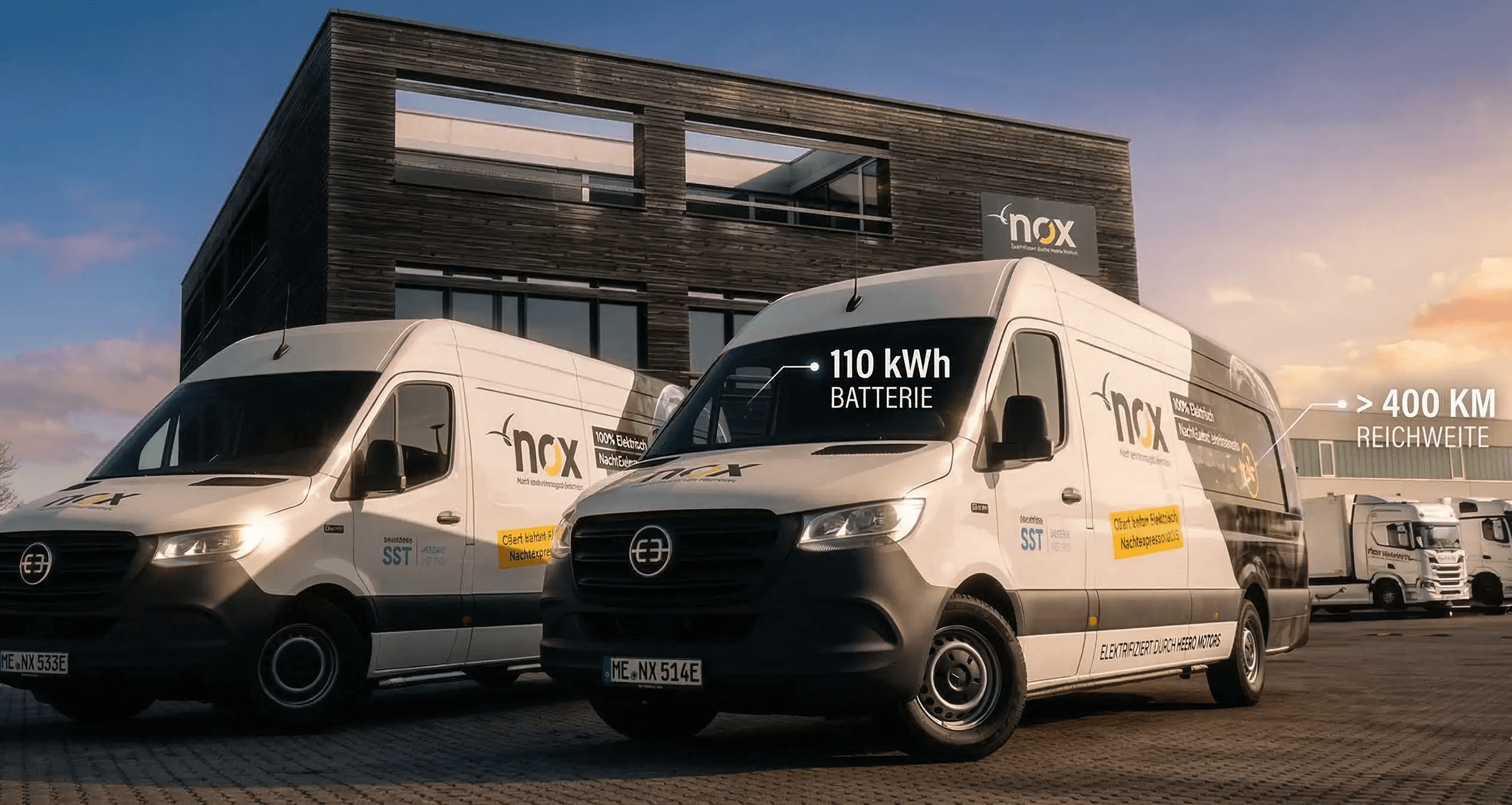
For 8 out of 10 commercial vehicles in passenger transport or distribution traffic, depot charging is the most economical and efficient method. Vehicles such as those used in urban delivery services or by municipal operators return to the depot every day. A charging time of 8-10 hours overnight at a 22 kW AC charge point is enough to fully charge the 110 kWh or 137 kWh battery of a HEERO. This predictable routine maximises battery preservation and minimises energy costs. Depot charging is the backbone of every TCO-optimised e-fleet. Well-planned overnight charging ensures full readiness for the next working day.
Opportunity Charging (DC): The key to maximum uptime
In multi-shift operations or on unforeseen routes, maximum availability is crucial. Here, DC fast charging is indispensable. It makes it possible to top up a vehicle significantly during the legally mandated 45-minute driver break or during a short charging stop at the logistics hub. Every HEERO based on the Mercedes-Benz Sprinter can be charged from 10 % to 80 % at a 165 kW charger in around 30-40 minutes. This flexibility secures operational readiness when time is a critical factor. Strategic fast charging of electric vehicles is therefore not a replacement for depot charging, but a necessary complement for demanding route and logistics processes. However, the right balance between the two methods requires intelligent management of the available power.
Securing grid stability: Why intelligent load management is indispensable
The simultaneous start of charging for 10 or more commercial vehicles can quickly overwhelm the electrical connection capacity of an operations building. This leads to costly peak loads, which can account for a large share of annual electricity costs. Intelligent load management is therefore not an option, but a necessity for the economical operation of an e-fleet.
A dynamic load management system continuously measures the site's total electricity consumption. It intelligently distributes the available power across the vehicles charging. If consumption in the building falls, the charging power for the vehicles is automatically increased. This ensures the grid connection is utilised to optimum effect and costly expansion can be avoided in more than 90% of cases.
The advantages of such a system are significant:
Avoidance of peak loads: Significantly reduces grid usage charges.
Optimum use of infrastructure: The existing grid connection is utilised to the full.
Prioritisation of vehicles: Vehicles needed earlier can be charged more quickly.
Integration of PV systems: Surplus solar power can be used specifically for charging.
HEERO offers comprehensive analysis and planning of load management systems with partner companies as part of depot charging consultancy. These systems optimise the conditions needed to meet statutory electrification requirements in a cost-efficient manner.
CVD Compliance: How your charging strategy ensures compliance with statutory quotas
The EU's Clean Vehicles Directive (CVD) sets clear targets for public procurement. By the end of 2025, 38.5% of newly procured light commercial vehicles and 45% of buses had to be classified as "clean". These quotas create significant pressure to act on municipalities and public enterprises. However, the conversion of the fleet must not only be sustainable, but also economical.
A well-thought-out charging strategy is the key to CVD compliance. In addition to purchasing new 100% electric HEEROs, converting existing Mercedes-Benz Sprinters (model 907) is a decisive lever here. This enables compliance with the quotas in just 10 working days per vehicle, without the higher capital costs for new vehicles and the loss of expensive special bodies and equipment. The combination of fleet electrification and a TCO-optimized AC charging strategy is the fastest route to legal compliance.
By focusing on cost-effective depot charging, the budget is preserved and the long-term economic viability of the fleet is secured. This turns the fulfillment of CVD requirements from a mere duty into an economically intelligent step. The right charging strategy is therefore not only an operational, but also a decisive regulatory success factor.
FAQ
Does frequent DC fast charging really damage the vehicle battery?
Modern battery management systems (BMS) significantly minimise the risk. What matters most for service life is above all managing battery temperature and avoiding repeated charging to 100% at maximum power. For day-to-day use, gentler AC charging remains the recommended method.
Which charging infrastructure is right for my depot?
This depends on your operating profiles. For more than 80% of fleets in distribution and passenger transport, a base of AC charging points for overnight charging is the most economical solution. This can be strategically complemented by individual, shared DC fast chargers for exceptional situations or multi-shift operations.
What is load management and why is it important for fleet operators?
Load management intelligently controls the charging power of multiple charging points to prevent overloading the electrical connection. It avoids costly peaks in electricity demand, which can dramatically increase your energy costs. In most cases, it makes an expensive expansion of the grid connection unnecessary.
How long does it take to charge a HEERO?
Charging time depends on the charging method. At a 165 kW DC fast-charging station, charging from 10% to 80% typically takes 30-40 minutes. At a 22 kW AC wallbox at the depot, the vehicle is fully charged overnight in 5-6 hours, which protects the battery and reduces electricity costs.
Can I fulfil the CVD quotas with a D2E conversion?
Yes, the D2E conversion (Diesel-to-Electric) is a fast and particularly cost-effective way to make your existing fleet CVD-compliant. As the base vehicle remains in place, you meet the legal requirements without having to invest in expensive new vehicles, while preserving the value of your specialist bodies.
What is the difference between charging power (kW) and battery capacity (kWh)?
Battery capacity, measured in kilowatt-hours (kWh), is the amount of energy a battery can store – comparable to the size of a fuel tank. Charging power, measured in kilowatts (kW), describes the speed at which the battery is charged – comparable to the flow rate at a fuel pump.
More useful links
National Co-ordination Centre provides information on lorry parking spaces and other commercial vehicle topics.
German Energy Agency (dena) provides a dossier on expanding charging infrastructure for electric lorries.
Federal Ministry for Digital and Transport (BMDV) publishes a press release on the 2025 Charging Infrastructure Conference.
P3 Group presents the P3 Charging Index 2024, a comprehensive analysis of charging infrastructure for electric vehicles.
VDE (Association for Electrical, Electronic and Information Technologies) offers a technical guide to charging infrastructure for e-mobility.
Federal Office for Logistics and Mobility (BALM) provides information on the Climate Protection and Sustainability in Transport funding programme (KSNI).
KfW presents four funding options for sustainable mobility.
Statista offers comprehensive statistics and data on e-mobility.
Federal Motor Transport Authority (KBA) publishes a report on e-mobility in Germany.