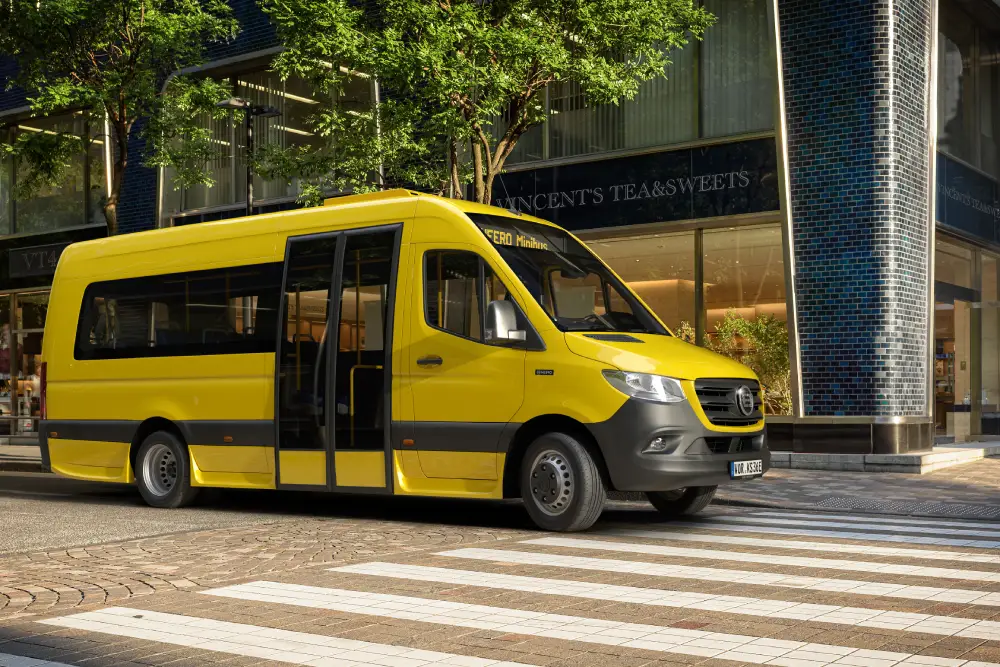
12-seater Electric MiniBus: optimise TCO and reliably meet CVD quotas

The Clean Vehicles Directive requires a quota for clean buses from 2025. For fleet managers, that creates pressure to act. HEERO offers a pragmatic solution: the 12-seater Electric MiniBus as a new electric vehicle and the D2E Diesel-to-Electric conversion for existing Sprinter vans help reduce costs and ensure compliance.
Topics on this page
The topic briefly and concisely
From 2025, the Clean Vehicles Directive requires a quota for clean buses; electric vehicles are essential for compliance.
A 12-seater Electric MiniBus reduces TCO thanks to significantly lower maintenance costs and much lower energy costs than diesel.
The Diesel-to-Electric (D2E) conversion for the MB Sprinter (907) preserves costly special equipment and enables electrification in just 10 working days (model series 907 only).
Fleet operators face a dual challenge from 2025: total cost of ownership (TCO) is rising, while the Clean Vehicles Directive (CVD) requires demanding quotas for zero-emission vehicles. A strategy focused solely on new vehicles is often uneconomical and results in the loss of valuable specialist equipment. HEERO addresses this problem with two strategic solutions: state-of-the-art new Electric MiniBus models based on the Sprinter platform and the D2E conversion (Diesel-to-Electric) for existing 907-series vehicles. This approach not only ensures compliance with the legal requirements, but also sustainably optimises your fleet's TCO and preserves the value of your vehicles.
Mastering CVD pressure: turning statutory quotas into an opportunity
The Clean Vehicles Directive (CVD) is no longer a distant vision, but has been applicable law in Germany since August 2021. For public contracting authorities and their service providers, binding minimum quotas apply to vehicle procurement. In the first reference period up to the end of 2025, 45% of all newly procured buses had to be "clean". Half of these, i.e., at least 22.5%, had to meet the stricter "emission-free" requirement, which in practice requires battery-electric drives. From 2026, these quotas will rise even further to 65% and 32.5% respectively.
These specifications create significant pressure on municipal and private fleets to modernize. A 12-seater bus as an electric model is a direct answer to this requirement. It enables operators to make passenger transport on a smaller scale emission-free and thus achieve the demanding quotas. The transition is therefore not only an ecological necessity, but a strategic decision to secure the future viability of the operation. With the right partner, compliance with the CVD requirements becomes plannable and efficient, as our electric Sprinter proves. The legal framework conditions clearly define the need for action.
TCO analysis: significantly reduce operating costs
The purchase costs are only part of the equation; the real savings of an electric bus are reflected in the total cost of ownership (TCO). While a diesel bus incurs ongoing expenses for fuel, oil changes and complex exhaust systems, the operating costs of an electric bus are significantly lower. The electricity costs per 100 kilometres are typically well below diesel expenditure. The advantage is even more pronounced in maintenance: an electric motor has significantly fewer moving parts than an internal combustion engine.
That leads to tangible savings. The following items are eliminated or greatly reduced:
Regular oil and filter changes
Maintenance of the exhaust system (e.g. AdBlue)
Clutch and gearbox wear
Reduced brake wear through regenerative braking
Studies show that maintenance costs for electric commercial vehicles can be up to 30-40 % lower than for comparable diesel models. This reduction in ongoing costs means that the higher initial investment more than pays for itself over a typical holding period of eight years. The analysis of WLTP range for commercial vehicles also shows that the efficiency of modern electric drivetrains, such as the HEERO eDrive system, is already sufficient for most operational scenarios today. This makes the transition not only ecologically sound, but above all economically sensible.
Preserve value: D2E conversion as a strategic alternative
For years, many fleet operators have invested in costly bespoke conversions for their Mercedes-Benz Sprinter. A new purchase would mean the total loss of these investments. This is exactly where the HEERO D2E conversion (Diesel-to-Electric) comes in. Instead of retiring a proven vehicle, we replace the diesel drivetrain with our high-performance electric drive. This process is specially optimised for the MB Sprinter (model 907) and takes a maximum of 10 working days.
The decisive advantage: the vehicle body remains fully intact. Whether it is a bus for school transport, a vehicle with low-floor access, or other custom designs - the functionality remains 100% intact. This not only protects your budget, but also significantly accelerates the electrification of the fleet. Instead of waiting for long lead times for new special-purpose vehicles, your converted 12-seater electric bus will be back in service promptly. The conversion is a key component of the circular economy and the most cost-effective solution for specialised fleets. This option also makes the transition attractive for vehicles with special requirements, such as a high towing capacity.
Ensuring practical suitability: range and charging concepts
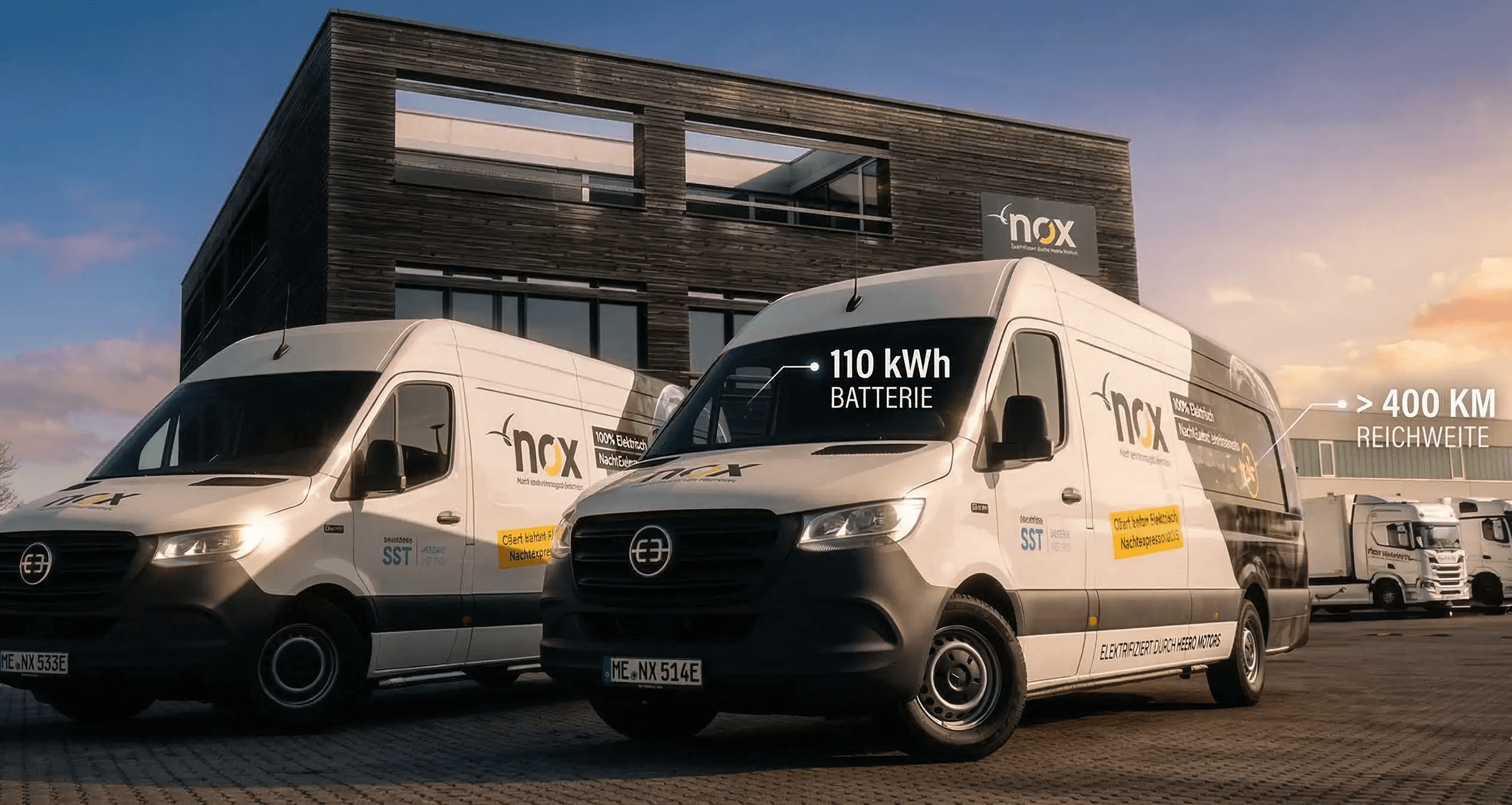
Concerns about insufficient range are one of the biggest hurdles in fleet electrification. The HEERO eDrive system and our new e-buses address this problem with a high-performance 110 kWh battery that enables a realistic range of up to 280 km (WLTP). For the typical daily use of a 12-seater bus in shuttle or regional transport, this is more than sufficient. In particular, our new vehicles with medium low-floor entry, based on the new 137 kWh battery with 600V technology, achieve an even further improved range of over 300 km.
A well-conceived charging concept is crucial for operational reliability. Our vehicles therefore support two central charging scenarios:
DC fast charging (165 kW): At public charging stations, the battery can be charged to 80% in just 30-40 minutes.
AC depot charging (22 kW): Overnight, the bus can be fully and cost-effectively charged at the depot to start every morning with 100% capacity.
This flexibility ensures that the vehicles can be optimally integrated into existing operational processes without compromising availability. A thorough analysis and a practical test, which you can arrange via our test drive request, provide final peace of mind. In this way, electromobility becomes a reliable reality in your fleet.
FAQ
What range does a 12-seater electric bus from HEERO achieve in practice?
Our MB Sprinter-based Electric MiniBus and D2E (Diesel-to-Electric) conversions already achieve a WLTP range of up to 300 km with the 110 kWh battery. In real-world operation, depending on factors such as payload, topography and temperature, you can plan on practical ranges of over 300 km, which is sufficient for most daily duty cycles in shuttle and regional transport.
How long does the D2E conversion of an existing Sprinter bus take?
The D2E conversion (Diesel-to-Electric) of a Mercedes-Benz Sprinter model 907 is a standardised process that usually takes no more than 10 working days (model series 907 only). During this time, the complete combustion powertrain is removed and replaced with our electric drive system, while your specific vehicle body is fully retained.
What warranty is provided for the conversion and the battery?
HEERO provides comprehensive warranty coverage for all components installed in the HEERO eDrive system, including the electric motor, power electronics and high-voltage battery. The precise terms and warranty periods form part of our tailored quotation and are aligned with vehicle manufacturers’ standards to safeguard your investment as effectively as possible.
Does the conversion affect the bus’s payload or driving characteristics?
The weight of the eDrive powertrain and battery is designed so that the original payload of the base vehicle is largely retained. Driving characteristics typically improve thanks to the lower centre of gravity and the electric motor’s immediately available torque, resulting in smoother and more dynamic acceleration.
What charging infrastructure is required to operate a 12-seater electric bus?
For efficient operation, we recommend installing a 22 kW AC wallbox at the depot (Depot Charging). This enables the vehicle to be fully charged overnight. For maximum flexibility, our vehicles also support DC fast charging of up to 165 kW at public charging stations, allowing charging to 80% in approx. 30-40 minutes.
Is a D2E conversion more economical than buying a new electric bus?
In many cases, yes - especially if you already have a Sprinter with expensive special bodywork and suffer a conventional engine failure. The D2E conversion is more cost-effective than a comparable new e-bus and avoids the depreciation of the existing body. Thanks to significantly lower operating and maintenance costs, the investment also pays for itself quickly.
More useful links
The International Council on Clean Transportation (ICCT) offers a factsheet on the total cost of ownership (TCO) of battery-electric buses (BETs) in Europe.
NOW GmbH provides a study overview on the total cost of ownership (TCO) of climate-friendly commercial vehicles.
Bundesministerium für Digitales und Verkehr (BMDV) provides information on the Clean Vehicles Directive.
Bundesamt für Logistik und Mobilität (BALM) offers information on the Climate Protection and Mobility (KSNI) funding program.
Umweltbundesamt (UBA) presents an analysis of the environmental balance of motor vehicles.
Kraftfahrt-Bundesamt (KBA) provides statistics on electromobility in Germany.
Verband der Automobilindustrie (VDA) publishes monthly figures on the automotive industry.
Fraunhofer ISI offers information on the topic of electromobility and energy systems.