165 kW fast charging for electric buses: lower TCO and secure CVD quota

The Clean Vehicles Directive requires you to meet your quota for clean buses. 165 kW rapid charging for the electric bus is not an option, but a strategic necessity to ensure operational readiness and reduce operating costs. HEERO shows how the switch can be achieved.
The topic briefly and concisely
65% of newly procured buses must be zero-emission? Immediate action is required.
165 kW DC fast charging enables charging to 80% in 30–40 minutes, maximising vehicle availability.
Electric buses can significantly reduce the total cost of ownership (TCO) compared with diesel buses.
Municipal and private fleet operators face a double challenge: the legal obligation to electrify and the pressure to optimize TCO. The Clean Vehicles Directive (CVD) mandated a procurement quota of 22.5% for zero-emission buses by 2025 - today, it is even higher. At the same time, vehicles must ensure maximum availability with minimal operating costs. A charging capacity of 165 kW for the electric bus is a decisive factor here. It drastically reduces downtime and integrates optimally into the operational workflow. High-power charging thus becomes the foundation for an economical and low-emission fleet strategy.
CVD Pressure by 2025: Statutory Quotas as a Driving Force
The pressure to transition bus fleets remains high. The EU's Clean Vehicles Directive sets clear deadlines for transport companies. By December 31, 2025, 45% of all newly procured buses had to be "clean." Half of this, meaning 22.5%, had to be completely emission-free. This requirement affects every public tender and significantly increases the pressure on municipalities. From 2026, these quotas will rise further to 65% and 32.5% respectively. Failure to meet these targets can lead to severe consequences. Fast and efficient electrification is therefore essential. Choosing the right vehicle and charging technology is becoming the decisive success factor. The transition not only ensures legal compliance but also positions companies for the future. The right charging strategy is the key to operational efficiency.
165 kW DC charging: maximum availability in 40 minutes
High vehicle availability is the core objective of every fleet management operation. The HEERO mid-low-floor bus achieves a decisive advantage with its 165 kW DC fast-charging capability. The 137 kWh battery can typically be charged to 80 % State of Charge (SoC) in 30 to 40 minutes. This charging performance far exceeds many market-standard benchmarks. For day-to-day operations, this means a drastically reduced downtime. A bus is therefore ready for several hours of service again after a short break. This rapid energy supply enables duty scheduling with almost no restrictions. The technical basis for this is the established CCS charging standard (Combined Charging System). The following advantages result directly from the high charging performance:
Reduction of depot dwell times by over 50 % compared with 80 kW systems.
Enabling multi-shift operation with only short charging breaks.
Greater flexibility in route planning and for unforeseen deployments.
Reduction in the number of vehicles required to cover the same timetable.
These technical specifications are the basis for superior economic efficiency in daily operation.
TCO analysis: significantly reduce operating costs
The acquisition costs are only part of the total cost of ownership (TCO). Over a life cycle of 10 years, electric buses can more than compensate for their higher acquisition costs. Studies show that the TCO of an electric bus can be significantly lower than those of a comparable diesel bus. Energy costs per kilometer are typically over 60% lower for electricity than for diesel. Another crucial point is maintenance costs. Electric buses save 30-40% of costs here, as oil changes and exhaust system maintenance are eliminated. Regenerative braking also significantly protects the braking system. Fast charging with 165 kW further optimizes TCO by maximizing vehicle utilization. Fewer vehicles are needed to deliver the same performance, which reduces fixed costs per vehicle. A well-thought-out depot charging strategy is the prerequisite for this.
Intelligent depot integration: load management as the key
The integration of 165 kW charging points requires professional planning of the depot infrastructure. Intelligent load management is crucial to avoid expensive peak loads. It optimally distributes the available grid connection power among the charging vehicles. HEERO offers comprehensive depot charging advice for this purpose. Analyzing the grid connection is the first step. Based on this, a scalable charging concept is developed. This often combines powerful 165 kW DC charging for short breaks with 22 kW AC charging for the night. Such a hybrid charging infrastructure in the depot offers maximum flexibility. The most important steps for successful integration are:
Analysis of the existing electrical infrastructure and the grid connection point.
Definition of the operational requirements and the necessary charging times.
Planning the optimal arrangement of AC and DC charging stations.
Implementation of a central charging and load management system.
Scalability planning for future fleet growth.
This ensures that the charging infrastructure grows along with the requirements of the fleet.
The HEERO solution: More than just an electric bus
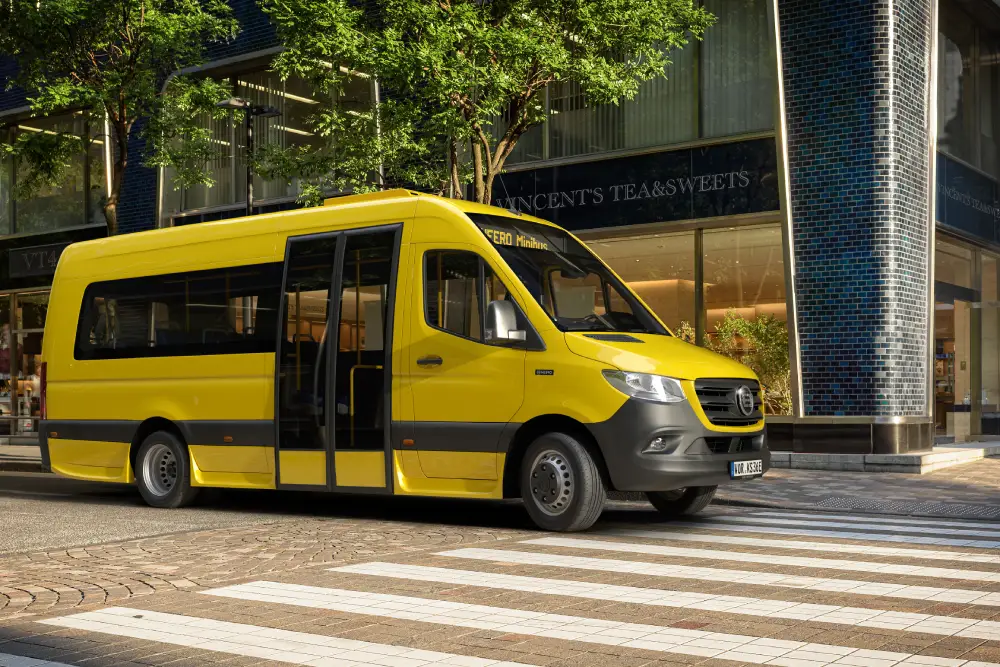
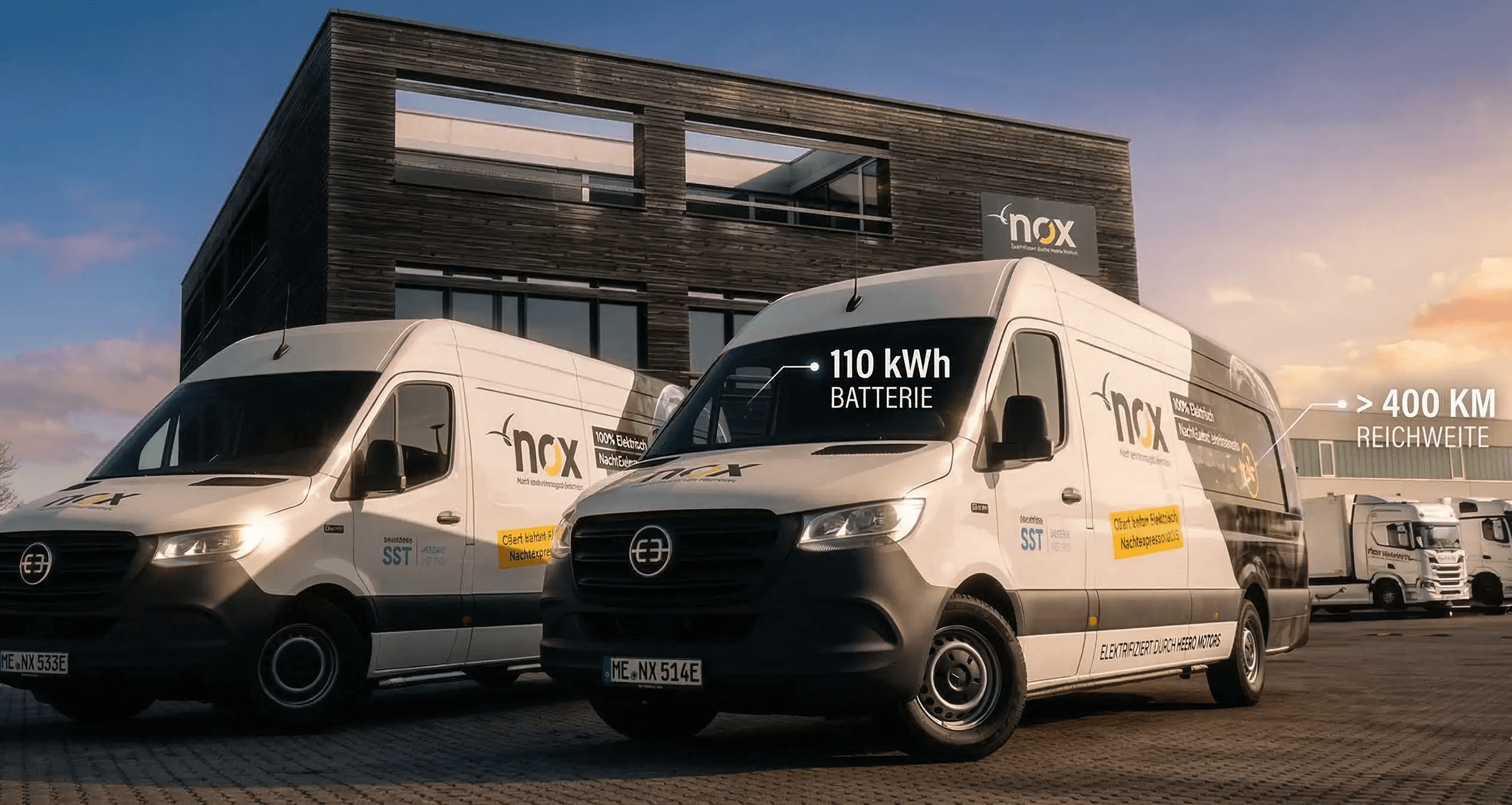
HEERO offers a pragmatic end-to-end solution for fleet electrification. The HEERO Mid-Door Low-Entry Midibus was developed specifically for the requirements of public transport. With a range of over 300 km and a 165 kW fast-charging option, it delivers the necessary performance. Its battery with 137 kWh capacity is designed for long operating days. In addition to new vehicles, D2E conversion (Diesel-to-Electric) is a core competence. Existing MB Sprinter vehicles are converted into high-performance e-buses in a maximum of 10 working days (model series 907 only). This secures the value of expensive special-purpose installations and accelerates CVD compliance. The mobile service of the "Flying HEEROs" also ensures high fleet availability. HEERO sees itself as a partner that covers the entire value chain from analysis through the vehicle to service. This makes the transition to e-mobility for fleet operators predictable and economically successful.
FAQ
How does 165 kW fast charging affect battery lifespan?
Modern battery management systems (BMS) precisely control the charging process to protect cell health. The HEERO low-entry midibus uses robust battery technology designed for high charging performance. The BMS optimises the charging curve and temperature, so that calendar ageing and cycle durability remain within the intended range. An intelligent depot charging strategy that combines DC fast charging with gentle AC charging can further extend service life.
Is a new grid connection generally required for 165 kW DC charging?
Not necessarily. A detailed site assessment by our experts will determine the available capacity of your grid connection. In many cases, intelligent load management can use the available power efficiently without costly grid expansion. The system prevents peak loads by dynamically distributing charging power to the vehicles with the highest priority. Only very large fleets or a low connection capacity make an upgrade necessary.
What range does the HEERO Mid-Door Low-Entry Midibus have after a rapid charge?
The HEERO Mid-door Low-Entry bus has a total range of over 300 km. A rapid charge to 80% of the 137 kWh battery capacity thus restores a typical range of over 240 km. This is more than sufficient for most urban and regional routes and enables flexible operation even on longer routes without intermediate charging.
What is the difference between the HEERO eBus and a D2E conversion?
The HEERO eBus, like the Mid-Door Low-Entry, is a brand-new vehicle designed from the ground up as an electric vehicle for passenger transport. By contrast, the D2E conversion is a service in which we convert existing diesel vehicles of the Mercedes-Benz Sprinter 907 type to a fully electric drive. This is ideal for fleets that want to retain their specialised and often expensive vehicle bodywork while also meeting CVD requirements.
Does HEERO also offer support with planning the charging infrastructure?
Yes, consulting and planning for depot charging infrastructure are a central part of our offering. Our experts analyse your site, your operating processes and your energy requirements. Based on this, we develop a tailored concept that includes AC and DC charging solutions as well as intelligent load management. We support you from the initial analysis through to the commissioning of the finished charging infrastructure.
What warranty is provided for the converted vehicles and batteries?
HEERO offers comprehensive warranty cover on all components of the electric powertrain we install, including the battery. The exact terms and conditions are specific to the vehicle and application, but are based on the standards of the commercial vehicle industry. Our aim is to provide you with a reliable and economically viable long-term solution for your fleet. Our service team, the "Flying HEEROs", is also available to support you at any time.
More useful links
Kraftfahrt-Bundesamt (KBA) offers statistics on new vehicle registrations, including electric vehicles.
Verband Deutscher Verkehrsunternehmen (VDV) addresses the topic of e-mobility in public transport.
Fraunhofer-Institut für System- und Innovationsforschung ISI provides research topics in the field of electromobility.
PwC provides a monitoring study on the funding of electric buses in public transport.
Bundesnetzagentur addresses the topic of e-mobility in the context of electricity and gas.
Umweltbundesamt provides information on climate protection in transport, including electromobility.
Verband der Automobilindustrie (VDA) offers a position paper on the master plan for charging infrastructure.
Zentralverband Elektrotechnik- und Elektronikindustrie (ZVEI) provides a technical guide to charging infrastructure for electromobility.