Overnight depot charging: significantly reduce TCO and maximise fleet availability

Are rising operating costs and the requirements of the Clean Vehicles Directive putting your fleet under pressure? Depot charging overnight is a strategic response: it can reduce energy costs by more than 25%, while maximising the availability of your vehicles and making optimal use of your existing infrastructure.
The topic briefly and concisely
Depot charging overnight significantly reduces the TCO of e-fleets by taking advantage of night-time electricity tariffs and lower maintenance costs.
It typically ensures 100% vehicle readiness at the start of the shift and eliminates unproductive charging time during the day.
Intelligent load management is crucial for operating charging infrastructure cost-effectively without expensive grid expansion.
For fleet managers in municipalities, bus companies and logistics companies, electrification is no longer an option, but a commercial and regulatory necessity. The challenge lies in integrating charging processes into day-to-day operations without compromising efficiency. Overnight depot charging is establishing itself as the superior method here. It makes use of the predictable downtime of vans to reduce energy costs through off-peak tariffs and to ensure full operational readiness for the next working day. This strategy is the key to fully unlocking the TCO advantages of e-mobility while also meeting the strict quotas of the Clean Vehicles Directive.
TCO Reduction: The cost-effectiveness of planned overnight charging
The switch to electric commercial vehicles pays off primarily through the total cost of ownership (TCO). An analysis by Transport & Environment shows that light electric commercial vehicles are already significantly cheaper on a TCO basis than comparable diesel models today. The key lever is depot charging overnight. Here, fleet operators can benefit from cheaper night-time electricity tariffs, which significantly reduce energy costs per kilometre. Savings of one third in operating costs are realistic.
In addition, costly items such as oil changes, exhaust system maintenance and AdBlue are eliminated. Buying electric buses new or converting them - both make sense. A HEERO Diesel-to-Electric (D2E) conversion even strengthens this effect: it preserves the value of your expensive specialist equipment and reduces the upfront investment compared with buying new. The payback period for a conversion is often within 4 years, solely through the lower operating costs. The combination of efficient fleet electrification and an optimised charging strategy is the most direct route to reducing costs. These predictable, lower costs provide a solid basis for long-term budgeting.
Maximum operational reliability through 100% readiness for service every morning
For operations in public transport, last-mile logistics or municipal services, reliability is essential. Overnight depot charging ensures that every vehicle starts the working day with a full battery and maximum range. Depending on the body configuration, a HEERO achieves a range of between 280 and over 300 km - more than enough for typical daily routes of 150 to 250 km or most public transport minibus runs. This buffer provides operational certainty, even for unforeseen deployments.
Integration into the operational process is seamless, as charging takes place during otherwise unproductive idle time. There is no need to schedule time-consuming stops at public rapid chargers, which increases driver productivity by up to 45 minutes per day. Full control over the fleet's state of charge directly at the depot is a strategic advantage. This predictability eliminates range anxiety and makes the electric fleet just as reliable as a diesel fleet. The right AC charging technology at the depot is the key to success.
Intelligent charging infrastructure: The foundation for efficient depot charging
The basis for overnight depot charging is a well-thought-out charging infrastructure. In most cases, charging with alternating current (AC) via a 22 kW wallbox is the most economical and technically sensible solution. A vehicle such as the HEERO low-floor minibus with a 137 kWh battery can be fully charged in around 6 hours - a time window that is easily available overnight. Intelligent load management is crucial for cost efficiency. This system dynamically distributes the available grid connection capacity across all charging vehicles.
Intelligent load management prevents costly load peaks, which can permanently increase grid charges. In many cases, this can avoid an expensive expansion of the grid connection. The following components are central:
AC wallboxes: Robust, legally compliant charging points with 22 kW output.
Dynamic load management: Controls charging power in real time based on the building's total consumption.
Backend system: For monitoring, controlling and billing all charging processes.
Energy management system: Optionally integrates a PV system for using self-generated electricity.
In addition, the Building Electromobility Infrastructure Act (GEIG) requires owners of non-residential buildings with more than 20 parking spaces to install at least one charging point from 2025. Strategic planning of the charging infrastructure is therefore also required by law.
Optimised battery lifespan through gentle AC charging
Battery lifespan is a key factor in the TCO of an electric vehicle. Frequent rapid charging at high direct current (DC) power can place greater thermal and chemical stress on the battery cells than slower AC charging. Depot charging overnight at 22 kW AC power is the gentlest method for preparing the battery for daily use. The lower heat generation protects the cell chemistry and can slow the battery's calendar ageing.
Modern battery management systems (BMS), as fitted in HEERO vehicles, do protect against overcharging, but the charging routine still has an impact. Experts recommend keeping the state of charge (SoC) in normal operation between 20 % and 80 % to maximise service life. Intelligent charging systems can be configured so that they initially charge the vehicles overnight only to 80 %, with the remaining 20 % supplied in the early morning hours shortly before operations begin. This approach minimises the time the battery spends at a high state of charge. With the right tips for battery-friendly charging, you can safeguard your investment in the long term.
CVD compliance: reliably meet legal requirements with depot charging
The EU's Clean Vehicles Directive (CVD) is creating considerable pressure to act for public contracting authorities and their service providers. Germany's Clean Vehicles Procurement Act (SaubFahrzeugBeschG) sets binding minimum quotas for the procurement of low-emission vehicles. By the end of 2025, 38.5% of newly procured light commercial vehicles had to meet the CVD criteria. For buses, the quota was even 45%.
New purchases can often be the preferred route for bus operators. However, the D2E conversion of existing Sprinter fleets (model 907) is the fastest and most capital-efficient way to meet these quotas. Instead of replacing proven vehicles with expensive custom conversions (e.g. passenger equipment for minibuses, crane bodies on chassis, tipping bodies on flatbeds,…) they are electrified within just 10 working days (907 series only). This enables municipalities and companies to meet the statutory requirements promptly, without disrupting operational activity or tying up capital in completely new bodies. Overnight depot charging is the logical complement, enabling these converted fleets to be operated economically and reliably. In this way, compliance with the CVD becomes a commercial advantage.
FAQ
What happens if the grid connection at the depot is not sufficient for all vehicles?
This is exactly where intelligent load management comes in. A dynamic system continuously measures the site’s total electricity consumption and distributes the available power optimally across the vehicles being charged. This ensures the grid connection is never overloaded. In many cases, this can avoid the need for costly grid expansion.
How long does it take to charge a HEERO eDrive system overnight?
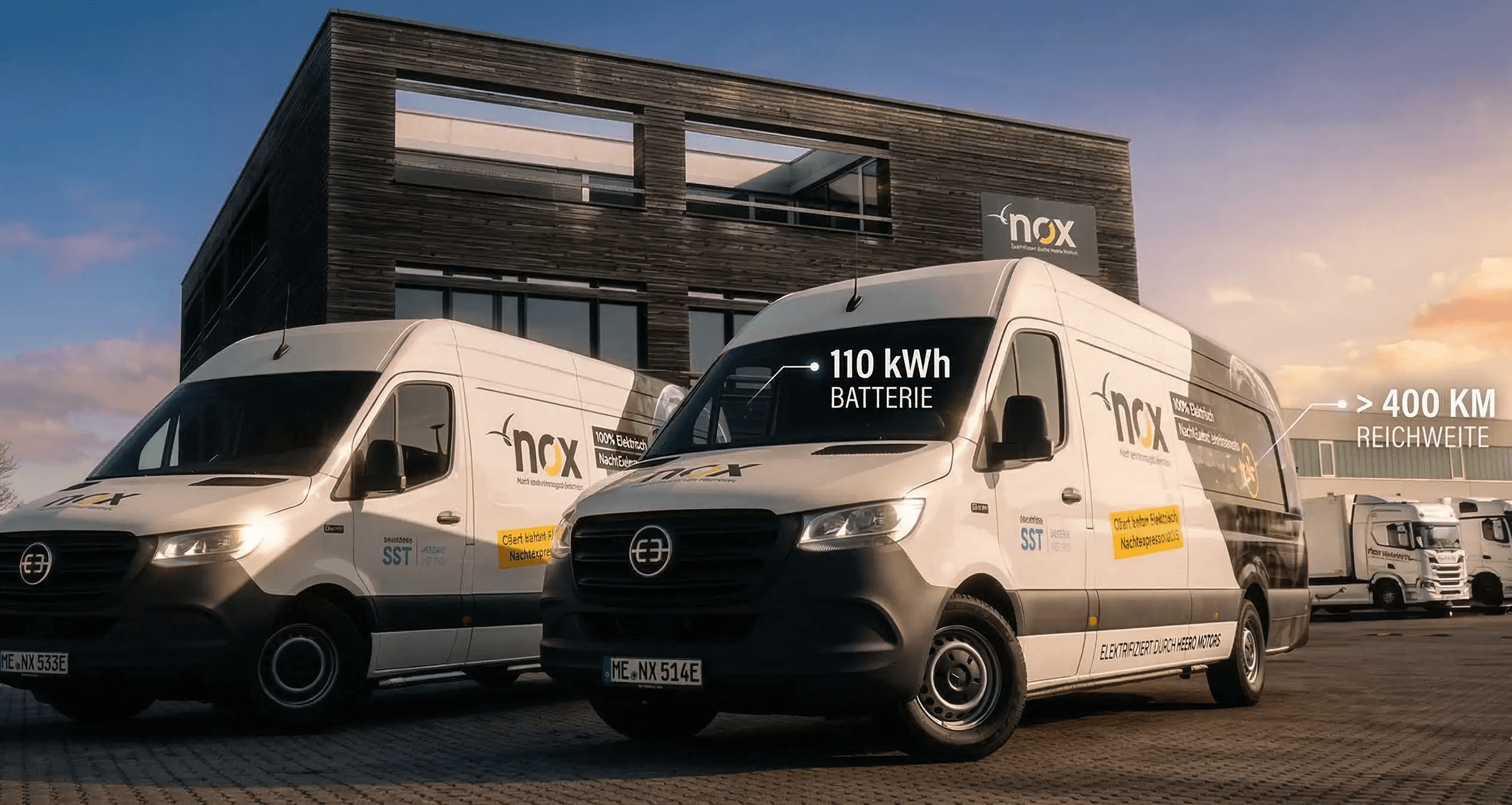
The 110 or 137 kWh battery of a HEERO eDrive system requires around 5-6 hours for a full charge (0-100%) at a typical 22 kW AC wallbox in the depot. Since the vehicles rarely arrive completely empty and are parked for 8 hours or longer, this is more than sufficient to guarantee full readiness for use every morning.
Is unattended overnight charging safe?
Yes, absolutely. Professionally installed charging infrastructure from manufacturers such as HEERO includes numerous safety mechanisms. These include residual current circuit breakers, overheat protection and automatic communication between the vehicle and the charging station. Charging automatically stops when the battery is full or in the event of a fault.
Does constantly charging the battery to 100% damage it?
Slow overnight AC charging is significantly gentler on the battery than frequent DC rapid charging. Modern battery management systems prevent harmful overcharging. For maximum service life, it is recommended to charge to around 80–90% in everyday use. Intelligent charging systems can manage this automatically and only charge to 100% shortly before departure.
Is the range after an overnight charge sufficient for unplanned, longer tours?
Yes, generally speaking. Sprinter vans with the HEERO eDrive system offer a practical range of up to 425 km (eTransporter). As most daily routes in urban and regional distribution traffic are between 150 and 200 km, this leaves a considerable buffer of over 200 km for unforeseen journeys. For occasional long-distance trips, a DC rapid charger can be used if required. Depending on the body configuration, the WLTP range is reduced, but thanks to HEERO technology it almost always remains the benchmark in its industry-standard application.
Who supports HEERO with planning the charging infrastructure?
HEERO offers comprehensive depot charging consultancy in combination with our cooperation partners. Our experts analyse your site, the existing grid infrastructure and your vehicle deployment schedule. Based on this, we develop a tailor-made concept for charging hardware and intelligent load management that optimises the TCO of your fleet and ensures maximum operational reliability.
More useful links
Company Car compares the total cost of ownership (TCO) of electric cars in Europe using the Car Cost Index.
The National Charging Infrastructure Coordination Centre offers information and initiatives on commercial vehicles.
The Federal Ministry for Transport and Digital Infrastructure (BMVI) provides the Charging Infrastructure Master Plan.
Fraunhofer ISI conducts research on e-mobility and energy systems.
The German Association of the Automotive Industry (VDA) presents its drive strategy for commercial vehicles.
The German Energy Agency (dena) offers a dossier on expanding charging infrastructure for electric lorries.
The Federal Ministry for Transport and Digital Infrastructure (BMVI) provides information on e-mobility in Germany.
The KfW Development Bank offers funding programmes for charging infrastructure.
Ayvens offers insights into CO2 benchmarking for fleets in the context of the environment and e-mobility.