Charging electric buses: reduce TCO and meet CVD quotas with the right charging strategy

The Clean Vehicles Directive requires a quota for clean buses from 2025. The key to a profitable transition lies not only in the vehicle, but in a charging infrastructure that reduces operating costs and maximises the availability of your fleet with planned range per charge.
The topic briefly and concisely
The CVD stipulates a quota for clean buses from 2025, which requires rapid and cost-effective electrification.
Full depot charging with 22 kW AC is the most cost-efficient method and, with a range of over 300 km, covers 90% of all urban routes.
Intelligent load management is crucial for avoiding costly power spikes and can reduce annual energy costs by several thousand euros.
Electrifying bus fleets is no longer an option, but a legal necessity. The Clean Vehicles Directive (CVD) stipulates a quota from 2025 under which all newly procured buses must be low-emission, with half of them even being completely zero-emission. This requirement presents fleet managers with significant challenges: ensuring the operational readiness of electric vehicles and controlling the total cost of ownership (TCO). A well-considered charging strategy for electric buses is the decisive lever for achieving both objectives and laying the groundwork for cost-effective operations.
CVD requirements by 2025 require immediate action
The pressure to act regarding the transition is increasing. The Clean Vehicles Procurement Act, the German implementation of the CVD, has been in force since August 2021 and defines clear milestones. For the first reference period up to December 31, 2025, 45% of newly procured buses had to be classified as "clean". At least 22.5% of new acquisitions had to be completely locally emission-free, which in practice translates to a battery-electric future for bus powertrains.
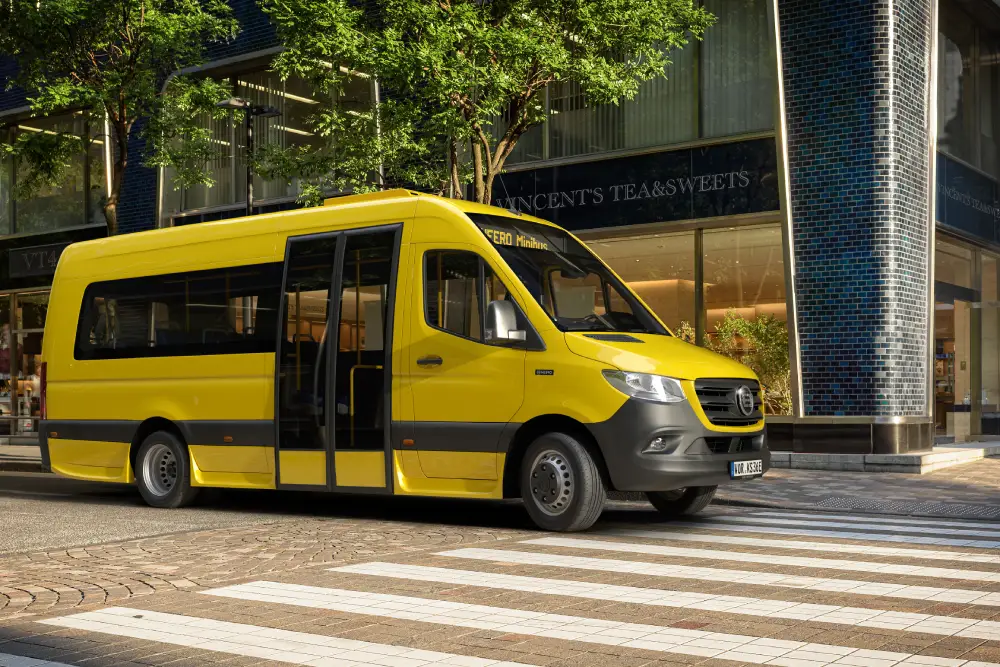
Starting in 2026, the requirements tighten significantly to a quota of 65% for clean buses - and it continues. These statutory requirements create a pressure to act that demands a rapid and simultaneously economical electrification solution. The fully electric HEERO minibuses based on existing Sprinter chassis are a pragmatic answer to this challenge. A well-thought-out charging logistics system is the foundation for success here.
Depot charging as the economic foundation of your e-fleet
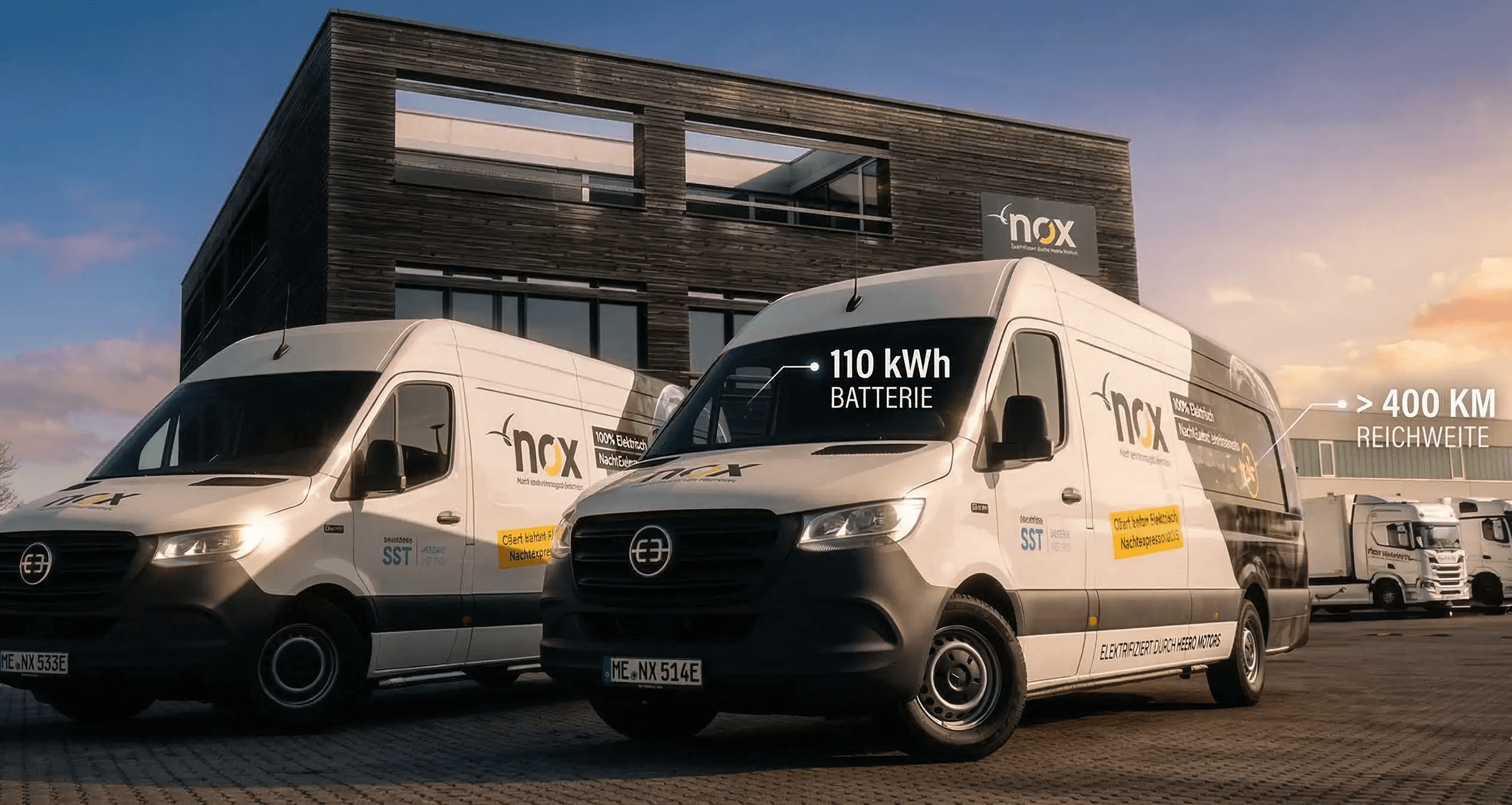
For 90% of all urban bus routes, overnight depot charging is the most efficient method. In this process, vehicles are charged over several hours at lower power, which protects the batteries and can significantly extend service life can. HEERO electric buses use a standard 22 kW AC charging output for this purpose, ensuring a full charge of the 137 kWh battery overnight. This enables a proven real-world range of over 300 km for the following day of operation.
The advantages of pure depot charging are significant and directly visible in the TCO calculation. The investment costs for the infrastructure are considerably lower compared with high-power chargers along the route. In addition, operators can use cheaper night-time electricity tariffs, which noticeably reduces energy costs per 100 kilometres. An optimised depot charging strategy is the first step towards cost control. The key advantages include:
Lower investment costs: Setting up AC charging infrastructure at the depot is up to 5 times cheaper than installing pantograph systems along the route.
Battery protection: Slower charging over 5-7 hours reduces thermal stress on the battery cells and maximises cycle life.
Use of night-time electricity tariffs: Electricity costs can be reduced by 10-20% by shifting charging processes to the night-time hours.
High operational reliability: The vehicles start each day with a 100% state of charge and full range, which simplifies scheduling.
This predictable and cost-effective base supply often makes expensive and complex interim charging unnecessary.
DC fast charging to maximise vehicle availability
Although AC charging is the norm, unforeseen peak deployment demands or routes covering more than 300 km per day require a rapid top-up. This is where DC rapid charging comes into play. The HEERO eBus platform is designed for a DC charging output of 165 kW. This means the 137-kWh battery is charged from 20 % to 80 % in just 30-40 minutes, enabling an additional range of over 200 km.
This ability for strategic rapid charging in the depot turns a potential operational pause into productive charging time of under 45 minutes. Instead of having to keep an additional reserve vehicle on standby, the same bus can be deployed again after a short break. This significantly increases fleet efficiency. The process is designed to be remarkably simple:
Connect vehicle: The bus is connected to a central DC charging station in the depot using a CCS connector.
Authorisation: Communication between the vehicle and the charging station starts automatically and checks the battery status.
High-power charging: Charging begins at the maximum power of 165 kW and dynamically adapts the charging curve.
Ready for service: After around 40 minutes, the bus is ready for a further 200-240 km of travel.
This targeted use of DC charging ensures that fleet flexibility is maximised without burdening the TCO with a widespread and expensive DC infrastructure.
Load management to avoid costly power peaks
The biggest financial pitfall when charging an electric bus fleet is peak loads. If 15 buses are connected simultaneously to 150-kW chargers, the power demand exceeds 2.2 megawatts - more than many depot grid connections can supply. The result is excessive demand charges, which can push the electricity bill up significantly. An intelligent load management system is therefore not a luxury, but an economic necessity.
The system intelligently distributes the available grid connection capacity across the vehicles being charged. It prioritises buses that need to leave early the next morning and charges others at different times. This ensures that the maximum power limit of the grid connection is never exceeded, avoiding costly grid upgrades and can reduce annual electricity costs by five-figure amounts. A depot with 20 buses can typically save more than €50,000 per year through load management. Implementing such a system is crucial for scaling E-bus operations.
Holistic planning as the key to success
A high-performance HEERO eBus with a range of over 300 km is only half the battle. Commercial success depends on a perfectly matched charging infrastructure. HEERO therefore offers, together with partners from our pool of experts, comprehensive depot charging consultancy that covers the entire process from analysing the grid connection to implementing load management. Our experts analyse your rotation schedules and the energy requirements of over 50 vehicles in order to design a bespoke charging solution.
This approach ensures that your fleet not only meets CVD quotas, but also operates with optimised total cost of ownership. By combining efficient vehicles - with the HEERO eDrive system - and intelligent charging infrastructure for electric buses, electrification becomes a predictable competitive advantage. This makes the transition predictable and profitable.
FAQ
How long does it take to fully charge a HEERO eBus?
Charging depends on the charging power. At a 22 kW AC wallbox at the depot, a full charge of the 137 kWh battery takes around 6-7 hours, ideal for the overnight operational break. At a 165 kW DC fast-charging station, the bus can be charged from 20% to 80% in just 30-40 minutes.
Is my existing depot grid connection sufficient for an e-bus fleet?
It depends on the size of your fleet and the available power. For more than 5 buses, intelligent load management is usually required to make optimal use of the existing connection and avoid costly grid expansion. HEERO analyses your connection capacity as part of the depot consultation and supports the planning of your charging infrastructure accordingly.
What is the difference between AC and DC charging for my bus fleet?
AC charging (alternating current) is the standard solution for cost-effective overnight charging at the depot, with up to 22 kW. DC charging (direct current) is fast charging with high power (165 kW at HEERO) for short charging stops, to quickly increase range during the working day. For TCO, a strategy with the highest possible share of AC charging is ideal.
What range does a HEERO eBus have, and is it sufficient for city driving?
The HEERO low-entry bus offers a proven range of over 300 km with the standard 137 kWh battery. This is sufficient for over 90% of typical urban and regional route operations in Germany, without the need for interim charging during the day.
Can I keep my existing specialist equipment during a D2E electrification conversion?
Yes, this is a key advantage of the HEERO D2E conversion. We not only build new electric buses, but also electrify existing Mercedes-Benz Sprinter vehicles of model 907. Your proven and often expensive bus equipment is retained in full. This protects your original investment and significantly reduces the total cost of electrification compared with buying a completely new electric vehicle.
What happens if a charging session is unexpectedly interrupted?
Modern charging management systems, as recommended by HEERO, monitor all charging operations in real time. If a charge is interrupted, a notification is sent immediately to fleet management. The system typically attempts to restart the charging process automatically. In addition, the charging process can be rescheduled to another available charging point to ensure the bus is ready to depart.
More useful links
The Federal Ministry of Transport and Digital Infrastructure offers answers to frequently asked questions about the Clean Vehicles Directive, which promotes the use of clean vehicles in the public sector.
The Offenburg University of Applied Sciences provides a conference paper on electromobility, which deals with scientific findings and developments in this field.
The Federal Ministry of Transport and Digital Infrastructure informs in a press release about the Master Plan for Charging Infrastructure 2030, which outlines the strategy for expanding the charging infrastructure in Germany.
The Federal Environment Agency offers comprehensive information and publications on the subject of electromobility and its environmental impact.
The Association of German Transport Companies (VDV) provides information and positions on e-mobility in public transport and highlights current developments and challenges.
Agora Verkehrswende publishes analyses and recommendations on the transition to electric buses in Europe and their impact on the transport sector.