HEERO Electric: What 80% subsidies achieved until 2024 and how total cost of ownership decreases
HEERO Electric: What 80% subsidies achieved until 2024 and how total cost of ownership decreases

Up to 425 kilometers of range after conversion – without the cost of a new vehicle. The funding round with up to an 80% subsidy ran until 2024; new calls for funding are not planned.
The topic briefly and concisely
The 80% funding for electric commercial vehicles and conversions by the BMDV (KsNI) ran until 2024; no new calls for funding are planned.
The consideration of Total Cost of Ownership (TCO) shows that HEERO electric vehicles are more economical than diesel models due to lower operating and maintenance costs.
The diesel-to-electric conversion (DTE) conserves resources in accordance with the Circular Economy Act and secures investments in existing specialized structures.
Rising diesel prices, strict climate requirements from the EU's Clean Vehicles Directive, and growing pressure to reduce CO₂ emissions present fleet operators with major challenges. However, many hesitate due to the high investment costs for new electric vehicles. This is precisely where the HEERO Electric comes in: We not only offer you state-of-the-art electric vans and buses as new vehicles, but also specialize in the conversion of existing fleets. This approach not only protects your budget, but also valuable resources in terms of the circular economy. State KsNI funding of up to 80% of the additional costs ran until 2024; new calls for funding are not planned, already approved projects will be fully funded.
Funding expired: Why the conversion still pays off
Switching to electromobility is no longer an option, but a business necessity. The EU's Clean Vehicles Directive obliges public authorities to meet fixed quotas for emission-free vehicles. At the same time, the KsNI funding guideline of the Federal Ministry for Digital and Transport (BMDV) has expired: until 2024, it covered up to 80% of the additional investment costs for the purchase or sustainable electric conversion of your commercial vehicle. This expiration shifts the calculation for fleet managers in municipalities and companies. Without new subsidies, the economic efficiency per vehicle must come from operating costs. The combination of regulatory pressure and expired subsidies makes a resilient economic viability calculation the basis of any future-proof investment. The decision for a HEERO electric vehicle is therefore not only an emission-related step, but above all a strategically wise one to secure your competitiveness.
Your 4-point plan for the HEERO Electric and funding in retrospect
The path to electrifying your fleet and clearly classifying the funding situation is straightforward with our pragmatic approach. We accompany you through each of the four steps to make the process as efficient as possible for you.
Conduct needs analysis: Together with you, we analyze the specific requirements of your fleet. We evaluate driving profiles, daily mileages of up to 500 km, and the required charging infrastructure.
Choose the right HEERO solution: Based on the analysis, you decide on the optimal solution. Whether a new powerful electric van or the conversion of an existing Sprinter – we have the right technology.
Prepare and submit the funding application: We actively support you in compiling the documents for the BMDV funding program. In the KsNI program, up to 80% of the additional costs for vehicle conversion and 40% for the charging infrastructure were eligible for funding; it ran until 2024.
Implement the transition smoothly: After funding approval, the conversion or delivery of your HEERO electric vehicle takes place. Our DTE conversions often take only a few weeks, so your vehicles are quickly ready for use again.
This structured process ensures that you can clearly classify the funding situation and plan your fleet modernization economically.
Technology that convinces: Range and performance in detail
Our HEERO electric vehicles are designed for demanding everyday work and offer performance values that surpass fossil fuel competitors. The basis of our technology is a powerful drivetrain designed for reliability and efficiency.
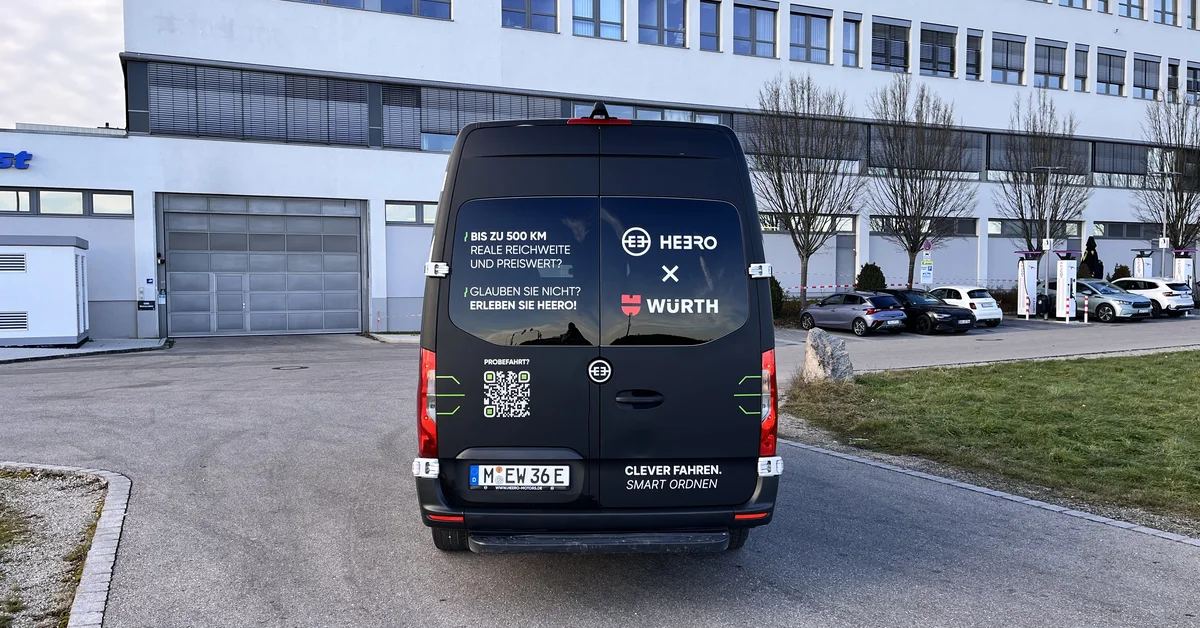
HEERO eTransporter: It achieves an industry-leading range of up to 500 kilometers on a single battery charge.
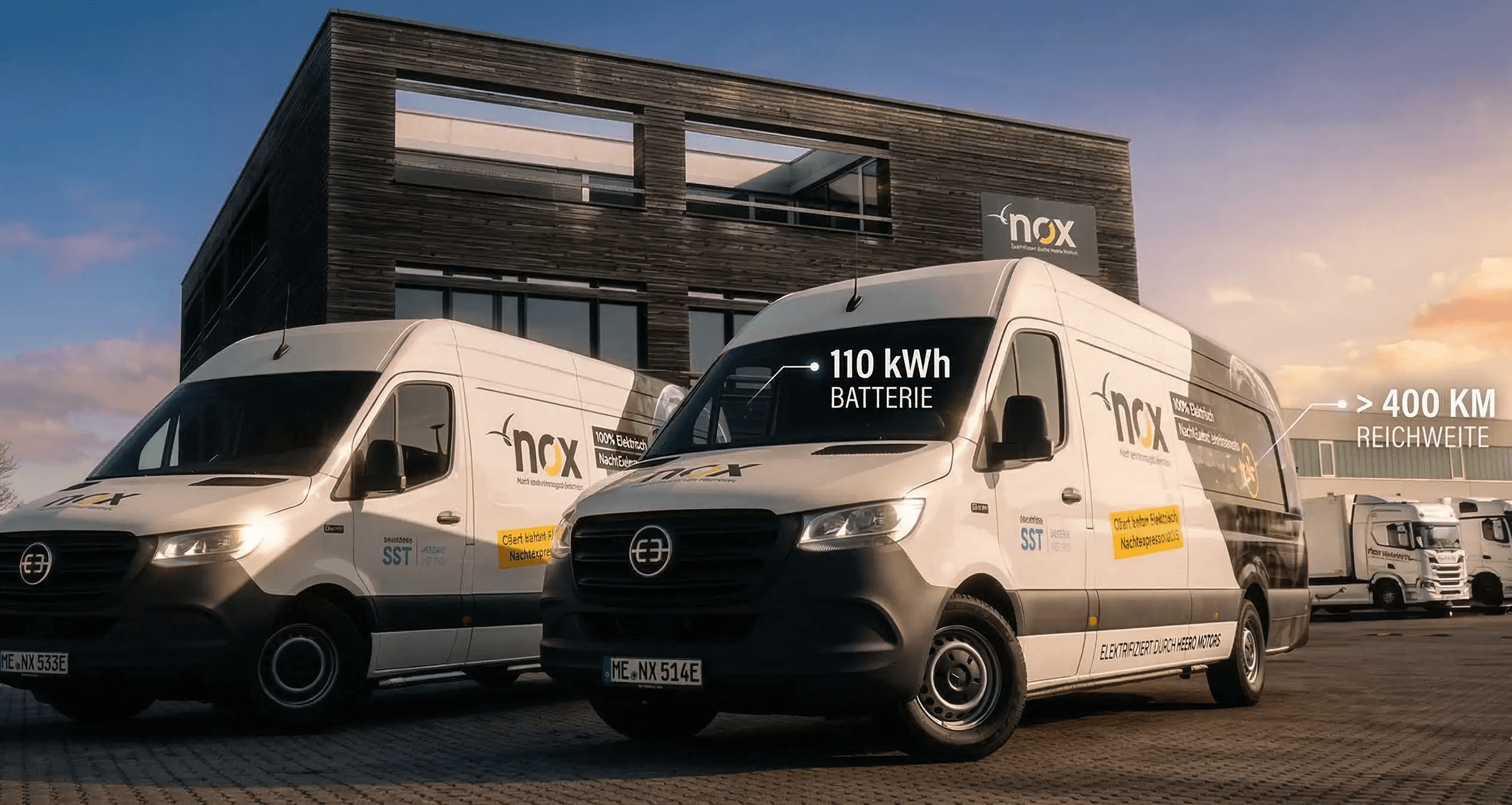
HEERO DTE-Sprinter: After conversion, your proven Sprinter offers a range of up to 425 kilometers.
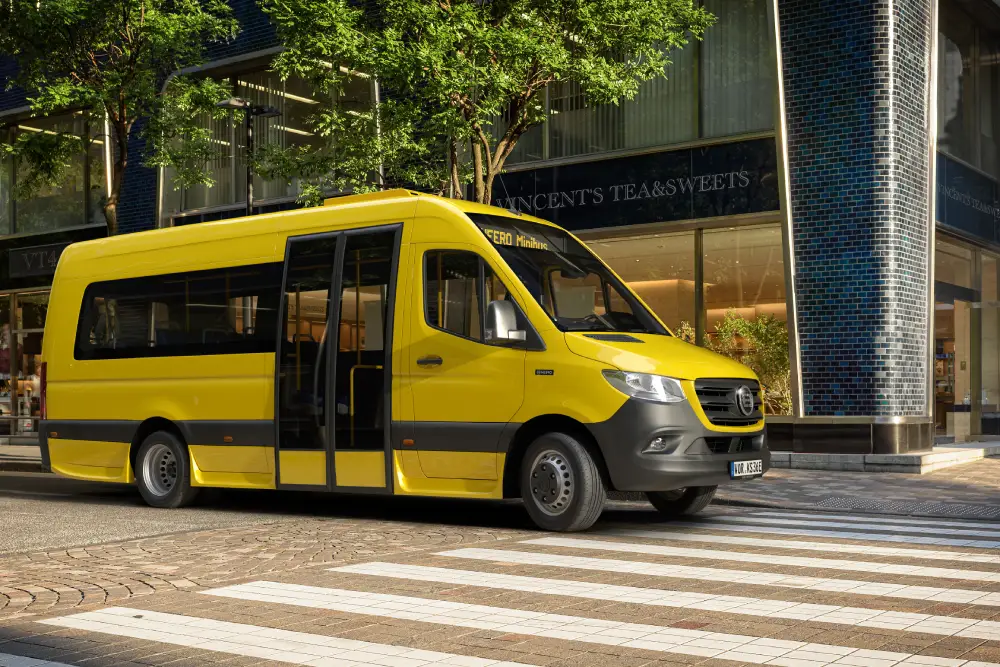
HEERO Bus-Lösungen: Both the low-entry and low-floor buses achieve up to 300 kilometers, ideal for urban and regional transport. The Tourer for nine people even reaches up to 400 kilometers.
Innovative Batterietechnik: As standard, we install battery systems with 110 kWh gross (96 kWh net). The low-floor bus has an even larger package with 137 kWh gross (115 kWh net).
Schnelles Laden: With up to 165 kW DC charging power, the low-floor bus is charged to 80% in around 30 minutes. Standard models charge with a powerful 135 kW.
These performance figures are not laboratory values, but practical key figures that give your company planning security for daily operations. This makes the transition to a zuverlässigen Sprinter Elektro plannable and efficient.
Economics in Focus: Total Cost of Ownership instead of Purchase Price
The higher acquisition costs of an electric vehicle are often perceived as a hurdle. However, looking solely at the purchase price is too short-sighted. The Total Cost of Ownership (TCO) is crucial for an economic evaluation. This includes all costs incurred over the entire service life of a vehicle. Studies show that electric commercial vehicles have a clear advantage here. The TCO analysis for a HEERO electric vehicle reveals significant savings in several areas. Lower energy costs per kilometer compared to diesel, a significantly reduced maintenance effort due to the elimination of oil changes or exhaust systems, as well as tax and toll advantages, mean that the investment often pays for itself after just a few years. Particularly in urban stop-and-go traffic, you maximize efficiency through recuperation. With a clear view of the TCO, the HEERO electric vehicle becomes the superior economic alternative for your fleet.
Circular economy as a principle: Your contribution to sustainability
Why replace an entire vehicle when only the drive system is outdated? Our Diesel-to-Electric conversion (DTE) is a prime example of a functioning circular economy and is in line with the objectives of the German Circular Economy Act (KrWG). Instead of scrapping functional vehicles with expensive custom bodies, we preserve their value and equip them with a locally emission-free drive system for the future. This approach offers enormous advantages. You protect your previous investments in bodies for trade, logistics, or municipal services. In addition, significant amounts of CO₂ and resources are saved compared to the production of a new vehicle. A DTE conversion significantly reduces the CO₂ footprint of vehicle manufacturing. With an intelligent conversion solution, you make a measurable contribution to climate protection and position your company as a pioneer in sustainability.
Start your transformation: secure a free funding analysis
Switching to an electric fleet with HEERO is a strategic win for your budget, your environmental balance, and your image. The KsNI funding ran until 2024; however, the competition is not waiting. The first step is simple and non-binding.
Start your funding analysis: Answer three questions and receive your subsidy roadmap with the current status of the funding programs.
Button: "To the free analysis"
free · non-binding · objective
More useful links
Bundesamt für Logistik und Mobilität (BALM) offers information on the Climate Protection and Sustainability in Transport (KSNI) funding program.
Bundesministerium für Wirtschaft und Klimaschutz (BMWK) provides a funding program to support e-commercial vehicle applications and infrastructure.
L-Bank Baden-Württemberg provides information on the BW-E-Nutzfahrzeuge funding program.
e-mobil BW, the State Agency for Electromobility and Fuel Cell Technology Baden-Württemberg, offers news on funding for e-trucks and charging infrastructure.
KfW provides an overview of four funding opportunities for sustainable mobility.
Nationale Leitstelle Ladeinfrastruktur provides information on the topic of commercial vehicles.