Charging cards for electric vehicles: How fleet operators can optimise their charging costs on the road
Charging cards for electric vehicles: How fleet operators can optimise their charging costs on the road

The transition to e-mobility presents fleet managers with new challenges, particularly when charging on the road. Hundreds of providers and confusing tariffs make cost control difficult. A well-considered strategy for charging cards in an electric vehicle fleet is crucial to effectively reduce TCO.
The topic briefly and concisely
A central charging card with access to a large roaming network is essential for fleet operators to control costs.
Contract-based charging is significantly more cost-effective for commercial fleets than spontaneous ad hoc charging by credit card.
The combination of 165 kW DC charging capability and a smart charging card strategy minimises downtime and maximises the...
Electrification of commercial vehicle fleets is essential to meet the Clean Vehicles Directive (CVD). However, with the purchase of a new HEERO or the D2E (Diesel-to-Electric) conversion of vehicles such as the Mercedes-Benz Sprinter, only the first step has been taken. The real complexity becomes apparent in day-to-day operations: charging on the road. An opaque market with more than 200 charging tariff providers in Germany and variable cost structures can quickly drive up total cost of ownership (TCO). For fleet operators, a central charging card solution is therefore not a convenience, but an economic necessity for managing efficiency and expenditure.
Market fragmentation as a cost trap for e-fleets
The German market for public charging infrastructure is highly fragmented. As of 1 October 2025, the Federal Network Agency recorded 179,938 public charging points operated by a wide range of companies. This diversity results in a confusing mix of pricing models, billed per kilowatt hour (kWh), per minute, or as a flat rate, often supplemented by blocking fees. For drivers, this means having to carry several charging cards or apps, which is inefficient and complicates billing for fleet management. According to a study, almost 10% of fleet operators are dissatisfied with their provider's price transparency and acceptance network. This lack of transparency makes precise TCO calculations considerably more difficult. A consolidated solution that provides access to a large network via a single card is therefore essential. The complexity of pricing structures requires a strategic choice of provider in order to avoid unforeseen costs.
Use roaming networks to simplify the charging process
The solution to a fragmented market lies in so-called roaming. Similar to mobile communications, roaming agreements between charging providers (EMPs) and charge point operators (CPOs) make it possible to charge at third-party charge points with just one contract. With a single charging card, drivers can access hundreds of thousands of charging points across Europe. However, caution is advised: roaming can involve additional fees that may increase charging costs by up to 3 cents per kWh. Choosing a provider with a large in-house charging network and fair, transparent roaming terms is crucial. For fleet managers, it is important to scrutinise the pricing structure carefully. A good overview of the suitable charging station on the move is essential. The following cost factors should typically be considered:
Base fee: A monthly fixed fee for using the card.
Usage price (per kWh): The cost of the energy actually charged.
Time-based tariff (per minute): Costs for the duration of the charging session, often at DC rapid chargers.
Blocking fee: Additional costs after a certain charging or parking time, to keep the charger available.
Roaming surcharge: Fees for using charging points outside your own network.
A careful analysis of these components is the basis for an economical charging solution.
Selecting the right charging card solution for your fleet
Selecting the right charging card for a commercial fleet requires a systematic approach. Unlike for private users, the focus here is on central administration and consolidated billing. A 2025 study shows that for 78% of companies, a combined card for charging and fuelling is already standard. For purely electric fleets, however, a specialist charging card is more efficient. A key criterion is software integration for the automated billing of all charging sessions. This significantly reduces administrative effort. A good charging solution also provides detailed reporting on charging behaviour and the costs incurred per vehicle. Understanding the differences between rapid charging and standard charging helps optimise route planning. Please consider the following steps when selecting a solution:
Needs analysis: Determine your fleet's typical routes and charging requirements (depot charging vs on-route charging).
Check network coverage: Ensure the provider offers extensive coverage at relevant locations and along key transport corridors.
Compare pricing and contract models: Analyse tariffs with no base fee versus those with fixed monthly costs and lower kWh prices.
Test the administration portal: Assess the user-friendliness of the backend for fleet managers (e.g. card management, invoice overview, reporting).
Ensure scalability: The solution should grow with your fleet and allow straightforward integration of new vehicles and cards.
This structured approach secures a future-proof and cost-efficient charging infrastructure for use on the road.
Ad-hoc charging vs contract-based charging: a TCO decision
Since the European AFIR Regulation came into force in April 2024, ad hoc charging, i.e. spontaneous charging without a contract using a credit or debit card, must be possible at new public charging points. This increases flexibility, but for commercial fleets it is usually the more expensive option. An ADAC analysis found that ad hoc charging can be significantly more expensive than contract-based charging with the same provider. For fleet operators, contract-based charging via a dedicated charging card is the only economically sensible solution. It enables not only lower and predictable kWh prices, but also centralised, tax-compliant billing of all charging sessions. The manual collection of individual receipts is eliminated, which drastically reduces administrative effort. In addition, contract tariffs often provide access to exclusive charging networks and services. Knowledge of the pitfalls of roaming is therefore of great importance. Although the AFIR Regulation aims to improve price transparency, fleet customers still only receive the best conditions through framework agreements.
Efficient charging on the road with high-performance vehicle technology
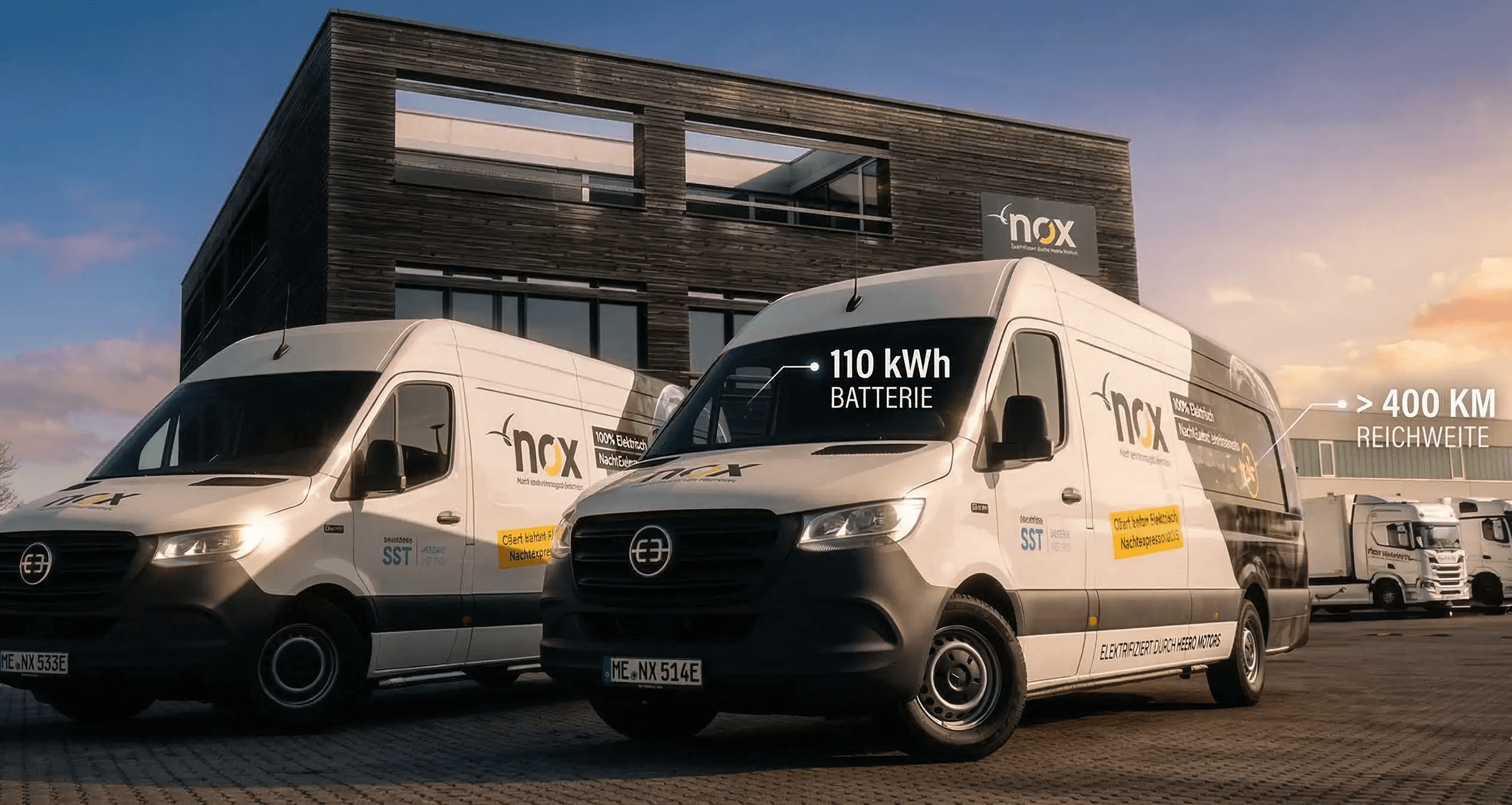
The best charging card strategy is only as good as the vehicle’s charging technology. Charging power is a key factor in downtime and, in turn, the driver’s productivity. The HEERO eDrive system is equipped with a DC charging output of 165 kW. This makes it possible to charge the 110 kWh battery from 20% to 80% in around 30 to 40 minutes in most cases - the 600 V technology in the 137 kWh batteries enables similar charging times. This short charging time is ideal for the legally mandated 45-minute driver break. The high charging power minimises unproductive waiting times and maximises the vehicle’s time in service. Fleet managers should specifically plan routes to stop at High-Power-Charging (HPC) stations with over 150 kW of power in order to fully exploit this advantage. In Germany, the number of these rapid chargers is growing strongly; it has increased noticeably within a year. The distinction between AC and DC charging is fundamental to planning here. A smart combination of a good charging card and a fast-charging-capable vehicle such as the HEERO mid-floor Electric MiniBus with a range of over 300 km ensures maximum efficiency in demanding day-to-day operations.
FAQ
How many charging cards does a driver need for nationwide coverage across Germany?
Thanks to roaming networks, one charging card from a major provider is usually sufficient. This gives access to hundreds of thousands of charging points in Germany and Europe. The best choice is a provider with broad acceptance and transparent roaming fees to simplify administration.
What are the biggest cost pitfalls when mobile charging eLCVs?
The biggest cost traps are unclear roaming charges, expensive ad hoc charging without a contract and blocking fees. The latter are charged when the vehicle remains at the charging point for too long after the charging process has finished. A charging card with a transparent tariff and good charging planning help to avoid these costs.
Can the billing of charging sessions be automated?
Yes, professional charging card providers for fleets offer digital management platforms. All charging sessions for the fleet are automatically recorded and consolidated in a monthly collective invoice. This makes it easy to allocate costs to individual vehicles and significantly reduces administrative effort.
Why is contract-based charging usually better for fleets than ad hoc charging?
Contract-based charging gives fleets predictable and significantly lower costs per kilowatt hour. It also removes the need for drivers to collect individual receipts, as all transactions are billed centrally and in a tax-compliant manner. Ad hoc charging is a stopgap solution, not a viable long-term strategy for businesses.
What impact does the vehicle’s charging power have on costs while on the road?
A high DC charging output, such as the 165 kW of the HEERO eDrive system, significantly reduces downtime at the charging station. Shorter charging times mean lower blocking fees and, above all, greater productivity for both driver and vehicle. Investing in vehicles capable of rapid charging therefore directly optimises total cost of ownership.
What does the AFIR regulation govern for charging on the road?
The EU’s "Alternative Fuels Infrastructure Regulation" (AFIR) creates a unified legal framework for charging infrastructure. Among other things, it stipulates that new charging points must enable ad hoc charging using common payment methods such as credit cards. The aim is greater transparency and user-friendliness, particularly for cross-border charging.
More useful links
The German Association of Energy and Water Industries (BDEW) provides comprehensive information on electric mobility, including market developments, charging infrastructure and policy frameworks.