Roaming charging for electric vehicles: TCO control for your fleet

Public charging for electric commercial vehicles often comes with unpredictable costs due to roaming fees. For fleet operators, controlling total cost of ownership (TCO) becomes a challenge. Discover strategies to overcome pricing opacity and operate your fleet economically.
The topic briefly and concisely
Roaming makes it possible to charge at charging points from different providers with a single contract, but it often leads to unpredictable additional costs.
The EU AFIR regulation improves price transparency by requiring ad hoc charging with clear price display at new fast-charging stations.
The most effective TCO control is achieved by maximising cost-effective depot charging, supported by vehicles with a long range (up to 300 km)..
The electrification of commercial vehicle fleets is essential for meeting the Clean Vehicles Directive (CVD). While depot charging is the most cost-effective method, public charging is necessary for many routes. This is where “roaming charging for electric vehicles” becomes a key issue. Different providers and unclear pricing structures can drive operating costs up unpredictably. For fleet managers, this means considerable administrative effort and a risk to TCO planning. A well-considered strategy, combined with vehicles that offer high ranges and charging performance, is the key to efficiency.
E-roaming: Understanding charging at third-party charging points
E-roaming enables drivers to use stations from different operators with just one charging contract. This is made possible by platforms such as Hubject or Gireve, which act as intermediaries between charge point operators (CPOs) and mobility service providers (EMPs). In Germany, according to the Federal Network Agency, 179,938 public charging points were already in operation as of 1 October 2025. This interconnectedness is essential to ensure nationwide coverage. For fleets, this means flexibility, but also new complexity in cost control. Billing is handled via the operator’s own provider, who, however, often charges surcharges for using third-party networks. A solid understanding of these interrelationships is the first step towards cost optimisation, as can be achieved through an analysis of charging card options. The variety of providers and tariffs requires careful assessment in order to find the most economical solution for the fleet.
Cost traps when roaming: hidden charges and lack of price transparency
The costs of roaming charging can vary significantly and are often opaque. While mobile network charging is regulated across the EU, significant additional costs can arise when charging electric vehicles. These typically consist of several components:
The energy price per kilowatt hour (kWh) charged by the CPO.
A fee from the roaming platform, often amounting to 2 to 4 cents per kWh.
Administrative costs from the user’s own EMP of 3 to 5 cents per kWh.
Possible additional blocking or start-up fees.
This structure means that the final price per charging session can be significantly higher than with direct charging. For a fleet manager, it is almost impossible to trace these costs without specialised software. An efficient way to locate charging stations helps, but does not solve the problem of price differences. This lack of transparency poses a significant risk to TCO calculations and makes the financial planning of fleet electrification more difficult.
AFIR Regulation: Greater Transparency for Ad-Hoc Charging
The EU’s “Alternative Fuels Infrastructure Regulation” (AFIR), which has applied since 13 April 2024, is intended to reduce opacity. The regulation stipulates that all newly installed public DC fast-charging points (from 50 kW) must enable ad hoc payment via card reader or contactless function. For AC charging points, a dynamic QR code is sufficient. The aim is to simplify charging without a prior contract and to display prices clearly per kWh, per minute or per charging session. By 1 January 2027, existing fast chargers along the TEN-T road network must also be retrofitted. This regulation strengthens users’ position by enabling direct price comparison at the charging point. For fleet operators, this is a step forward; however, it does not replace a comprehensive charging and cost management strategy that also takes into account the ratio of AC to DC charging.
Strategies for optimising TCO for electric vehicle fleets
The most effective way to reduce charging costs is to maximise depot charging at your own operating site. Here, electricity costs are typically well below 30 cents per kWh. Public charging should only be used when necessary. The following strategies help keep TCO under control:
Choosing a fleet charging card provider: Specialised providers bundle access to thousands of charging points and provide a consolidated monthly invoice.
Analysing the roaming network: Select a provider whose partner network offers optimal coverage in the regions your fleet uses most frequently.
Implementing charging policies: Define clear rules for drivers on when and where public charging is permitted in order to minimise expensive ad hoc charging sessions.
Using telematics data: Analyse driving and charging data to optimise routes and reduce the need for public charging.
The combination of depot charging and a smart public charging strategy can reduce energy costs by a significant margin. Thoughtful planning for charging on the road is crucial here. This strategically minimises reliance on expensive and confusing roaming tariffs.
Vehicle technology as the key to independence
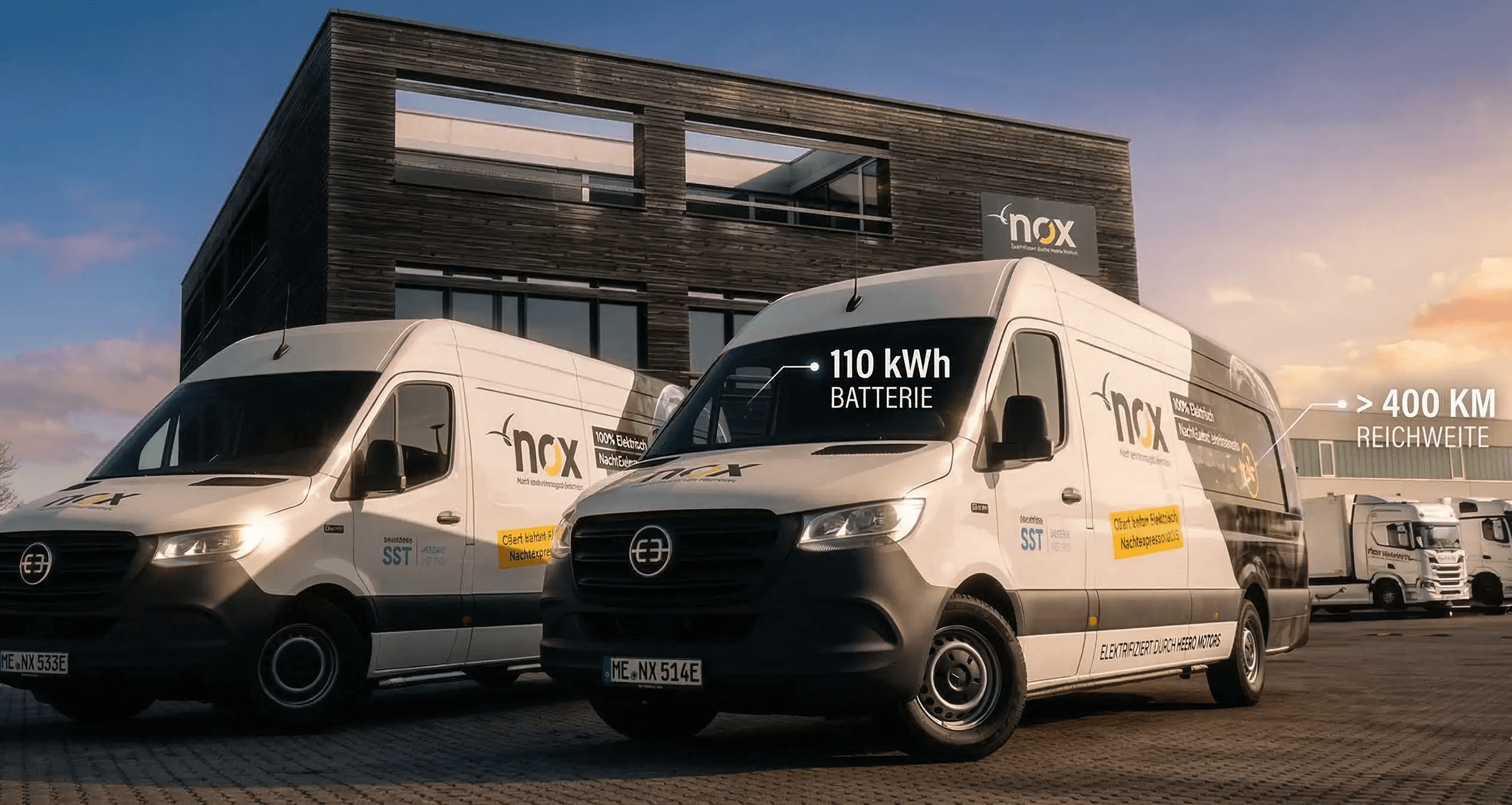
The best strategy against high roaming costs is to avoid them arising in the first place. The vehicle's technology plays the decisive role here. A HEERO D2E-converted Sprinter (model 907) has a range of up to 300 km. This high range makes it possible to complete most daily routes without intermediate charging and to charge economically overnight at the depot. Every public charging session avoided is a direct saving in operating costs. If charging on the road is unavoidable, the 165 kW DC charging power ensures that the battery is charged to 80% in 60-90 minutes. This short dwell time minimises downtime and reduces the risk of blocking fees that can occur with slower standard charging. Investing in a vehicle with superior range and charging power is therefore a direct investment in reducing TCO.
Conclusion: Controlling roaming costs through planning and technology
Roaming charging for electric vehicles remains a complex challenge for fleet operators. The opaque cost structures of many providers can make TCO planning considerably more difficult. The AFIR regulation does create more transparency in ad-hoc charging, but fleets achieve the most effective control through a strategic combination of depot charging and choosing the right vehicle. Models such as the HEERO eTransporter with up to 500 km range reduce the need for public charging to a minimum. Prioritising depot charging and using vehicles with long range are the most pragmatic levers for TCO optimisation. Professional advice on building your own charging infrastructure is therefore the first step towards economically successful electrification. Arrange a consultation to start your fleet analysis and calculate the TCO of your fleet.
FAQ
What is the difference between a CPO and an EMP?
A Charge Point Operator (CPO) operates the physical charging infrastructure. An E-Mobility Service Provider (EMP) enters into contracts with drivers and enables them to access various charging networks, including those of other CPOs, via roaming agreements. HEERO advises you on selecting the right partners for your depot charging infrastructure.
Is roaming charging generally more expensive than direct charging?
Generally, yes. With roaming, additional fees are incurred for the intermediation platform and the administrative effort of the EMP. These costs are passed on to the end customer and can increase the price per kWh by several cents. Therefore, charging directly with a provider without roaming or at your own depot is typically the most cost-effective option.
How does vehicle range help reduce roaming costs?
A high vehicle range, such as the up to 425 km of the HEERO D2E-Sprinter, reduces the need for unplanned charging stops en route. Most daily routes can be completed without external charging. The vehicle returns to the depot with remaining range and is then charged overnight with low-cost electricity, which minimises reliance on expensive public charging points.
Does the AFIR regulation solve the problem of high roaming costs?
The AFIR regulation does not directly solve the problem of roaming costs, but it does create greater transparency. By requiring ad hoc prices to be displayed directly at the charging point, drivers can compare costs before charging. This increases competitive pressure, but it does not automatically reduce the roaming surcharges that apply to contract-based charging.
Does HEERO offer its own charging card for public charging?
No, HEERO focuses on providing highly efficient electric commercial vehicles and advising on the optimum depot charging infrastructure. We see charging at your own operating site as the primary and most cost-effective solution. For the necessary public charging, we recommend specialised fleet card providers and support you in selecting the right solution.
Can I monitor the charging costs of my drivers working in the field?
Yes, by using a specialised fleet charging card, you benefit from centralised, transparent billing for all charging sessions. Combined with telematics data from the vehicles, you can analyse charging behaviour, enforce policies and optimise route planning to avoid costly and inefficient charging stops. This is a key element of modern fleet management.
More useful links
Statista offers a topic page on charging infrastructure for electric cars with statistics and data.
This study by NOW GmbH analyses charging infrastructure in Germany for the period 2025-2030.
Fraunhofer ISI presents, in a press release, a cost analysis of electric cars compared with combustion engine vehicles.
The Federal Environment Agency offers information and resources on e-mobility.
The ADAC offers a cost comparison between electric cars and combustion engine vehicles.
The German Association of the Automotive Industry (VDA) provides information on e-mobility.
The KfW offers funding programmes for e-mobility for companies.
The Federal Ministry of Finance provides information in a press release on tax exemption for electric cars.