Find charging stations on the move: Efficient charging planning for e-fleets

The operational efficiency of an electric fleet depends on well-planned charging strategy. With almost 180,000 public charging points in Germany, the infrastructure is in place. The decisive factor is the right strategy to minimise downtime and actively reduce the Total Cost of Ownership (TCO).
Topics on this page
The topic briefly and concisely
With almost 180,000 public charging points in Germany, a robust charging infrastructure for electric fleets is the foundation for operational success.
Specialised charging apps and route planners are essential. Integrate charging stops efficiently into route planning and minimise downtime.
E-roaming and the requirement for ad hoc charging by credit card significantly simplify access to and billing at charging points.
For fleet managers, the question of how to find a charging point while out on the road is central to operational planning. The concern about unproductive stops and range issues is a key factor in electrification. But the facts have changed: as of October 2025, public charging infrastructure in Germany has grown to almost 180,000 charging points and is constantly being expanded. The issue is no longer availability, but the intelligent integration of charging processes into day-to-day operations. Strategic route and charging planning is the key to fully realising the advantages of electric mobility, such as lower operating costs, and meeting the statutory requirements of the Clean Vehicles Directive (CVD).
Charging infrastructure in Germany: A solid foundation for fleets
The basis for the successful electrification of commercial vehicle fleets is a reliable charging infrastructure. As of 1 October 2025, the Federal Network Agency recorded exactly 179,938 public charging points in Germany. This figure alone demonstrates the high density of the available network. For commercial users, however, another metric is decisive: the number of DC fast-charging points.
Of the total, 44,247 are classified as fast-charging points, representing an increase of 34% within just one year. This disproportionate expansion in the DC segment is of strategic importance for fleet operators. A HEERO eDrive system can charge at up to 165 kW, significantly reducing downtime. The focus of network expansion on high-performance chargers directly supports TCO reduction by minimising break times. (For more on this topic, please see our dedicated article on "Fast charging vs. normal charging".) The growing infrastructure therefore creates the basis for the next step: using digital tools for optimal planning.
Digital tools: using the right charging apps and route planners
Availability of charging points alone does not solve the operational challenge. Only specialised software makes the network efficiently usable for fleets. Modern charging apps and fleet management systems offer crucial functions for this. They make it possible to find charging stations on the move and check important parameters in real time.
Effective route planning considers far more than location alone. The following data are crucial:
Availability of the charging point in real time
Charging power (AC/DC in kW)
Connector type (in Europe typically CCS for DC charging)
Cost per kWh or per minute
Authentication and payment methods
Integrated route planners for E-vehicles calculate the optimum route including the necessary charging stops. They take into account the current State of Charge (SoC) of the vehicle battery and the specific consumption. This integrates the estimated charging time from 20 to 80 per cent directly into the schedule. With the right digital tools, access to charging points becomes predictable and transparent.
Access and payment: simplify charging cards, roaming and ad-hoc charging
A fragmented market with countless providers was long a barrier to public charging. Thanks to charging roaming and legal requirements, the situation has improved significantly. For fleet managers, this means considerable administrative relief. The principle of E-Roaming works similarly to mobile communications: with a single charging card or app from one provider (EMP), charging can take place at the chargers of many different operators (CPOs).
This reduces the number of contracts needed to a minimum. Spontaneous access is made even easier by the Charging Stations Ordinance (LSV). This requires an ad hoc charging option without a contract for all newer public charging points. Payment must be possible simply using common debit or credit cards. For drivers, this means they can approach almost any public station and pay for the charging session directly with a company credit card. Choosing the right charging card with roaming function nevertheless remains an important lever for cost control. The technical hurdles have therefore been overcome, shifting the focus to the strategic optimisation of charging operations.
Optimising charging strategy: understanding the charging curve and state of charge (SoC)
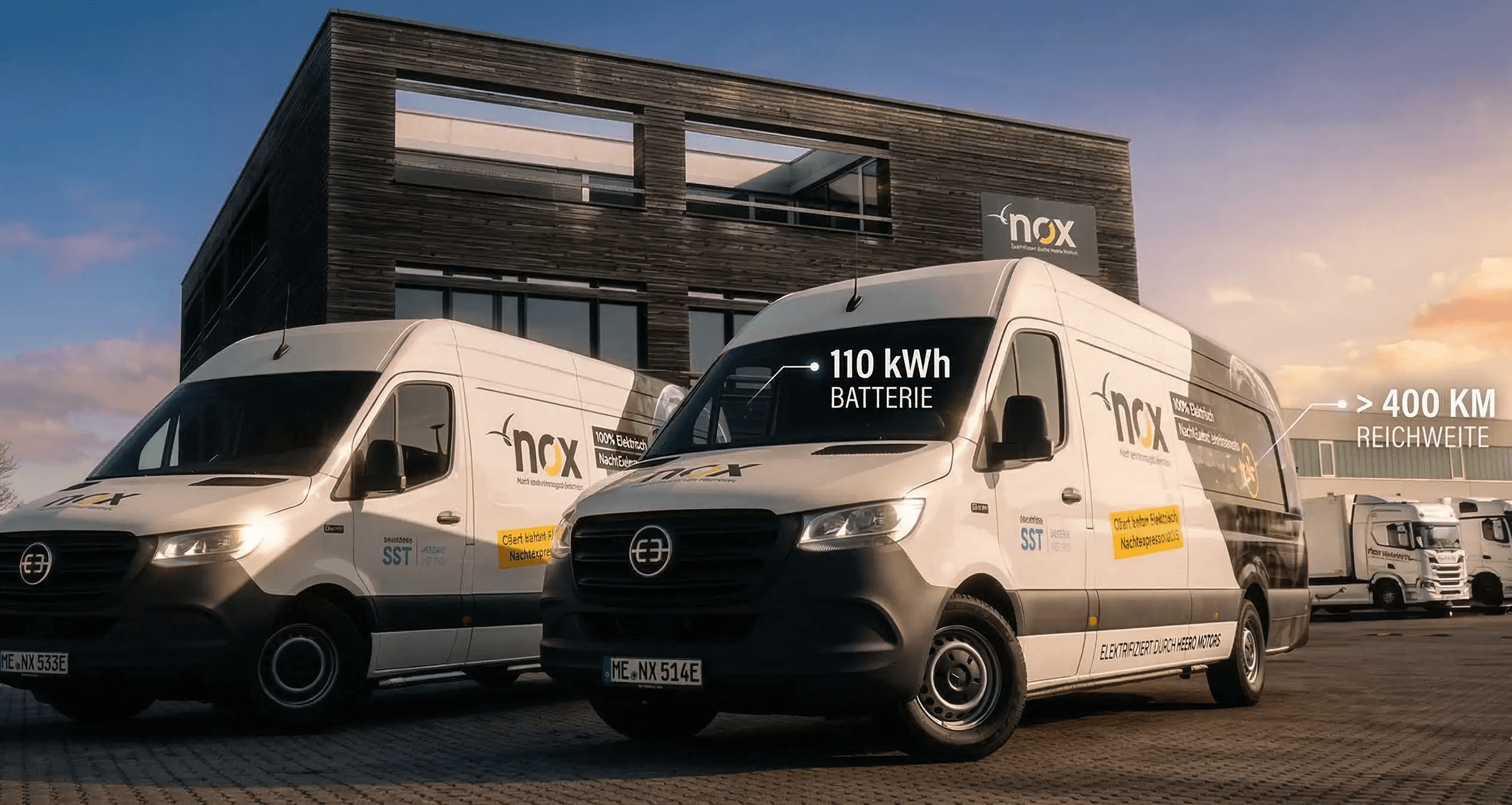
The efficiency of en-route charging is largely determined by the vehicle's charging speed. A HEERO with its 110- or 137-kWh battery is designed for DC charging power of up to 165 kW. This makes it possible, in general, to charge the battery from 10% to 80% in 30 to 40 minutes. This very range is crucial for route planning. Charging power is not linear, but follows a charging curve.
Maximum power is typically achieved in a SoC window between 20% and 60%. From a state of charge of around 80%, the battery management system significantly reduces charging power to protect the cells. In practice, this means that charging from 80% to 100% often takes disproportionately long. It is therefore usually more time- and cost-efficient to continue the journey at 80% SoC and, if needed, plan in another short stop. Helpful tips for battery-friendly charging support the longevity of the vehicle battery. A smart charging strategy is therefore the final building block for the economical operation of an e-fleet.
FAQ
How reliable are the availability indicators for charging stations in apps?
Reliability is high, as most modern charging stations report their status in real time to network backends. Typically, accuracy is above 95%. Nevertheless, in rare cases, discrepancies can occur due to communication errors. It is advisable to use route planners that suggest alternative stations nearby.
Do I need a separate app or charging card for each charge point?
No, that is no longer necessary. Thanks to e-roaming networks, you can charge at thousands of charging points operated by different providers with a single charging card or app. In addition, the Charging Point Ordinance (LSV) requires newer charging stations to offer ad hoc payment by standard debit or credit card, which makes charging possible without a contract.
What is the difference between AC and DC charging on the road?
AC charging (alternating current) is slower and typically used for overnight charging at the depot, with charging outputs of up to 22 kW. DC charging (direct current) is fast charging for on-the-go use, with outputs from 50 kW to over 300 kW. A HEERO eDrive system uses DC charging with up to 165 kW to reduce downtime to a minimum of 30-40 minutes for a charge to 80%.
Why should you often only charge to 80% when on the road?
Charging from 80% to 100% takes disproportionately long, as the battery management system significantly reduces charging power to protect the battery. For time-efficient route planning, it is therefore almost always more sensible to continue driving at 80%. This maximises productive driving time while also protecting the battery.
What type of connector does a HEERO require in Europe?
For fast DC charging on the road, HEEROs, like almost all modern electric vehicles in Europe, use the CCS connector (Combined Charging System). This is the established standard and is available at practically all public DC rapid charging stations. For slower AC charging, the Type 2 connector is used.
What can I do if a planned charging point is faulty?
Modern charging apps and route planners usually display the status of charging points. If a charging point is unexpectedly out of service, use the app to find the nearest available alternative. Good route planning generally allows for a charging reserve of at least 15–20% SoC to help absorb such unforeseen situations.
More useful links
Statista offers statistics and data on various aspects of charging infrastructure for electric cars.
The Federal Network Agency provides comprehensive information on electromobility, including relevant regulations and framework conditions.
The NOW GmbH provides a study on charging infrastructure 2025-2030 with forecasts and analyses on expansion.
The National Charging Infrastructure Coordination Centre offers insights and data on the expansion of charging infrastructure in the Ö-LIS report.
The dena (German Energy Agency) offers a dossier on expanding charging infrastructure for electric lorries, with a focus on the specific requirements for commercial vehicles.
The KfW provides information on funding programmes for charging infrastructure, especially for companies.
The ADAC offers an article on charging infrastructure at motorways and service areas up to 2025, with a focus on availability and expansion.
The Fraunhofer IAO offers information on energy and charging infrastructure planning as well as services and research in this area.