TCO Reduction: How to Charge Your Electric MiniBus for 22 Passengers Economically and CVD-Compliantly
TCO Reduction: How to Charge Your Electric MiniBus for 22 Passengers Economically and CVD-Compliantly

The Clean Vehicles Directive mandates a 45% quota for clean buses by the end of 2025, putting immense pressure on fleet operators. At the same time, operating costs for diesel vehicles are skyrocketing.
The topic briefly and concisely
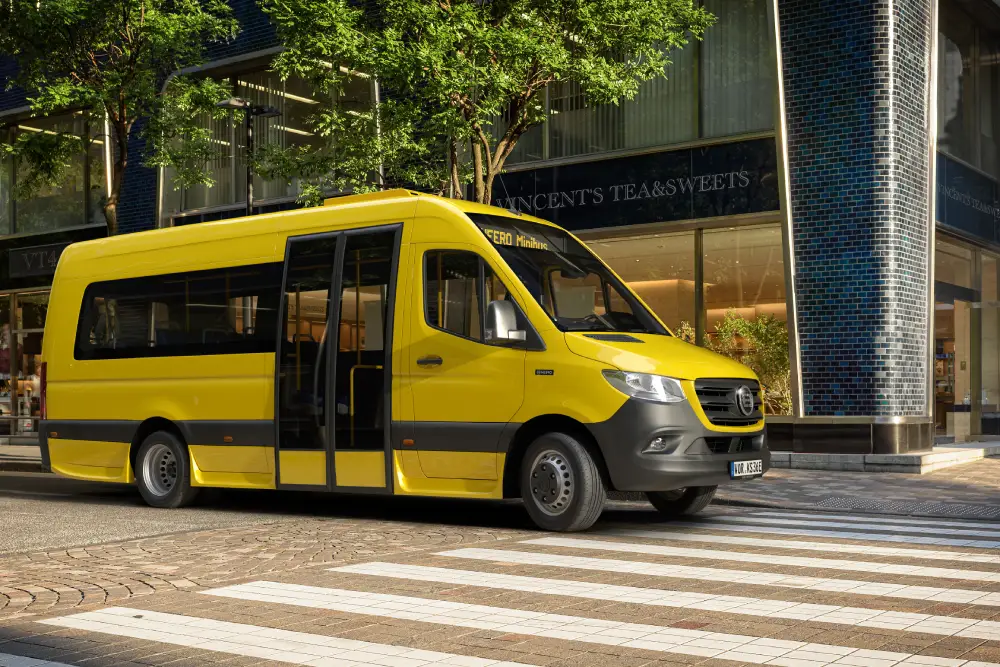
The D2E conversion of a Sprinter into a 22-passenger Electric MiniBus ensures compliance with the 45% CVD quota for clean buses by 2025.
By lowering energy and maintenance costs, the conversion reduces the TCO compared to its diesel counterpart and usually pays for itself within 4-6...
With a range of up to over 300 km and 165 kW DC fast charging, the converted Electric MiniBus is designed for demanding daily passenger transport.
For operators of passenger transport fleets, electrification presents a dual challenge: compliance with strict legal requirements and maintaining economic efficiency. Purchasing new electric minibuses involves high investments and long delivery times. HEERO offers an efficient alternative. Within a maximum of 10 working days (model series 907 only), we transform your existing Mercedes-Benz Sprinter 907 into a powerful electric minibus for 22 passengers. This approach not only ensures compliance with CVD quotas, but also sustainably optimizes your total cost of ownership.
CVD pressure: 45% clean buses required by 2025
The EU's Clean Vehicles Directive (CVD) is no longer a distant future prospect, but a concrete requirement for the year 2025. It obliges public authorities to meet fixed quotas for clean and emission-free vehicles when procurement is renewed. For buses, this quota is 45%, half of which, i.e. 22.5%, must be completely emission-free. This regulation directly affects municipalities and transport companies operating on behalf of public contracts. The pressure to electrify the fleet is therefore motivated not only by emissions, but above all by regulation. Failure to meet the quotas can lead to severe consequences. The challenge is to master this transformation economically and without disrupting ongoing operations, which often makes purchasing new fleets impractical. Retrofitting existing vehicles offers a decisive strategic advantage here.
TCO Analysis: D2E conversion beats buying new
The Total Cost of Ownership (TCO) is the decisive key figure for every fleet manager. While purchasing new electric vehicles causes high capital costs, the retrofitting significantly reduces the TCO. The operating costs of a retrofitted e-Sprinter are typically significantly lower than those of a comparable diesel vehicle. Lower expenditures for energy compared to fuel and reduced maintenance effort are the main drivers here. An electric motor has far fewer wear parts than an internal combustion engine, which can significantly reduce service costs. The preservation of your existing special superstructures is particularly valuable. Instead of investing in expensive new vehicles, your proven HEERO eBus based on the Sprinter is made fit for the future. The payback period for the retrofit is usually only 4 to 6 years. This approach not only protects your budget but also promotes the principles of the circular economy.
Practical performance: Up to over 300 km range and fast charging
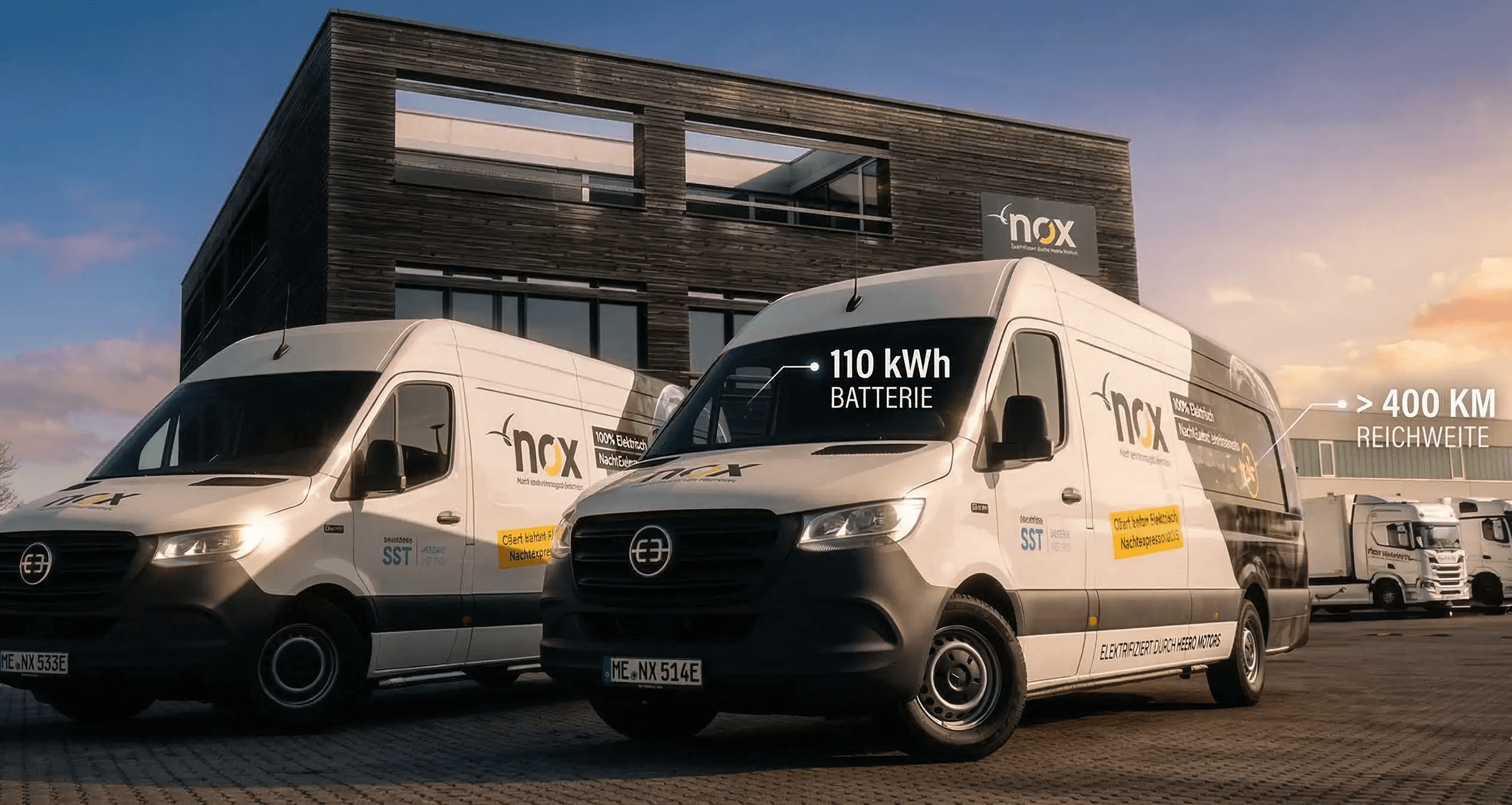
Range anxiety is a common concern in fleet electrification. The Sprinter minibus for 22 passengers, converted by HEERO, dispels this concern with a practical WLTP range of up to 300 km. This performance is made possible by a powerful 110 kWh battery designed for the demanding daily routine of shuttle services or regional scheduled operations. This means that daily operations of over 300 km can be easily realized without intermediate charging. Should energy be required, the DC fast charging capability with 165 kW ensures minimal downtime. In just 60 to 90 minutes, the battery can be recharged to 80% of its capacity. This charging performance meets the needs of modern logistics processes. For planned fast charging of electric buses overnight in the depot, an AC charging option with 22 kW is available. This way, every minibus starts its shift with full capacity every day.
Intelligent Charging Infrastructure as an Efficiency Driver
An efficient charging infrastructure is the backbone of any e-fleet. HEERO therefore offers not only vehicle conversion, but also comprehensive consulting for depot charging of electric buses. The implementation of an intelligent charging infrastructure in the depot is crucial for cost control. Well-thought-out charging solutions typically include:
AC Depot Charging: With 22 kW charging power, vehicles are charged overnight in a cost-effective and battery-friendly manner.
Load Management: An intelligent system optimally distributes the available grid power among the vehicles to be charged, avoiding costly peak loads.
Integration of PV Systems: The use of own solar power can significantly reduce energy costs further.
Scalability: The charging infrastructure is planned from the very beginning to grow with your fleet.
Optimized charging management can significantly reduce energy costs. This strategic planning not only ensures smooth operations, but also maximizes the profitability of your electric minibus fleet. The right charging infrastructure in the depot is therefore a key component for success.
The HEERO Process: Quality and speed in 10 days (model series 907 only) (model series 907 only)
Time is a critical factor for fleet operators, because every stationary vehicle costs money. HEERO has optimized the conversion process for the Mercedes-Benz Sprinter 907 for maximum efficiency. The entire conversion is completed in a maximum of 10 working days (only model series 907). During this period, the complete diesel drivetrain is replaced by our patented electric drive system. The vehicle body remains untouched, which secures the integrity and value of your vehicle. We back our quality promise with a comprehensive warranty on all components installed by us. Should a service case arise, our mobile service, the "Flying HEEROs", is ready to reduce downtime to a minimum. This lean and quality-assured process makes electrification plannable and ensures a fast reintegration of the vehicle into your fleet.
FAQ
How does a payload of 22 passengers affect the range of the converted Electric MiniBus?
The specified range of up to over 300 km is a WLTP value that considers average usage. Under a full load and depending on the driving profile, topography, and ambient temperature, the real-world range can typically deviate significantly. However, our eDrive systems are designed for continuous operation under load and offer a high level of planning reliability for most daily routes, even with a full passenger load.
Which Mercedes-Benz Sprinter models are eligible for our Diesel-to-Electric (D2E) conversion?
Our D2E conversion system is specifically optimized for Mercedes-Benz Sprinter 907 series. We focus on the base models 313, 316, 319, and 324. This specialization enables us to deliver a highly efficient and quality-assured conversion process in just 10 working days (907 model series only). For other models, we offer individual assessments.
What happens to the removed diesel engine and the old components?
In line with the circular economy, the removed components are not simply discarded. Fully functional diesel engines and transmissions are inspected, refurbished, and supplied to the spare parts market. Other materials are professionally recycled. This process reduces waste and conserves valuable resources, which is a core commitment of our corporate philosophy.
What warranty does HEERO offer on the D2E conversion?
HEERO offers a comprehensive warranty on the entire electric drivetrain, including the battery, electric motor, and power electronics. The exact terms and conditions are aligned with vehicle manufacturer standards, securing your investment for the long term. Details regarding warranty periods and scopes will be provided in your individual quote.
Does the battery weight affect the payload of the 22-passenger Electric MiniBus?
The weight of the battery is largely compensated for by the elimination of the heavy diesel engine, the transmission, and the exhaust system. The remaining reduction in payload is typically marginal and is calculated precisely during the planning of the Diesel-to-Electric (D2E) conversion. For passenger transport with up to 22 passengers, the payload capacity remains absolutely sufficient and practical for daily operations.
What is the expected lifespan of the installed batteries?
We exclusively use high-quality lithium-ion batteries designed for a long service life in the commercial vehicle sector. Under normal operating conditions and by following recommended charging cycles (e.g., avoiding constant charging to 100%), you can expect a lifespan of 8 to 10 years or over 2,000 charging cycles before the capacity drops below 80%.
More useful links
A factsheet on the total cost of ownership of battery-electric buses in Europe can be found at The ICCT.
The Bundesministerium für Verkehr provides an FAQ on the Clean Vehicles Directive.
Comprehensive information on the topic of electromobility is provided by the Verband Deutscher Verkehrsunternehmen (VDV).
Data on new registrations and the fleet of light, medium, and heavy commercial vehicles are available at NOW GmbH.
Information on the Klimaschutz und Nachhaltigkeit im Verkehr (KSNI) funding program can be obtained from the Bundesamt für Logistik und Mobilität (BALM).
Current news on the topic can be found at the Umweltbundesamt Österreich.
The Nationale Leitstelle Ladeinfrastruktur offers information specifically on the topic of commercial vehicles.
The ADAC provides comprehensive information on e-transporters.
Further information on electromobility in Germany is provided by the Bundesministerium für Verkehr.