Electric bus charging station: How bus operators can optimise TCO and meet current CVD quotas

Electric bus charging station: How bus operators can optimise TCO and meet current CVD quotas

The Clean Vehicles Directive required a quota of 45% clean buses by the end of 2025. A strategically planned charging station for every electric bus in the depot is the key to regulatory compliance and reducing the total cost of ownership (TCO). Discover how to efficiently electrify your fleet.
The topic briefly and concisely
Night-time depot charging is the most cost-effective strategy for over 80% of bus operations and ensures operational readiness.
Intelligent load management can significantly reduce operating costs by avoiding expensive peak loads.
A combination of cost-efficient 22 kW AC charging and flexible 165 kW DC charging covers all operational requirements.
The electrification of bus fleets is no longer an option for local authorities and transport operators, but a legal necessity. The Clean Vehicles Directive (CVD) required a procurement quota of 45% for clean buses by 31 December 2025, of which half had to be completely emission-free. The subsequent years continue to tighten the quotas. The key to success lies not only in the vehicle, but in a well-conceived charging infrastructure. An efficient charging station for every electric bus, especially in the depot, ensures operational readiness and becomes the decisive lever for optimising Total Cost of Ownership (TCO). The right strategy avoids costly peak loads and maximises vehicle availability to over 95%.
Depot charging as the economic backbone of the e-bus fleet
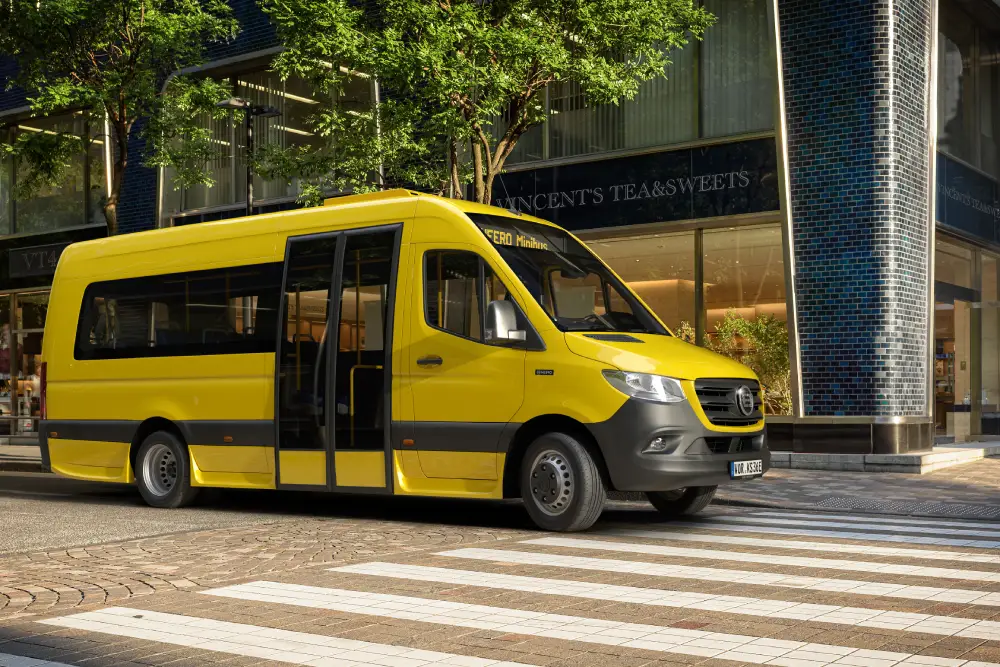
For over 80% of all urban bus routes, overnight depot charging is the most efficient method. Vehicles are reliably supplied with energy in 6-8 hours during operational downtimes. This eliminates the need for expensive and complex opportunity charging along the route. The predictability of charging processes in the depot enables a charging infrastructure utilization of over 90%. Integration into existing depots is a decisive cost advantage. A careful analysis of the route schedules ensures that every HEERO eBus with a 137 kWh battery is fully operational in the morning with a range of over 300 km. This strategy forms the basis for a smooth transition to electromobility.
Precisely calculate grid connection capacity and avoid cost pitfalls
The greatest challenge when setting up a charging station for an electric bus is often the existing grid connection. Insufficient connection capacity can lead to costly upgrades in the five- to six-figure range. A precise needs analysis is therefore essential. It takes into account the number of vehicles, the battery capacities of, for example, 137 kWh, and the desired charging times. As a rule, it is not necessary to charge all 20 buses in a fleet at maximum power at the same time. Intelligent sequencing can significantly reduce peak loads. Professional planning of the charging infrastructure is the first step towards avoiding bad investments and laying the foundations for a scalable solution. This makes optimal use of the existing grid connection before any expansion is considered.
AC vs DC charging: choosing the right technology for the depot
The choice between AC (alternating current) and DC (direct current) charging technology has a direct impact on investment and operating costs. For typical overnight depot charging, AC charging is often the more economical choice. Here are the key differences:
AC charging station (22 kW): The acquisition costs per charging point are up to 10 times lower than for DC chargers. The installation is simpler and uses the rectifier built into the vehicle. All HEERO e-buses are optimised for this cost-efficient depot charging with 22 kW.
DC charging station (from 165 kW): This technology is designed for rapid charging to 80% battery level in 30-40 minutes. It is useful when vehicles also need to be back in service quickly during the day. The HEERO charging power of 165 kW via CCS standard offers maximum flexibility here.
For most fleet operators, a combination of both technologies is ideal. A base of cost-effective 22 kW AC charging points for overnight charging, supplemented by a few 165 kW DC fast chargers for operational flexibility, represents the optimal solution.
Intelligent load management to reduce operating costs
An intelligent load management system is the key to controlling energy costs. It dynamically distributes the available grid capacity across the charging electric buses and thus prevents costly load peaks, which can account for a significant part of the electricity bill. Such a system takes into account the state of charge of the batteries, the planned departure time and the priority of the respective vehicle. Electricity costs can be significantly reduced through targeted charging during off-peak tariff periods. HEERO offers, as part of depot charging consultancy (with its affiliated partners), a comprehensive load management system. This ensures that all vehicles are charged on time without overloading the grid connection. The investment in such a system typically pays for itself in less than 24 months, solely through the network charges avoided.
The HEERO end-to-end solution: from analysis to service
A functioning charging infrastructure is more than the sum of its parts. HEERO offers, always in combination with partners from our pool of experts, a holistic approach that focuses on the specific requirements of your fleet. The process begins with a detailed fleet and location analysis to determine the exact energy requirements. Based on this, a tailored charging solution is designed that optimally combines AC and DC technology. Our HEERO electric buses, such as the mid-low floor bus with a range of over 300 km, are perfectly matched to the charging infrastructure. Our service team, the "Flying HEEROs", in combination with continuously expanding on-site HEERO hubs, ensures long-term operational reliability with 98% availability.
FAQ
How long does it take to plan and install charging infrastructure for a bus depot?
Planning and implementing a charging infrastructure for electric buses is a multi-stage process. Following an initial analysis, which takes around 2–4 weeks, the further steps depend heavily on the condition of the grid connection. Smaller installations can be delivered in 3–6 months, while projects requiring an upgrade to the grid connection typically take 9–14 months. Early planning is therefore essential.
What charging power is actually required for an electric bus in the depot?
For standard overnight charging at the depot, an AC charging output of 22 kW is generally more than sufficient. This allows a 137 kWh battery to be fully charged in under 8 hours. DC rapid chargers with 165 kW or more are only necessary when buses have very short dwell times or when a high level of operational flexibility is required for unplanned deployments. A detailed analysis of the duty schedules provides the answer here.
What happens if the power demand of the charging infrastructure exceeds the capacity of the grid connection?
Without a load management system, this would lead to overload and trigger the fuses, bringing the entire operation to a standstill. An intelligent load management system prevents this by dynamically reducing the charging power of individual vehicles, thereby keeping the total load below the limit of the grid connection. It ensures that the maximum power is never exceeded, while still making sure that all buses are fully charged in time.
Is a new transformer usually required for the charging infrastructure?
Not necessarily. With pure AC charging solutions at 22 kW, the infrastructure can often be connected to the existing low-voltage grid. A dedicated transformer is usually only required when installing multiple DC fast-charging stations (from 50–150 kW), as these must be connected directly to the medium-voltage grid. A thorough grid analysis in advance will clarify the exact requirement.
Which connector type do the HEERO electric buses use, and is it standardised across Europe?
All HEERO vehicles use the CCS connector (Combined Charging System), which is standardised across Europe. This standard combines the Type 2 connector for AC charging with two additional contacts for DC rapid charging. This ensures that your vehicles can charge at over 99% of all public and private charging stations in Europe, guaranteeing maximum compatibility and future-proofing.
Who supports HEERO with planning the charging infrastructure?
HEERO offers comprehensive depot charging consultancy with partners. This begins with a detailed analysis of your vehicle deployment schedules and the site. The exact energy demand is determined, the optimal arrangement of charging points is planned and an intelligent load management concept is designed. Our aim is to create a maximally efficient and TCO-optimised charging infrastructure that is precisely tailored to your operational requirements and our vehicles.
More useful links
The Federal Ministry for Digital and Transport provides information on the Clean Vehicles Directive, an EU directive for promoting clean vehicles.
The Association of German Transport Companies (VDV) offers a presentation on the current status and outlook of electric buses.
Siemens provides information on depot charging solutions for electric buses and other electric vehicles.
The NOW GmbH (National Organisation Hydrogen and Fuel Cell Technology) has published a guide to action for electromobility in fleets.
PwC offers a supporting study on the funding of electric buses in public transport (ÖPNV).
The Project Management Jülich (PtJ) provides information on funding opportunities for the procurement of buses.
PwC presents the E-Bus Radar, which provides insights into the market and development of electric buses.
Statista delivers statistics and outlooks on the market for electric buses in Germany.