Electric Sprinter 20-seater: optimise TCO and reliably meet CVD quotas

The Clean Vehicles Directive calls for a quota for clean buses by then. HEERO midibuses, either as customised new vehicles or as a HEERO Diesel-to-Electric (D2E) conversion for your Mercedes-Benz Sprinter (model 907), offer a smooth transition.
Topics on this page
The topic briefly and concisely
The D2E conversion of a Sprinter to an Electric MidiBus takes just 10 days (model series 907 only) and helps ensure compliance with the current CVD quota.
Electrification can reduce total cost of ownership (TCO) by over 30%, primarily through energy and maintenance savings.
HEERO protects investments by preserving expensive specialist bodywork and extending the vehicle lifecycle in line with the circular economy..
For operators of passenger transport fleets, regulatory pressure is increasing. The implementation of the Clean Vehicles Directive (CVD) into German law, the SaubFahrzeugBeschG, mandates binding procurement quotas for emission-free vehicles. A Sprinter 20-seater as an electric version is no longer an option, but a necessity. The challenge lies in the high investment costs and the limited availability of new vehicles. HEERO offers several pragmatic solutions: the conversion of existing Sprinter fleets and a portfolio of highly efficient new e-buses. This approach not only ensures CVD compliance, but also sustainably optimizes the Total Cost of Ownership (TCO).
CVD pressure: achieve the bus target
The Clean Vehicles Directive (CVD) sets a clear timeframe for electrification. By 31 December 2025, 45% of all newly procured buses had to be "clean". At least half of this quota, i.e. 22.5% of new procurements, had to be completely emission-free. This directly affects the operation of vehicles such as a Sprinter 20-seater electric. From 2026, these quotas will even rise to 65%, which further increases the pressure to act.
These statutory requirements force municipal and private fleet operators to act quickly. However, focusing solely on the purchase of new electric buses often leads to two problems: extremely long delivery times of over 12 months and high capital commitment. Retrofitting offers a strategic alternative here. It enables fast compliance with the quota in just 10 working days (model series 907 only) per vehicle for the 907 model. This makes the transition plannable and budget-friendly. Learn more about our HEERO eBus solutions.
The continued use of proven base vehicles such as the Sprinter 313, 316 or 319 conserves valuable resources. This circular economy approach not only makes sense in terms of emissions, but is also economically advantageous. Instead of writing off a functioning fleet, its life cycle is significantly extended. This not only protects your budget, but also ensures that your special bodies retain their value.
TCO analysis: reduce operating costs by over 30%
The Total Cost of Ownership is the decisive factor for the profitability of a fleet. An electrified Sprinter significantly reduces running costs. The energy costs per 100 kilometers for an electric vehicle are typically 40-60% lower than those of a comparable diesel vehicle. In addition, maintenance costs are significantly lower, as many wear parts of the combustion engine are eliminated.
Our TCO analyses show a savings potential in operating costs of over 30%. This results from several factors:
Energy costs: Lower costs per kilometer compared to diesel.
Maintenance: Elimination of oil changes, exhaust system maintenance, and less brake wear due to recuperation.
Taxes & levies: Savings on vehicle tax and rising CO2 levies on fossil fuels.
Longevity: The lifespan of modern LFP batteries often exceeds 3,500 charging cycles, ensuring reliable operation for many years.
Particularly for vehicles with a high annual mileage, the investment in retrofitting often amortizes after just 4 to 6 years. Retrofitting an existing Sprinter is significantly more cost-effective than purchasing a new electric bus. This makes electrification feasible even for fleets with a limited budget. The WLTP range of our vehicles is optimized for most application scenarios.
D2E conversion: to an electric Sprinter in 10 days (Model Series 907 only)
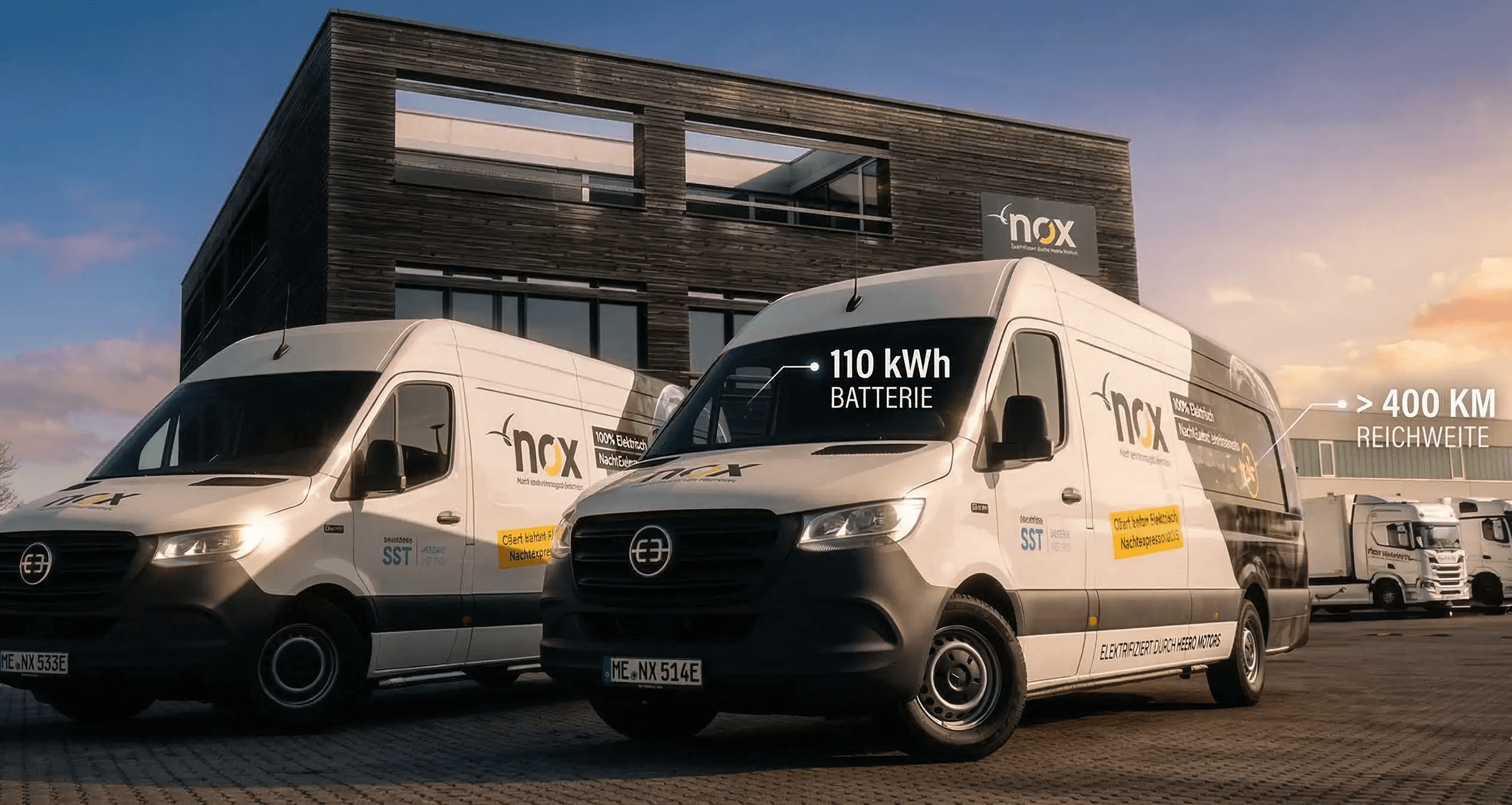
The HEERO conversion is a standardized and highly efficient process. For the Mercedes-Benz Sprinter model 907 we guarantee a conversion time of a maximum of 10 working days (only model series 907). During this time, the complete diesel drivetrain is replaced by our electric drive. The centerpiece is a 110 kWh battery, which enables a practical range of up to 300 km.
The process fully protects your existing investments. The vehicle frame and, above all, expensive special bodies remain untouched. This is a decisive advantage compared to buying a new vehicle, where bodies often have to be redesigned and financed. Our approach is a prime example of the practical application of the circular economy. We preserve assets instead of destroying them.
The technical components are designed for demanding commercial use. With a DC charging capacity of 165 kW, the battery can be charged to 80% in 60-90 minutes. A 22 kW AC charger is available for overnight depot charging. Maintenance of the electric drive is carried out by our mobile technicians, the "Flying HEEROs", directly at your location, which minimizes downtime.
The HEERO portfolio: New e-buses for every need
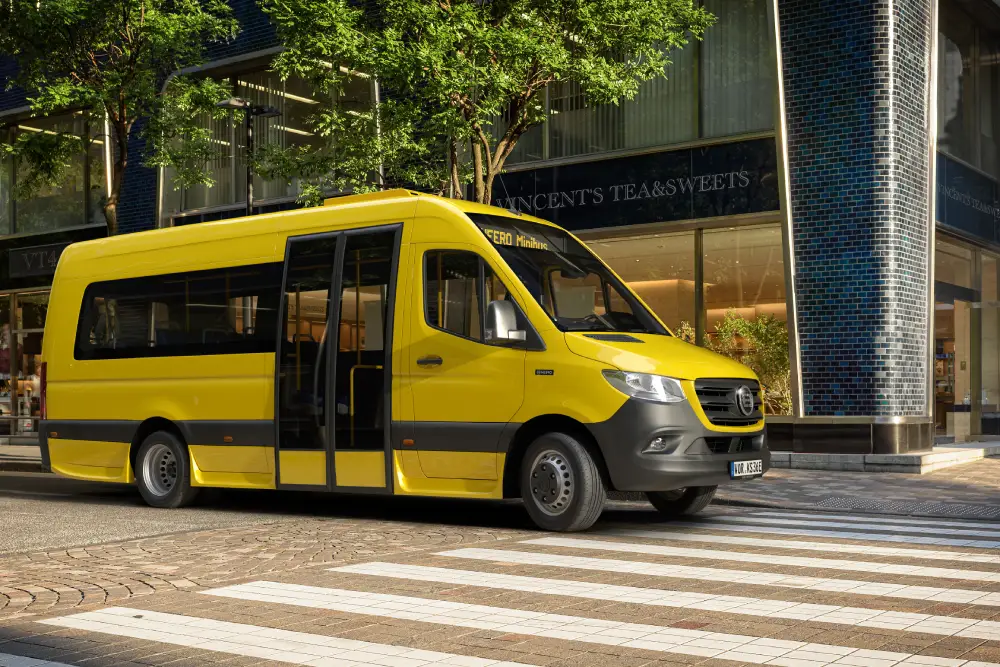
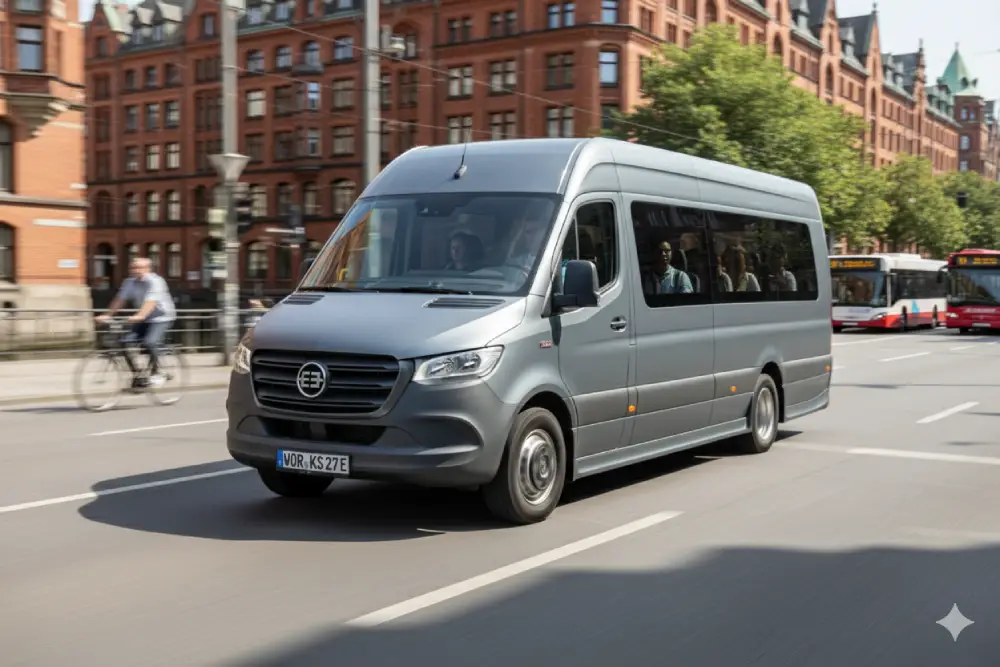
In addition to D2E conversion, we offer a complete portfolio of new electric buses based on the Sprinter. These vehicles are ideal when fleet expansion or the replacement of older vehicles is due. Each model is designed for specific passenger transport requirements and offers a range of over 300 km.
Our range of new vehicles comprises three main variants:
HEERO Mid-Door Low-Entry Midibus: Optimised for scheduled services with easy boarding. Equipped with a 137 kWh battery and 165 kW DC charging capacity.
HEERO Rear-Door Low-Entry Midibus: Offers maximum flexibility for mixed operating profiles in urban and regional transport.
HEERO High-Floor Midibus: Designed for comfort on longer routes, ideal for shuttle services or excursion trips.
All our new vehicles are based on the proven technology of the Mercedes-Benz Sprinter and our more than 10 years of experience in electrification. They not only meet the CVD standards, but also set benchmarks in efficiency and reliability. Compare the performance data of different models and find the perfect solution for your fleet.
FAQ
What warranty is offered on the D2E conversion?
HEERO offers a comprehensive warranty on all components of the electric drivetrain installed by us. This includes the battery, electric motor and power electronics. The exact terms are designed for the high demands of commercial use and protect your investment in the long term. The base vehicle manufacturer’s warranty for unmodified parts generally remains in place.
What is the service life of the installed 110 or 137 kWh battery?
We use exclusively high-quality battery cells, typically based on lithium-nickel-manganese-cobalt (NMC). This technology is known for its high energy density at low weight and strong performance in cold conditions. We calculate a service life of more than 3,500 full charge cycles before capacity drops below 80%. With average use, this corresponds to a service life of well over 10 years in typical fleet operations.
Is a range of more than 300 km realistic even in winter?
The stated range is a WLTP figure. In practice, the range depends on factors such as driving style, topography, payload and outside temperature. In winter, the range may decrease by 20-30% due to the energy required for heating. However, our systems are optimised for these conditions, and the range is also sufficiently dimensioned in winter for most daily routes in regional and urban transport.
What happens to the removed diesel engine and the old components?
In the spirit of a consistent circular economy, the removed components are fed into a recycling process. Functional engines and transmissions are tested and returned to the market as spare parts. Parts that can no longer be used are professionally dismantled and raw materials such as steel, aluminum, and copper are sent for recycling. This is how we minimize the CO2 footprint of the conversion.
Can other Sprinter models besides the 907 also be converted?
Our standardised D2E conversion process is currently optimised for the Mercedes-Benz Sprinter Model 907, ensuring a fast conversion time of 10 days (Model Series 907 only). We are continuously expanding our range. For enquiries about other models or base vehicles such as the 313, 316, 319 or 324, please arrange a bespoke fleet analysis with our expert team.
Does HEERO also offer solutions for charging infrastructure at the depot?
Yes, successful electrification goes beyond the vehicle. HEERO offers comprehensive consulting for depot charging. We analyse your energy requirements, plan the optimal charging infrastructure and implement intelligent load management. This ensures that your fleet is ready for operation every morning with full capacity, without overloading the local electricity grid. This is an integral part of our TCO-optimised end-to-end solution.
More useful links
The Fraunhofer ISI provides a press release on electromobility, which offers insights into current developments and research findings.
The Umweltbundesamt provides comprehensive information on electromobility, including its benefits and challenges for environmentally friendly mobility.
The NOW GmbH provides information on funding programs and support options for setting up charging infrastructure for electric vehicles.