V2X charging solutions: use fleets as mobile energy storage and reduce TCO

Is your electric vehicle fleet standing idle for more than 90% of the day? With V2X charging options, that downtime becomes an active source of revenue. Discover how you can use your converted Sprinter vehicles as mobile energy storage units to reduce costs and help stabilise the grid.
The topic briefly and concisely
V2X technology turns e-fleets into mobile energy storage systems that can stabilise the power grid and generate revenue.
With Vehicle-to-Grid (V2G) and Vehicle-to-Building (V2B), fleets can lower energy costs and actively reduce total cost of ownership (TCO).
The HEERO eDrive system, based on 400V, provides the technical foundation for the economical implementation of V2X concepts.
Rising energy costs and volatile power grids present fleet operators with new challenges. At the same time, with your electrified vehicle fleet you have a valuable but often underused asset: mobile energy storage. V2X charging technology turns your parked HEEROs into active participants in the energy market. Rather than merely generating costs, your vehicles can use their batteries to generate revenue, shave peak loads at your own depot and stabilise the public grid. This strategic deployment is a key lever for reducing total cost of ownership (TCO) and rapidly meeting CVD quotas.
V2X technology: from a pure consumer to an active grid stabiliser
Vehicle-to-Everything (V2X) is the umbrella term for technologies that enable bidirectional energy transfer. This means that electricity flows not only into your vehicle, but can also flow back again when needed. This capability opens up completely new use cases and revenue models for fleet operators. The technology is governed by the international standard ISO 15118-20, which ensures secure communication between the vehicle, charging point and grid.
The most important V2X applications for commercial fleets include:
Vehicle-to-Grid (V2G): Your vehicles feed electricity back into the public grid to balance fluctuations. In return, you receive remuneration from the grid operator.
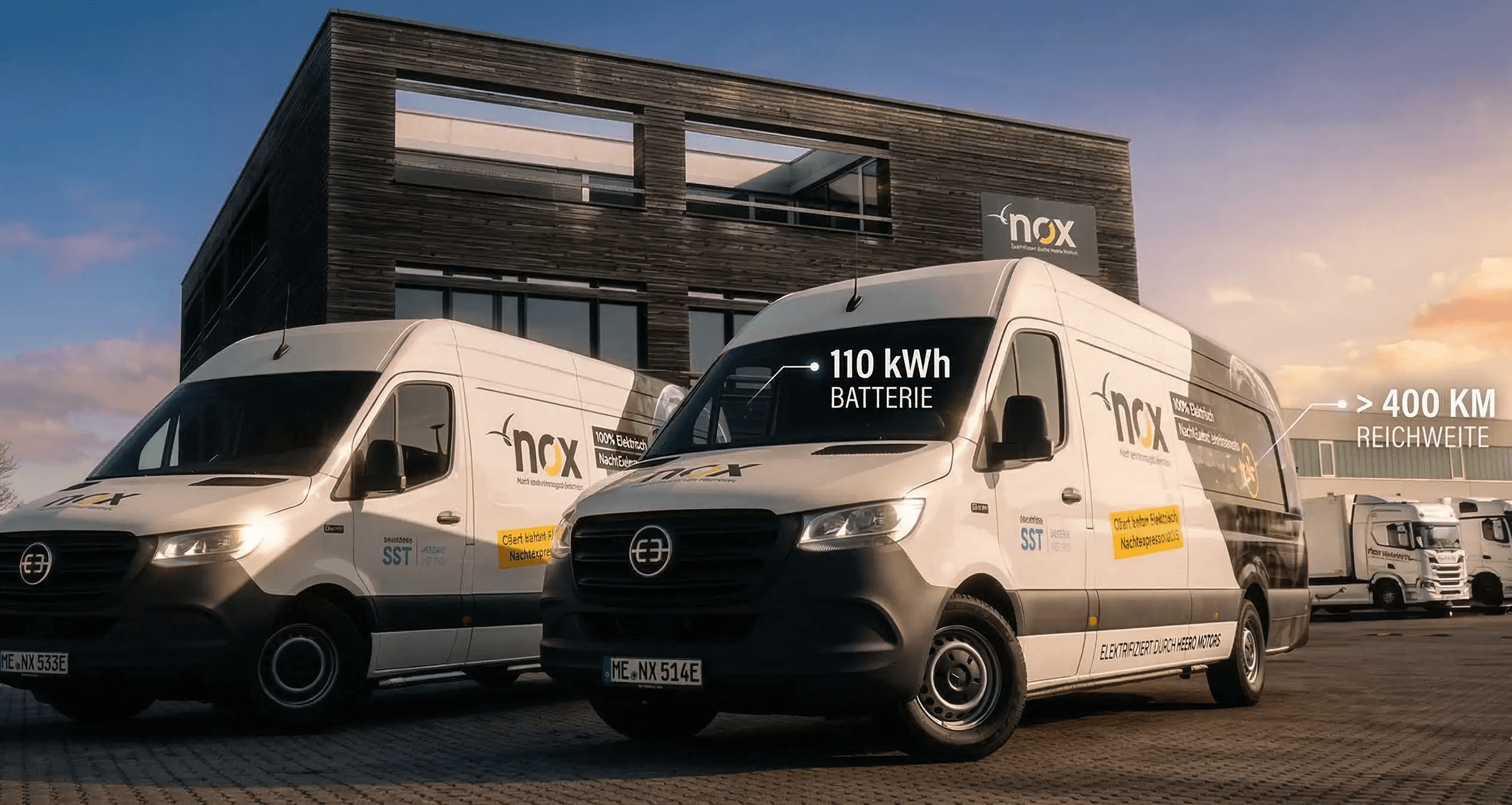
Vehicle-to-Building (V2B): The vehicle batteries supply your own operating building with electricity to avoid costly load peaks (peak shaving). A HEERO with a 110-kWh battery can supply a small office with power for over 8 hours.
Vehicle-to-Load (V2L): Your HEEROs become a mobile power socket and supply tools or devices directly on site with up to 3.6 kW of power.
This flexibility makes your fleet an integral part of your company's energy management. The potential for reducing TCO is considerable, as the economic analysis shows.
Reducing TCO through V2G: Monetising Downtime
Each parked electric vehicle is an untapped resource. With Vehicle-to-Grid (V2G), you can activate this resource and realise direct financial benefits. Studies show that V2G can generate annual savings of several hundred euros per vehicle. A fleet of 50 vehicles can therefore generate a five-figure sum each year. This revenue comes from participation in energy markets, where you are compensated for providing balancing power. Fleet vehicles with predictable downtime, such as those commonly used in trades and delivery services, are particularly well suited to V2G applications.
Another lever for reducing costs is peak shaving at your own depot. Instead of drawing expensive peak-load electricity from the utility, you use the lower-cost stored electricity from your vehicle batteries. This can reduce your depot’s electricity costs by up to 30 per cent. The economic benefits of electrification are therefore maximised through V2G. The technological and regulatory foundations for these models are already in place.
Technical requirements and regulatory progress
The technical basis for V2X is the communications standard ISO 15118-20, which ensures interoperability between vehicles and charging stations. To use V2G and V2B, you need a bidirectional DC wallbox. HEEROs are technically prepared for these applications with their 165 kW DC charging capability and CCS connector. Our experts in depot charging infrastructure will advise you on the selection and implementation of the right hardware.
The legal framework in Germany is also developing positively. With the amendment to the Energy Industry Act (EnWG) at the end of 2025, key hurdles such as the double charging of grid fees for fed-back electricity were abolished. From 2026, electric vehicles will be treated legally like stationary storage systems, which significantly increases the economic attractiveness of V2G models. This regulatory clarity creates the necessary investment security for fleet operators. The foundations of bidirectional charging are therefore in place to future-proof your fleet.
Practical applications: from emergency generator to mobile power station
The possible applications of V2X go far beyond pure grid stabilisation and offer concrete added value in day-to-day operations. For example, a municipal works depot can use its HEERO FlatBed vehicles to power emergency lighting or important tools in the event of a power outage (V2L). This increases resilience and avoids the use of noisy, high-emission diesel generators. A logistics company can use its HEERO fleet overnight as buffer storage for its own photovoltaic system, optimising self-consumption to almost 100% (V2B).
These use cases show how the HEERO eDrive system becomes far more than just a means of transport. It becomes a multifunctional tool that increases energy self-sufficiency and reduces operating costs. Intelligent control ensures that mobility is never restricted; by the planned departure time, the vehicles are usually sufficiently charged. Concern about battery safety and longevity is addressed through intelligent charging and discharging strategies.
HEERO eDrive System: The ideal foundation for your V2X strategy
A HEERO vehicle, either as a new vehicle or with D2E conversion (Diesel-to-Electric), is a fast and cost-effective way to build a V2X-capable fleet. Within a maximum of 10 working days (Sprinter model series 907), we convert your existing vehicle into a modern electric vehicle with a 110 kWh or 137 kWh battery - the ideal capacity for effective V2X applications. You not only retain your valuable specialist bodywork, but also create the basis for new revenue streams and cost savings in the energy sector.
Our approach goes beyond the vehicle. HEERO are e-mobility experts and, together with our cooperation partners, support you with holistic planning: from analysing your driving profiles to specifying the depot charging technology and integrating intelligent load and charging management. This ensures that you can fully exploit the potential of your electrified fleet and set the course for future-proof, economical and CVD-compliant mobility. Arrange a consultation to receive your individual TCO analysis and V2X potential assessment.
More useful links
The Federal Ministry for Economic Affairs and Climate Action offers a comprehensive dossier on electromobility in Germany.
The Fraunhofer IAO provides information in a press release about the concept of 'power on four wheels' in the context of electromobility and bidirectional charging.
The TÜV Association outlines in a press release the necessary foundations for the safe market introduction of bidirectional charging.
The NOW GmbH provides a factsheet comparing different drive types for passenger cars.
FAQ
What is the difference between V2G and V2B?
Vehicle-to-Grid (V2G) refers to feeding electricity from the vehicle battery back into the public electricity grid to help stabilise it. Vehicle-to-Building (V2B) uses the electricity to cover the energy needs of the building itself, for example to cut expensive peak loads (peak shaving).
Do I need a special wallbox for V2X?
Yes, for V2X applications such as V2G and V2B, a bidirectional DC charging station is required. It can control the flow of electricity in both directions. Conventional (unidirectional) wallboxes cannot do this. Our charging infrastructure experts will advise you on selecting the right technology for your depot.
Does bidirectional charging affect the service life of the vehicle battery?
Current studies, including those from RWTH Aachen, show that the impact of V2G on battery ageing is minimal when managed intelligently. Intelligent charging and discharging strategies that avoid extreme states of charge ensure that the battery service life is hardly affected, while significant economic benefits are realised at the same time.
Is the HEERO eDrive system V2X-capable?
Yes, our 400V systems are technically prepared for V2X thanks to bidirectional technology. They feature the required CCS charging connector and a large 110 kWh battery, providing an ideal foundation for V2G and V2B applications. Final activation depends on the charging technology used and the backend system.
What role does the ISO 15118 standard play?
ISO 15118, in particular the -20 part standard, is the key communications standard for bidirectional charging. It governs the secure and standardised exchange of data between the electric vehicle, the charging station and the power grid backend. This is the prerequisite for interoperability and the automated billing of V2G services.
When can broad availability of V2G in Germany be expected?
Technically, V2G is already possible today in pilot projects. With the legislative adjustments at the end of 2025, which will take effect from 2026, the greatest economic barriers will be removed. We expect commercial V2G offerings for fleet customers to become increasingly available throughout 2026, once the corresponding tariffs and billing processes have been established.