Is 22 kW AC charging enough for commercial vehicle fleets? A TCO analysis

Fleet managers face the decision: is 22 kW AC charging at the depot sufficient, or are expensive DC fast chargers necessary? The answer lies in analysing dwell times and total cost of ownership (TCO). For over 90% of use cases, the AC solution is not only sufficient, but clearly superior.
The topic briefly and concisely
For a 110 kWh battery, charging time at a 22 kW AC charging station is only 5 hours, which is entirely sufficient for overnight downtime of 8–12 hours...
The purchase and installation costs of 22 kW AC wallboxes are significantly lower than those of DC fast-charging stations.
Intelligent load management avoids costly grid connection upgrades and ensures that all vehicles are ready for service in the morning.
The electrification of commercial vehicle fleets is not a question of if, but how. A central, often overlooked lever for economic efficiency is the charging strategy. While DC fast charging (direct current) promises high performance, a pragmatic question arises for fleet operators: Is this even necessary for daily operations in the depot? The analysis shows that charging with 22 kW alternating current (AC) is usually the smarter choice. It optimizes the Total Cost of Ownership (TCO), protects the battery, and ensures the operational readiness of the vehicles – right where they spend most of their time: overnight in the depot.
Charging time analysis: 5 hours for a full shift
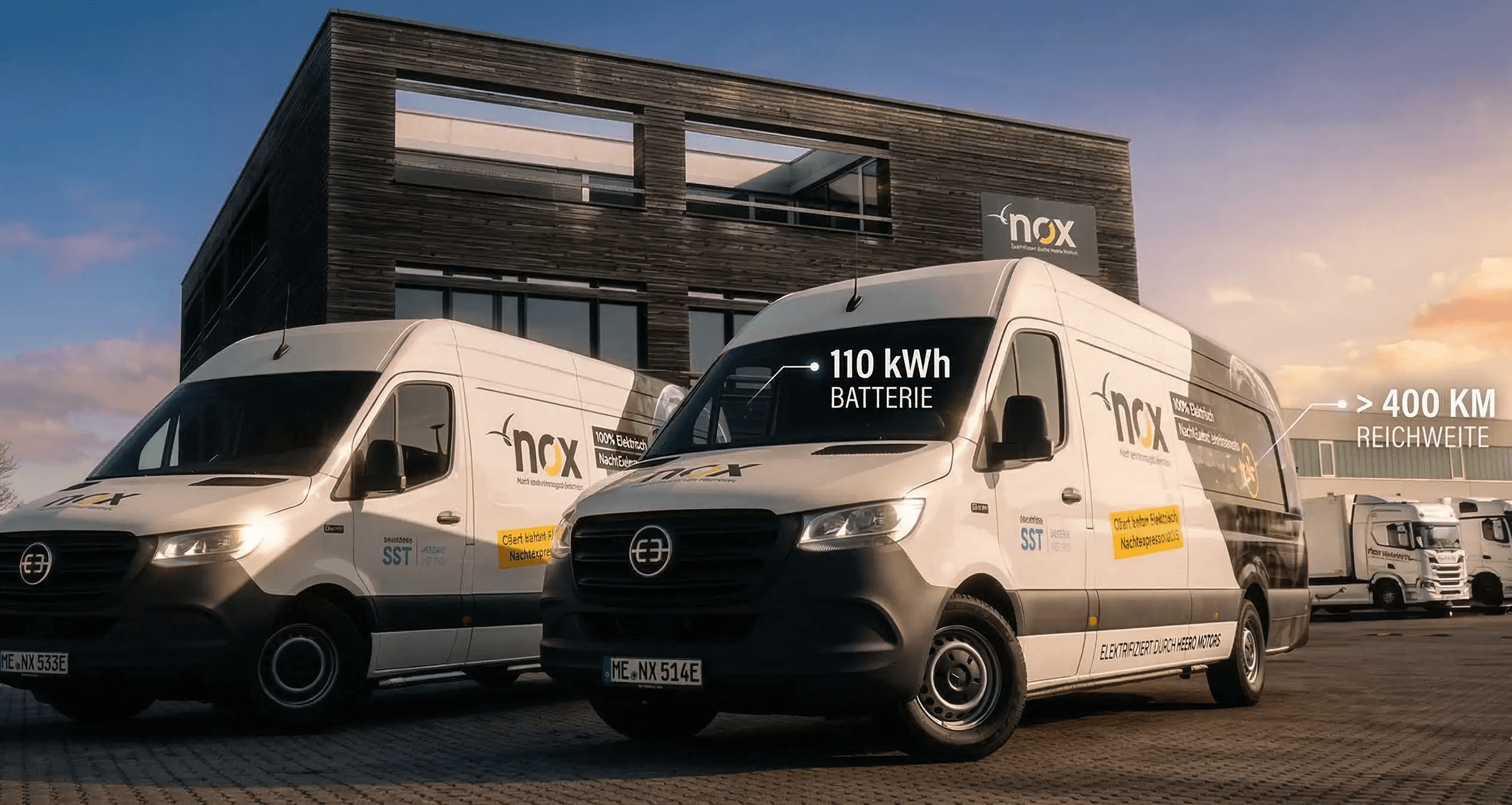
The core question of charging infrastructure can be answered mathematically. A HEERO Sprinter with a 110-kWh battery requires exactly 5 hours for a full charge at a 22-kW AC wallbox (110 kWh / 22 kW). Typical commercial vehicles in municipal or last-mile operations have overnight idle times of 8 to 12 hours. This means there is more than enough time available for a full charge. This simple calculation proves that higher charging capacities are not required for overnight depot charging. The vehicles are fully ready for operation every morning with 100% capacity and a range of up to 425 km. Operational reliability is thus fully guaranteed without having to invest in more expensive infrastructure. This efficiency in the utilization of idle time is the first building block for TCO reduction.
TCO benefit of AC charging: significantly lower infrastructure costs
The decision between AC or DC charging has a massive impact on the total cost of ownership. AC wallboxes are significantly cheaper to purchase and install than DC fast-charging stations. The costs for DC systems can quickly be five to ten times higher, especially if a new medium-voltage connection becomes necessary. In addition, the slower AC charging is gentler on the battery, which extends the lifespan of the 110 kWh battery and secures the residual value of the vehicle. The savings in infrastructure can add up to tens of thousands of euros per location.
An overview of the key cost advantages of 22 kW AC charging:
Lower hardware costs: A 22 kW wallbox costs only a fraction of a 50 kW DC charging station.
Reduced installation costs: Connection to the existing low-voltage grid is often possible without expensive grid expansion.
No charging losses: Modern AC systems operate with an efficiency of over 95%.
Longer battery lifespan: Gentle charging cycles significantly reduce the degradation of the battery cells over the holding period.
These factors make 22 kW AC charging the most economical method for plannable charging in the depot.
DC rapid charging: the exception, not the rule
Despite the advantages of AC charging, DC charging also has its place, albeit in a different role. DC charging is designed for "opportunity charging" – quick recharging on the go to extend the range during unexpected trips. The HEERO Sprinter can charge with up to 165 kW of direct current and thus reaches an 80% state of charge in just 60 to 90 minutes. This is ideal for vehicles in 2-shift operations or on very long, unscheduled routes. However, for over 90% of fleets, this is a rare use case. The strategic question is not AC or DC, but the right balance. The foundation is usually cost-effective AC charging at the depot. DC charging is a supplement for specific operational peaks, not a basis for daily operations.
Ensuring grid stability: intelligent load management as the key
If an entire fleet charges simultaneously at 22 kW, the grid connection capacity can quickly reach its limits. Ten vehicles would simultaneously require 220 kW of power. An intelligent load management system is the solution here. It dynamically distributes the available power among the connected vehicles. This ensures that the depot's maximum connection capacity is never exceeded, while still ensuring that all vehicles are fully charged in the morning. Such a system avoids expensive peak loads and can significantly reduce annual grid fees.
The process of intelligent load management typically takes place in these steps:
Analysis: The system records the State of Charge (SoC) of each individual vehicle battery.
Prioritization: Vehicles with a low SoC or an earlier departure time are prioritized.
Distribution: The total available power is staggered and dynamically distributed among the vehicles.
Monitoring: The charging process is continuously monitored and adjusted in order to stabilize the grid.
HEERO offers comprehensive depot charging consulting to plan such a customized and cost-effective charging infrastructure.
CVD compliance and operational reliability through predictable charging
The EU's Clean Vehicles Directive (CVD) exerts significant pressure on public contracting authorities and their service providers to decarbonise their fleets. Procurement quotas for clean commercial vehicles stand at 38.5%. A reliable charging infrastructure is the foundation for meeting these statutory requirements and maintaining operations. A depot infrastructure based on 22 kW AC charging offers maximum operational reliability. The vehicles are ready for use according to plan every day. This reliability is a crucial factor for the fulfillment of service contracts and the avoidance of contractual penalties. The conversion by HEERO in combination with well-thought-out charging planning ensures that fleet operators not only meet the CVD quotas, but also do so in the most economical way.
FAQ
Is 22 kW AC charging sufficient for any fleet size?
Yes, a charging capacity of 22 kW is generally suitable for fleets of any size. What matters is not the output per vehicle, but intelligent load management that distributes the total capacity of the grid connection optimally across the vehicles. This means that 20 or more vehicles can also be charged reliably overnight without overloading the electricity grid.
What happens if my vehicle can only charge at 11 kW AC?
A 22 kW wallbox is backwards compatible. If your vehicle only supports a charging capacity of 11 kW, it will also only charge at this rate. The charging time for a 110 kWh battery then doubles to around 10 hours, which is generally still more than sufficient for most overnight idle periods. However, investing in 22 kW infrastructure is future-proof.
Do I need approval for 22 kW wallboxes?
Yes, in Germany charging installations with a power output of more than 11 kW must be approved by the responsible grid operator before installation takes place. This helps ensure grid stability. HEERO supports these processes as part of depot charging consultancy, helping to ensure smooth planning and commissioning.
Does frequent 22 kW charging damage the vehicle battery?
No, charging at 22 kW AC is considered standard charging and is very gentle on the lithium-ion battery. Compared with DC fast charging at 165 kW or more, it creates significantly less thermal stress, which slows cell ageing and maximises the battery’s service life. This has a positive effect on the vehicle’s TCO and resale value.
How high are the charging losses when charging with 22 kW AC?
Modern on-board chargers in vehicles such as the HEERO D2E Sprinter work very efficiently. Charging losses during conversion from alternating current to direct current are typically only 5 to 8%. That means that of the 22 kW of power supplied by the wallbox, over 20 kW are fed directly into the battery. This is an excellent figure for energy efficiency.
Can I also combine DC chargers with a 22 kW charging infrastructure?
Yes, a hybrid charging infrastructure is often a sensible strategy. The basis for predictable overnight charging is provided by the cost-efficient 22 kW AC wallboxes. For operational emergencies or vehicles in multi-shift operation, a single DC fast charger can be installed as a “joker” option. HEERO analyses your individual requirements and plans the optimal combination.
More useful links
Kraftfahrt-Bundesamt (KBA) offers detailed statistics on electromobility in Germany.
Bundesministerium für Digitales und Verkehr (BMDV) provides information on commercial vehicles with alternative drivetrains in the context of climate protection in transport.
Nationale Leitstelle Ladeinfrastruktur provides information and resources specifically for commercial vehicles.
NOW GmbH offers an overview of studies on the total cost of ownership (TCO) of climate-friendly commercial vehicles.
The International Council on Clean Transportation (ICCT) highlights the total cost of ownership (TCO) of battery-electric commercial vehicles in Europe, with a focus on Germany, in a factsheet.
Bundesnetzagentur provides comprehensive information on the topic of electromobility.