Electric Tipper: Significantly lower TCO while retaining your expensive custom body

Are you facing the challenge of electrifying your tipper fleet in compliance with the Clean Vehicles Directive, without having to write off your valuable bodies?
Topics on this page
The topic briefly and concisely
Significantly reduce the operating costs of your tipper truck through lower energy and maintenance costs compared to diesel.
Preserve 100% of your expensive custom bodies and avoid bad investments by continuing to use your MB Sprinter 907 with our Diesel-to-Electric (D2E) conversion.
Meet Clean Vehicles Directive (CVD) procurement quotas (38.5% for light commercial vehicles) quickly and efficiently without purchasing new vehicles.
The electrification of commercial vehicle fleets is no longer an option for municipalities and businesses, but a commercial and legal necessity. Especially with specialized vehicles like the electric tipper, the high costs of new vehicles and the loss of proven bodies represent a massive hurdle. The D2E (Diesel-to-Electric) conversion (Diesel-to-Electric) from HEERO for the Mercedes-Benz Sprinter (model 907) solves this dilemma. It enables rapid electrification in a maximum of 10 working days (model series 907 only), secures the value retention of your specialized bodies, and reduces operating costs by up to one third.
TCO Reduction: Reduce operating costs by over 50%
Total Cost of Ownership (TCO) is the decisive factor for fleet managers. An Electric FlatBed based on a D2E-converted Sprinter significantly reduces running costs. Energy costs per 100 kilometers are around 6 euros, while a comparable diesel flatbed consumes approximately 14.40 euros. This corresponds to a saving of almost 60% on "fuel costs" alone.
Maintenance is also a key lever for reducing costs. Maintenance costs for an electric transport vehicle can be significantly lower over a five-year period than for its diesel counterpart. Typical servicing tasks such as oil changes, exhaust system maintenance, or the replacement of wear parts on the combustion engine are completely eliminated. This leads to a reduction in workshop time of at least 40%.
Additionally, operators benefit from tax advantages and lower levies. In Germany, pure electric vehicles are exempt from vehicle tax for 10 years. These direct savings improve the TCO balance from day one and accelerate the amortization of conversion costs. A detailed analysis of your fleet costs will reveal the full potential. The combination of these factors makes the Diesel-to-Electric conversion the economically smartest decision.
Preserving value: Keep using 100% of your customized bodies
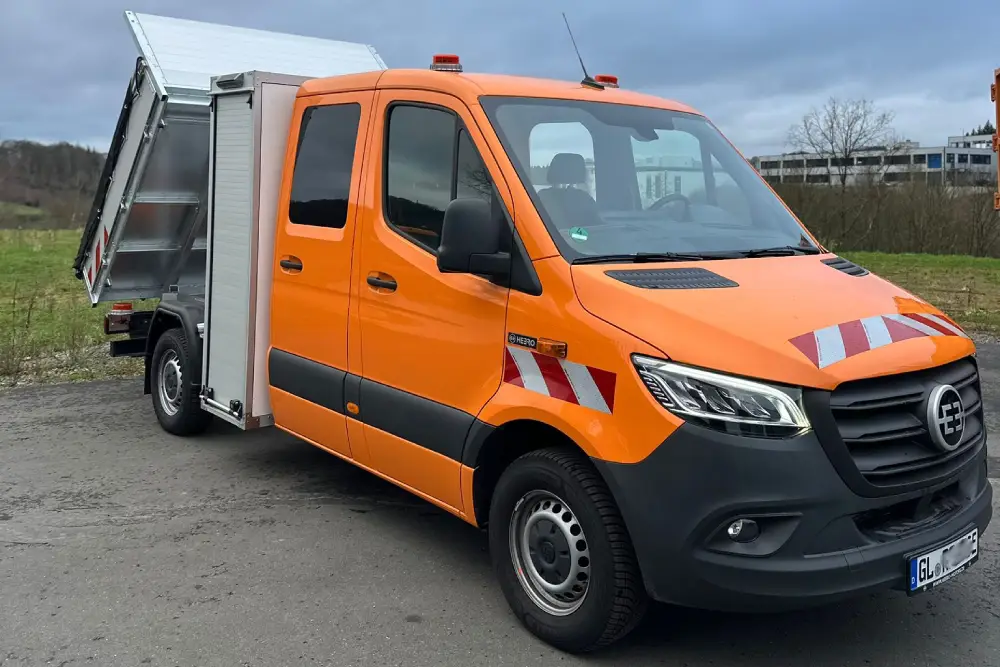
A tipper body for a Mercedes-Benz Sprinter often costs between 10,000 and 25,000 euros. When purchasing a new electric vehicle, this investment is lost. The HEERO D2E conversion focuses on the chassis of the Sprinter 907 and fully preserves the expensive custom body. Your proven vehicle remains 100% intact with all of its functions.
The conversion process is designed for maximum efficiency and takes just 10 working days for the 907 model (907 model range only). This minimizes vehicle downtime compared to the months of waiting for a new chassis and body. The following steps ensure quality:
Dismantling of the diesel drivetrain
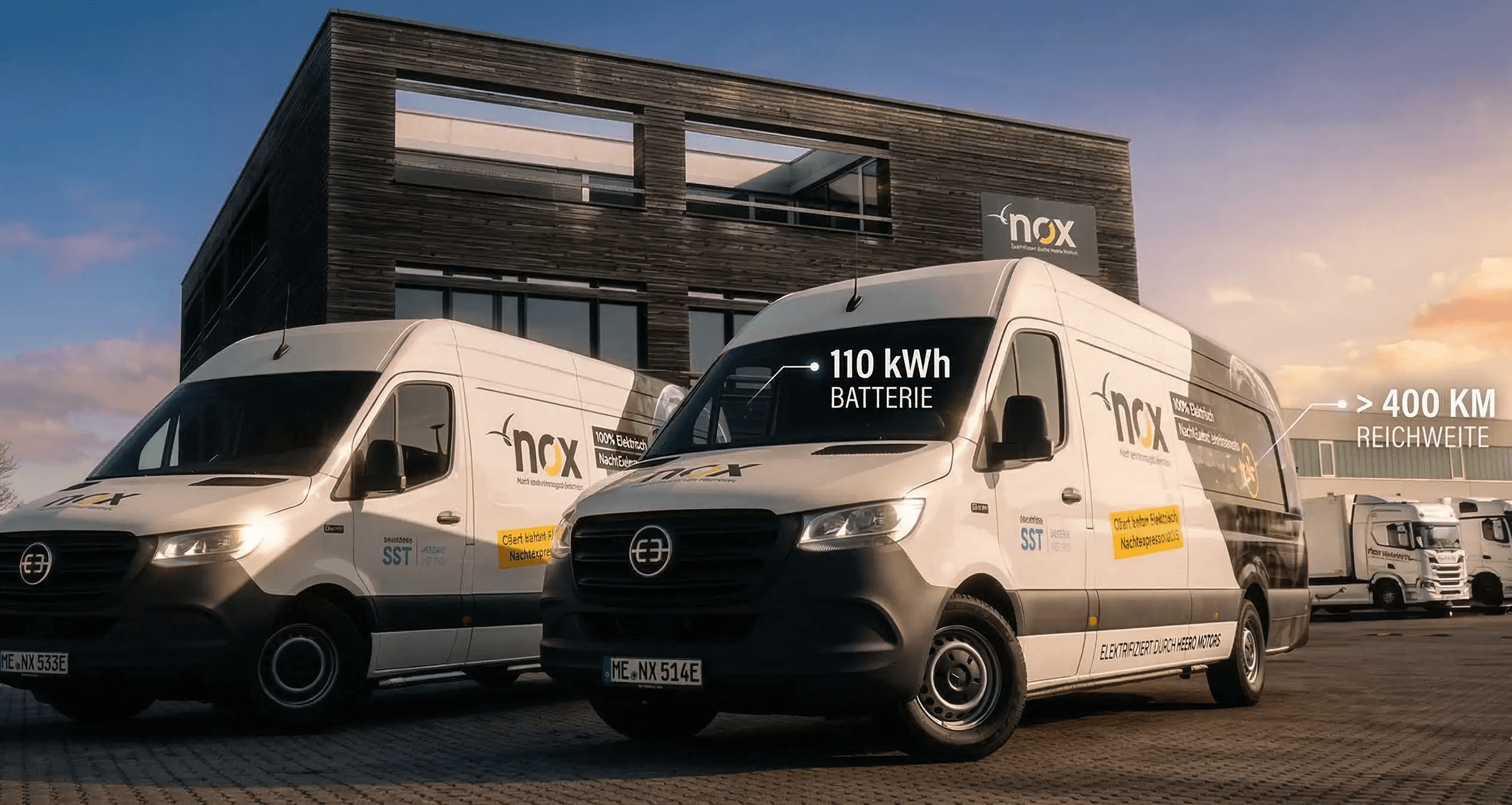
Integration of the HEERO eDrive with 110 kWh battery
Adaptation of vehicle systems and interfaces
Quality assurance and test drives according to applicable standards
This approach not only protects your budget, but also promotes the circular economy by continuing to use existing resources. Instead of discarding a functioning vehicle, it is upgraded for a second, emission-free lifespan. Learn more about our solutions for special-purpose vehicles and how we preserve their value. This makes electrification predictable and conserves valuable resources.
CVD Compliance: Efficiently meeting statutory quotas
The EU's Clean Vehicles Directive (CVD) is putting public contracting authorities under pressure to act. By the end of 2025, 38.5% of light commercial vehicles procured in Germany must be classified as "clean". For heavy commercial vehicles, the quota is 10%. The D2E conversion is the fastest way to achieve these binding minimum targets without having to replace the entire fleet.
A converted electric tipper counts as a zero-emission vehicle and contributes fully to meeting the quota. This is particularly relevant for municipalities and their service providers, who must meet the requirements of the German Clean Vehicles Procurement Act (SaubFahrzeugBeschG) in public tenders. The conversion of a single tipper can already significantly improve the quota.
From 2026, the regulations will tighten further: the 38.5% quota for light vehicles will then apply exclusively to completely zero-emission models. Transitioning early ensures legal compliance and avoids bottlenecks in vehicle procurement. With an electrified Sprinter, you are more than one step ahead of the legal requirements. The strategic conversion of existing fleets is therefore a central building block for a future-proof procurement strategy.
Practicality: Performance and range for the daily workday
An electric tipper must perform reliably in demanding daily work. The Sprinter converted by HEERO is equipped with a 110 kWh battery, enabling a practical range of up to 300 km (WLTP). This fully covers typical daily operations in the municipal, construction, or gardening and landscaping sectors. The performance of the electric motor ensures high torque from the very first turn, which is particularly advantageous when loaded.
The charging capacity is optimized for commercial use. At a 165 kW DC fast-charging station, the battery is charged to 80% in 60 to 90 minutes. For planned overnight charging at the depot, an AC charging capacity of 22 kW is available. This charging flexibility ensures maximum vehicle availability of over 95% in single-shift operations.
There are also no compromises when it comes to payload and towing capacity. The well-thought-out integration of the battery components ensures that the Diesel-to-Electric conversion does not limit the functionality of the tipper. Information on the towing capacity of electric commercial vehicles shows that modern systems can also handle heavy tasks. The technical specifications prove that the converted electric tipper is in no way inferior to a new electric vehicle.
More useful links
The Federal Motor Transport Authority (KBA) provides detailed data and analyses on vehicle registrations.
Statista provides statistics on the stock of trucks with alternative drivetrains in Germany and offers insights into their distribution.
The Federal Environment Agency (UBA) provides data on transport infrastructure and the vehicle fleet, including information on the composition of the German vehicle fleet.
The NOW GmbH offers detailed figures and trends on new registrations and fleets of passenger cars, trucks, and buses in its data finder.
The Federal Office for Logistics and Mobility (BALM) provides information on the Climate Protection and Mobility (KSNI) funding program to support climate-friendly commercial vehicles.
The ICCT (International Council on Clean Transportation) offers a factsheet on the Total Cost of Ownership (TCO) of battery-electric trucks in Europe, specifically for Germany.
FAQ
How long does the D2E conversion of a Sprinter tipper take?
The D2E conversion of a Mercedes-Benz Sprinter (model 907) is a standardized process designed for maximum efficiency. As a rule, the complete electrification of your FlatBed Tipper takes no longer than 10 working days (model series 907 only). This significantly minimizes downtime in your fleet.
Will my FlatBed Tipper retain its payload capacity after the Diesel-to-Electric (D2E) conversion?
Yes, payload capacity is carefully factored into the conversion design. Through the intelligent placement of the 110 kWh battery and the lightweight eDrive components, we ensure that the payload of your Tipper remains highly practical for standard construction or municipal applications, with only a marginal difference from the original diesel vehicle.
What warranty does HEERO offer on the conversion?
HEERO offers a comprehensive warranty on all components of the electric drivetrain installed by us, including the battery. In this way, we secure your investment and guarantee the reliability and longevity of our D2E conversion (Diesel-to-Electric) for at least 24 months.
Can any tipper body on the Sprinter 907 be converted?
Our D2E conversion is specially designed for the Mercedes-Benz Sprinter 907 chassis. It is compatible with the vast majority of tipper bodies based on this platform, including three-way tippers and skip loaders. For a precise compatibility check, please contact our technical team for a comprehensive fleet analysis.
What happens to the removed diesel engine?
In line with the circular economy, the removed diesel engines and transmissions are not discarded. They are professionally reconditioned and returned to the spare parts market. This process conserves valuable resources and is an integral part of our sustainability-focused corporate philosophy.
Does HEERO also offer support for the charging infrastructure?
Yes, we offer holistic consulting for depot charging infrastructure. Our experts analyze your requirements, plan the optimal configuration of AC charging points (up to 22 kW), and develop concepts for intelligent load management. This ensures that your electric tipper fleet is charged reliably and cost-effectively every single night.