Wallbox at the depot: optimise TCO for electric commercial vehicles and meet CVD quotas

The electrification of commercial vehicle fleets is no longer an option, but a commercial and legal necessity.
Topics on this page
The topic briefly and concisely
Depot charging with 22 kW AC wallboxes reduces TCO by using lower-cost night-time electricity tariffs and maximises fleet availability.
Intelligent load management avoids costly grid connection upgrades and significantly reduces annual energy costs.
The combination of the HEERO eDrive system and depot charging is the fastest way to meet the rising CVD quotas for light commercial vehicles from 2025 onwards.
From 2025, fleet managers face a dual challenge: keeping costs under control while also meeting the statutory requirements of the Clean Vehicles Directive (CVD). By the end of 2025, the CVD already required a quota of 38.5% for clean, light commercial vehicles. However, a key to easing the cost burden does not lie in public charging, but at your own depot. A strategically planned charging infrastructure with AC wallboxes at the depot is the most economical method for charging electric commercial vehicles overnight. This not only significantly reduces energy costs, but also maximises the availability of your fleet for the next working day.
Depot charging as a strategic lever for reducing TCO
Charging at your own depot is the most economical way to operate an electric fleet. Energy costs here are typically 40-60% lower than at public DC fast-charging stations. By scheduling overnight charging with 11 or 22 kW AC wallboxes, you benefit from lower night-time tariffs and ensure 100% vehicle availability at the start of the shift. This alone can reduce the TCO per vehicle by several thousand euros per year. Appropriate depot charging infrastructure is crucial to fully realise this potential. Investment in your own infrastructure often pays for itself in as little as 2-3 years through lower operating costs alone. This turns electrification from a cost factor into a competitive advantage. Because from 01.01.2026, the requirement for the share of zero-emission vehicles under the CVD regulations will increase further.
Technical requirements for wallboxes in a commercial depot
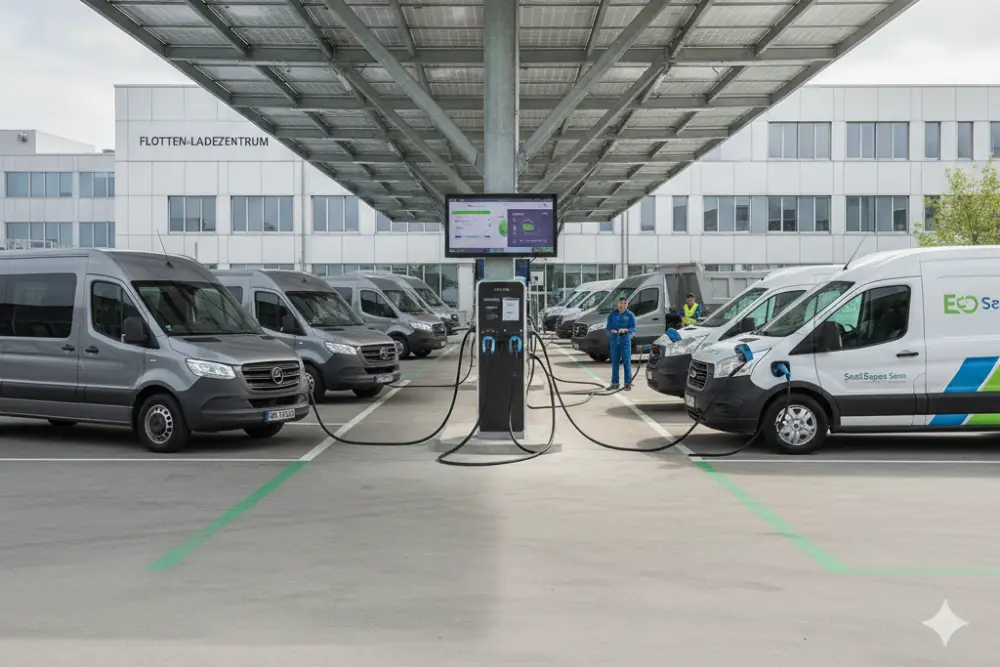
The selection of the right wallboxes for an electric commercial vehicle depot requires a detailed analysis. For typical overnight charging, 22 kW AC wallboxes are the most efficient solution. They fully charge the 137 kWh battery of a HEERO eDrive system in approx. 7 hours. Installation must be carried out by a qualified electrician in accordance with standards such as DIN VDE 0100-722 to ensure operational safety. Important technical features are:
Charging power: 22 kW (AC) for predictable, overnight charging processes.
Connector type: The Type 2 connector is the European standard for AC charging.
Authorisation: RFID cards or app control prevent unauthorised use.
Connectivity: LAN or WLAN capability for integration into a load management system.
Many businesses overlook the need for a scalable concept from the outset. A modular system makes it easy to expand charging points as your fleet grows. The distinction between AC and DC charging is fundamental to the cost structure. While AC charging is the norm, DC charging points with 165 kW can be strategically added for rapid top-up charging.
Intelligent load management to avoid costly grid peaks
A high-performance grid connection is often a limiting factor, and expanding it involves costs of over €100,000. Intelligent load management can be a solution to make optimal use of the available grid capacity. It dynamically distributes the available power across all charging vehicles. This ensures that the maximum grid connection point is never exceeded, avoiding costly load peaks and high network charges. Significant savings in annual energy costs can thereby be realised. The implementation of such a system is a core component of the HEERO depot charging consultancy provided by affiliated partners.
An intelligent system takes various factors into account for an optimal charging strategy:
Departure times: Vehicles that are needed earlier are given priority.
Battery status (SoC): The charging requirement of each individual vehicle is controlled individually.
Electricity prices: The system can automatically shift charging to times with favourable electricity tariffs.
PV integration: Surplus solar power from the rooftop installation can be used directly.
This technology makes an expensive upgrade of the grid connection unnecessary in over 70% of cases. Well-conceived load management in the depot is therefore not a luxury, but an economic necessity for every growing e-fleet. It forms the basis for stable and cost-efficient operations.
CVD compliance through the combination of HEERO commercial vehicles and depot charging
The Clean Vehicles Directive (CVD) is the decisive legislative driver for fleet electrification. By the end of 2025, 38.5% of newly procured light commercial vehicles and 10% of trucks had to be low-emission. By choosing HEERO commercial vehicles in combination with an optimized depot charging infrastructure, you create a solution that is sustainable both in terms of emissions and cost-effectiveness. HEERO supports you in the holistic electrification of your fleet, from analysis to commissioning. This way, you not only meet the legal requirements but also secure long-term cost advantages.
FAQ: Frequently Asked Questions about Charging Infrastructure at the Depot
FAQ
Which charging power is right for my depot?
For scheduled overnight charging of commercial vehicles, AC wallboxes with 22 kW charging power are generally the most economical and technically sound solution. They enable a full charge of the 137 kWh battery of a HEERO eDrive system in just under 7 hours, without placing unnecessary strain on the power grid. DC fast chargers with 165 kW are only suitable for specific use cases where vehicles need to be recharged quickly during the working day.
Do I need to upgrade my grid connection for the charging infrastructure?
Not necessarily. In most cases, an expensive expansion of the grid connection can be avoided by means of an intelligent, dynamic load management system. This system distributes the available power optimally across the vehicles being charged and thus prevents overloads. An analysis of your connection capacity and charging requirements is the first step that the HEERO experts carry out as part of a depot consultation.
How long does it take to install wallbox infrastructure at the depot?
The installation period depends greatly on the scope and the site conditions. The installation of individual wallboxes can be completed within a few days. For larger charging parks involving civil engineering works, new supply lines and the integration of a load management system, implementation typically takes several weeks. Early planning is crucial to avoid delays caused by approval processes or the grid operator.
What is the difference between a wallbox for home use and one for a commercial depot?
Commercial wallboxes are designed for heavier use and a greater number of charging cycles. They also offer important functions for fleet operations, such as RFID authorisation, connection to a backend system for billing and monitoring, and the ability to be integrated into load management. Private wallboxes generally do not offer these professional features.
Can HEEROs also be charged at the depot?
Yes, absolutely. A HEERO has a standardised Type 2 connection for AC charging at up to 22 kW, as well as a CCS connection for DC charging at up to 165 kW. The vehicles can be seamlessly integrated into any standards-compliant charging infrastructure at the depot.
How is the operational reliability of the charging infrastructure ensured?
Safety is ensured by strict compliance with technical standards and regulations, such as DIN VDE 0100-722. This includes installation by certified electrical specialists, the use of residual current devices (RCDs) and miniature circuit-breakers, as well as regular maintenance and inspections of the system (E-Check). HEERO and its partners work exclusively to these high standards.
More useful links
The ICCT offers a fact sheet on the total cost of ownership (TCO) of battery-electric trucks (BETs) in Europe.
Transport & Environment provides a briefing on the decarbonization of long-haul road freight in Germany.
NOW GmbH offers a study overview on the total cost of ownership (TCO) of climate-friendly commercial vehicles.
Fraunhofer ISI publishes a feasibility study on delivery services with battery-electric trucks.
Nationale Leitstelle Ladeinfrastruktur offers information and resources for commercial vehicles.
NOW GmbH provides a guide to simple charging of electric commercial vehicles at depots.
Deutsche Energie-Agentur (dena) offers a dossier on the expansion of charging infrastructure for electric trucks.
Bundesamt für Logistik und Mobilität (BALM) provides information on the Climate Protection and Mobility (KSNI) funding program.
Statista offers statistics on the fleet of trucks with alternative drivetrains in Germany.