Lower TCO & meet CVD requirements: The 19-seater Electric MiniBus as a strategic fleet advantage
Lower TCO & meet CVD requirements: The 19-seater Electric MiniBus as a strategic fleet advantage

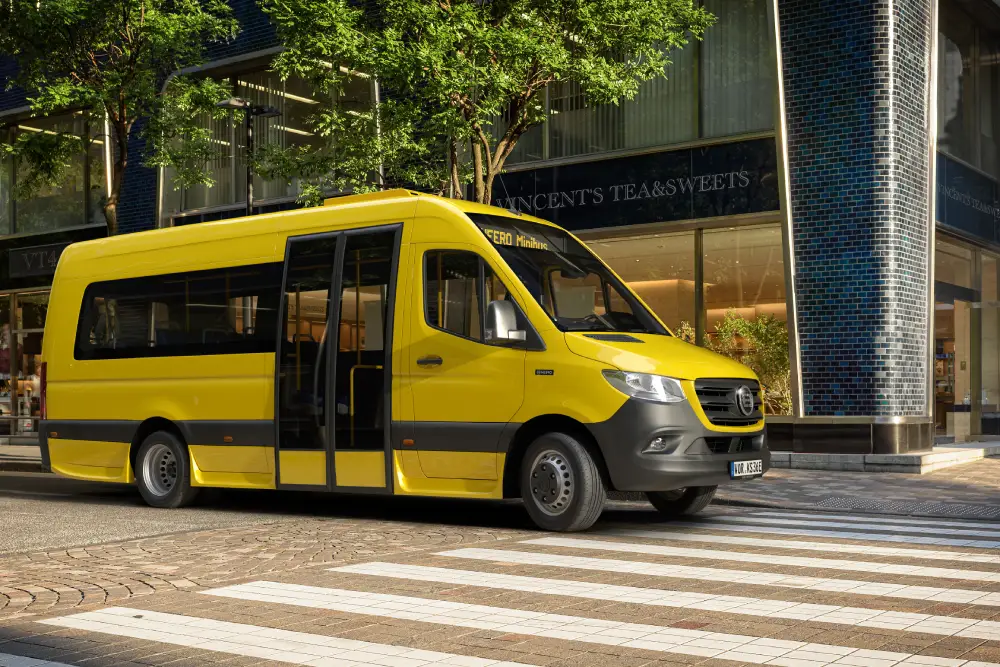
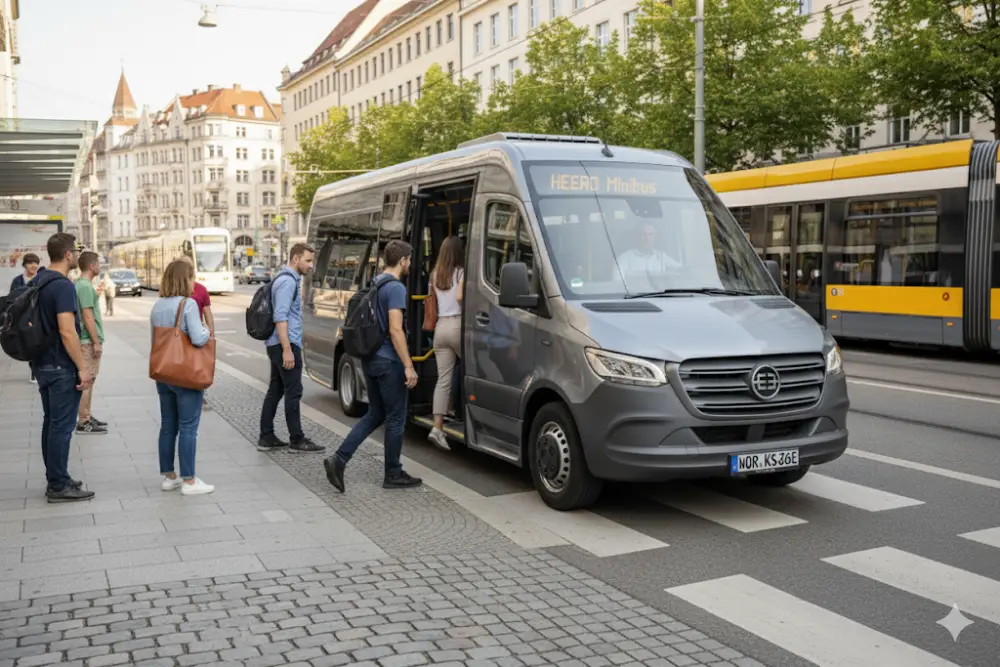
In 2025, bus fleet operators face double the pressure: rising operating costs and strict EU regulations. An Electric MiniBus with 19 seats is no longer just an option, but a strategic necessity for TCO optimization and compliance with the Clean Vehicles Directive. Discover the economic advantages.
Topics on this page
The topic briefly and concisely
Meet the 45% CVD quota for clean buses by 2025 through the strategic deployment of electric 19-seater Electric MiniBuses.
Reduce your fleet's Total Cost of Ownership (TCO) through significantly lower energy and maintenance costs.
Preserve the value of your existing fleet with fast D2E conversion (max. 10 days (only 907 model series)) of MB Sprinter vehicles.
Passenger transport is undergoing a transformation driven by two factors: cost-effectiveness and legislation. For fleet managers, this means reducing the total cost of ownership (TCO) while simultaneously meeting the demanding quotas of the Clean Vehicles Directive (CVD). A 19-seater bus with electric drive directly addresses both challenges. It offers significantly lower operating and maintenance costs compared to diesel counterparts and ensures compliance with the procurement quota of 45% for clean buses required by 2025. HEERO offers two pragmatic solutions for this: the conversion of existing Sprinters and highly efficient new electric bus vehicles.
Securely achieve CVD quotas by 2025
The Clean Vehicles Directive (CVD), implemented through the Clean Vehicles Procurement Act (SaubFahrzeugBeschG), creates significant pressure to act. By the end of 2025, 45% of all newly procured buses in the public sector had to be "clean". Crucially, half of this quota, i.e. 22.5%, had to be met by completely "emission-free" vehicles such as the 19-Sitzer Bus Elektro. From 2026, these quotas will even rise to 65% (clean) and 32.5% (locally emission-free) respectively. These specifications make electrification inevitable for municipalities and transport companies. The transition not only ensures legal compliance, but also positions fleet operators for the future in a competitive environment. A modern electric bus is the direct answer to these regulatory requirements. The rapid availability through conversion or new vehicles makes it possible to achieve these goals promptly and predictably.
Significantly reduce Total Cost of Ownership (TCO)
The acquisition of an electric vehicle is only one part of the equation; the total cost of ownership (TCO) is the decisive factor for economic viability. Studies show that battery-electric commercial vehicles will have a more favorable TCO than comparable diesel models in many use cases as early as 2025. The savings for an electric 19-seater bus are significant and consist of several components. Lower energy costs per kilometer are the most obvious benefit, as electricity is typically cheaper than diesel. Added to this is a drastically reduced maintenance requirement, as many wear parts of the combustion engine, such as exhaust systems or oil filters, are eliminated. This can lower maintenance costs significantly. The electrification of your fleet, for example with a converted electric Sprinter, is therefore a direct investment in lower running costs. These TCO advantages make the transition a strategically wise decision.
Maximize value creation through D2E conversion
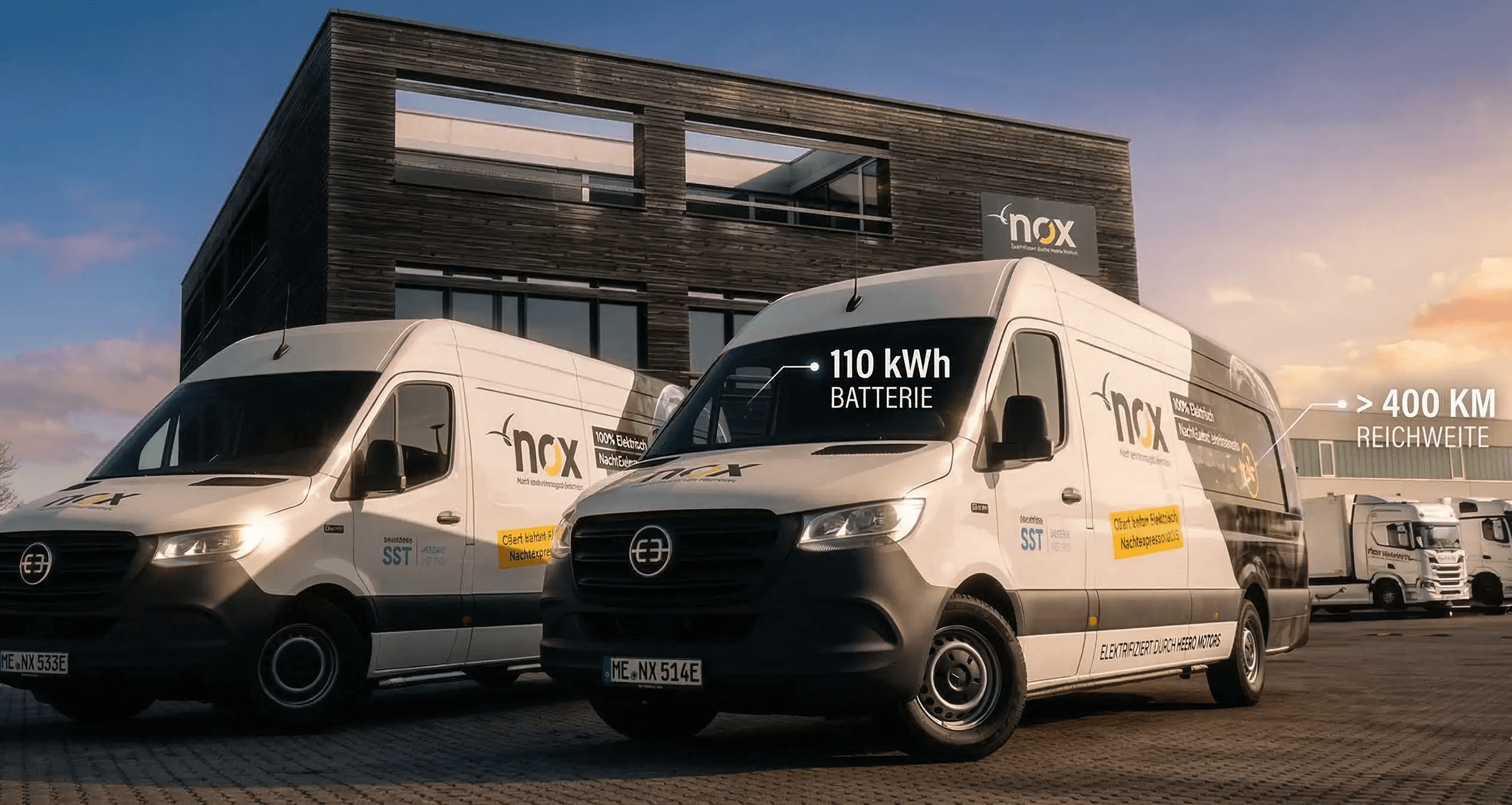
Why replace a proven vehicle when only the drivetrain is outdated? The HEERO retrofitting for the Mercedes-Benz Sprinter 907 series is a prime example of applied circular economy. Instead of investing in an expensive new purchase and accepting the loss in value of an existing special body, the existing vehicle base is preserved and modernized. This approach not only conserves resources but also your budget. The conversion of a Sprinter, for example the models 313, 316, or 319, takes a maximum of 10 working days (only model series 907). The vehicle is equipped with a 110 kWh battery system and a powerful electric drive. The advantages of this method are clear:
Value preservation: Existing special bodies and vehicle components continue to be used.
Speed: The fleet is electrified within just 10 working days per vehicle.
Sustainability: The continued use of the chassis significantly reduces the CO2 footprint compared to new production.
Cost control: Retrofitting costs are typically significantly lower than those of a comparable new vehicle.
This method offers a fast and economical bridge to electromobility and is ideal for fleets based on the proven Sprinter platform, as is often used for a 20-Sitzer Elektro Sprinter.
Ensuring practical range and charging capacity for real-world operations
Range anxiety is a thing of the past with modern battery technology. A Sprinter converted with the HEERO system achieves a range of up to over 300 km (WLTP). The HEERO eBus based on the Sprinter, such as the low-floor rear bus or the Tourer, offers practical ranges of over 300 km. These values ensure that daily schedules can be completed without unforeseen charging stops. The charging performance is also designed for professional use. With up to 165 kW direct current (DC), the 110 kWh battery can be charged to 80% in 60-90 minutes. For planned overnight charging in the depot, a 22 kW alternating current (AC) charging option is available. This charging flexibility typically ensures maximum vehicle availability of over 95% in daily operation. A realistic estimation of the range is crucial; you can find more information under WLTP-Reichweite bei Nutzfahrzeugen. This makes the electric 19-seater bus a reliable tool in the fleet.
FAQ: Answers to your questions about the 19-seater Electric MiniBus
FAQ
What is the range of a HEERO electric 19-seater bus?
The range depends on the specific model. A Sprinter electrified through D2E conversion (the basis for many bus bodies) achieves a range of up to over 300 km. Our specialized bus models, such as the Tourer or the low-floor rear bus, are designed for practical ranges of over 300 km, which is more than sufficient for most daily routes.
How long does the D2E conversion of an existing Sprinter Bus take?
The D2E conversion of a Mercedes-Benz Sprinter 907 series is a highly efficient process. We guarantee a conversion time of maximum 10 working days (907 series only). During this period, the diesel powertrain is removed and our electric drive system, including the 110 kWh battery, is integrated, ensuring your vehicle is quickly back in operation.
Which Mercedes-Benz Sprinter models are eligible for our Diesel-to-Electric (D2E) conversion?
Our D2E conversion system is specifically designed for the Mercedes-Benz Sprinter 907 series. This includes common base vehicles for minibus bodies such as the 313, 316, 319, and 324 models. This allows us to guarantee high quality and fast conversion times. Please contact us to evaluate your specific fleet vehicles.
What warranty does HEERO offer on the conversion?
HEERO offers a comprehensive warranty on all components of the D2E conversion, including the battery and the electric drivetrain. This secures your investment and provides the same reliability you would expect from a new vehicle. Our service team, the Flying HEEROs, is also at your disposal for maintenance and support.
Is the D2E conversion more cost-effective than buying a new vehicle?
In most cases, yes—especially if you already operate a fleet with expensive or specialized bodies. The D2E conversion prevents the depreciation of your existing vehicle and is generally more cost-effective than a comparable new electric vehicle. A detailed TCO analysis for your fleet will show you the exact savings potential.
Does HEERO also offer charging solutions for an entire bus fleet?
Yes, HEERO sees itself as an end-to-end partner for fleet electrification. In addition to the vehicles, we also offer comprehensive consulting for depot charging infrastructure. This includes planning charging capacities, intelligent load management, and the integration of 22 kW AC charging stations to ensure the operational readiness of your entire fleet.
More useful links
Kraftfahrt-Bundesamt (KBA) provides current statistics on new vehicle registrations in Germany, including data on electric vehicles, which are relevant for fleet development.
Verband Deutscher Verkehrsunternehmen (VDV) provides comprehensive data and facts on public transport, which are important for the planning and implementation of electromobility in the bus sector.
Umweltbundesamt (UBA) offers detailed information on transport infrastructure and vehicle fleets in Germany, including relevant data on the development of low-emission and zero-emission vehicles.
PwC offers an accompanying study on the funding of electric buses in public transport, which provides important insights for the conversion of bus fleets.
NOW GmbH provides a guide on electromobility in fleets, offering practical guidance for the transition to electric commercial vehicles.
Roland Berger publishes publications on the electrification of fleets, offering strategic insights and analyses for companies and municipalities.
Bundesministerium für Digitales und Verkehr (BMDV) provides information on funding programs to strengthen public transport, which support the purchase and conversion of electric buses.
Deutsche Energie-Agentur (dena) offers a dossier on the expansion of the charging infrastructure for electric trucks, the findings of which are also relevant for planning the charging infrastructure of electric buses.