Charging batteries for electric commercial vehicles: How fleets optimize TCO and efficiency

Correctly charging the batteries of electric commercial vehicles is the key to TCO reduction and operational readiness. Incorrect strategies lead to high costs and downtime. HEERO shows you how to make your fleet efficient and CVD-compliant through optimized depot charging and smart technology.
The topic briefly and concisely
Depot charging with AC power is the most cost-effective and battery-preserving method for over 90% of daily distribution routes.
Intelligent load management can prevent costly grid expansion and significantly reduce ongoing electricity costs by shaving peak loads...
The D2E conversion of a Sprinter 907 takes only 10 working days (907 model series only), preserves the value of custom bodies, and ensures immediate...
The electrification of commercial vehicle fleets is no longer an option, but a commercial and legal necessity. The Clean Vehicles Directive (CVD) requires significant quotas for clean vehicles in public tenders by 2025. However, the key to success lies not only in the vehicle, but in a well-thought-out charging strategy. The efficient charging of vehicle batteries directly influences the total cost of ownership (TCO), vehicle availability, and the lifespan of your investment. An optimized charging infrastructure is the lever to fully exploit the TCO advantages of electric commercial vehicles and to meet legal requirements. HEERO supports fleet operators with conversion and holistic charging advice.
Regulatory pressure and TCO relevance determine the charging strategy
The Clean Vehicles Directive (CVD) sets clear deadlines and forces fleet operators to take action. For the reference period until the end of 2025, 38.5% of light duty and 10% of heavy duty commercial vehicles in public procurement had to be "clean". This legal obligation makes a rapid electrification of the fleet inevitable. Economic efficiency depends significantly on operating costs, in which charging the battery plays a central role. Studies show that battery-electric trucks can already achieve TCO parity with diesel counterparts today if charging costs are optimized. Energy costs account for a significant portion of TCO over a vehicle's lifespan. A charging strategy that is just 10% more efficient can significantly reduce total cost of ownership. Planning the charging infrastructure is therefore not a purely technical decision, but a strategic one that determines competitiveness.
Depot charging as the economic backbone of the e-fleet
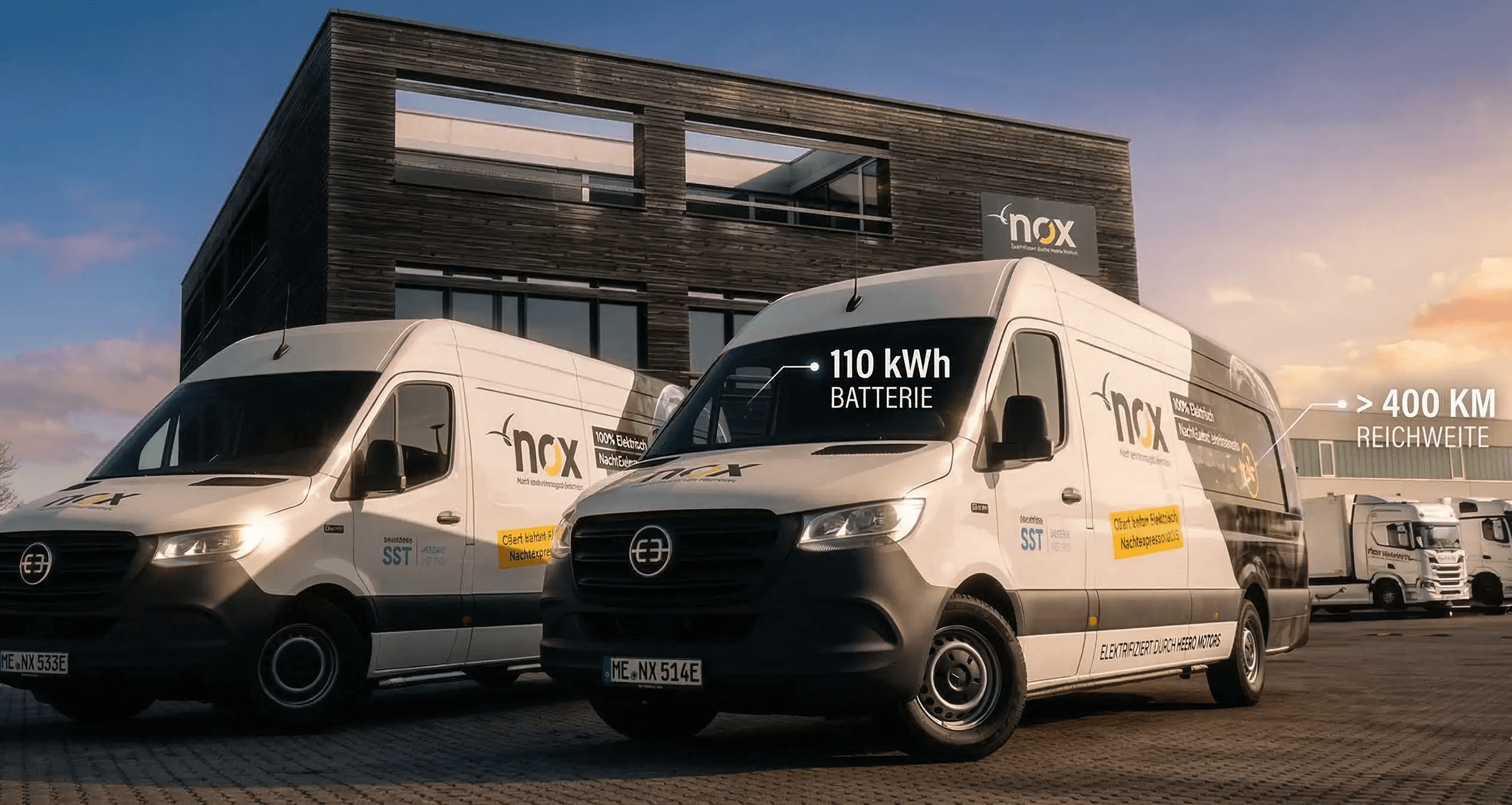
For commercial vehicle fleets with predictable routes and overnight idle times, depot charging is by far the most economical method. While public DC fast charging is important for unforeseen long distances, AC charging overnight at your own location forms the basis for low TCO. The HEERO Sprinter is equipped with a 22 kW AC on-board charger that reliably fully charges the 110 kWh battery overnight. AC charging is not only cheaper, but is also gentle on the battery, which can extend its lifespan by several years. Over 90% of all daily driving profiles in distribution transport can be covered by pure depot charging. The advantages of AC charging in the depot are clear:
Using cheap night-time electricity tariffs significantly reduces energy costs.
Less stress on the battery leads to slower degradation.
High predictability and maximum vehicle availability at the start of the shift.
Independence from public charging infrastructure and its price fluctuations.
A well-thought-out concept for AC and DC charging is crucial for operational efficiency.
Strategically planning the right charging infrastructure
Setting up a charging infrastructure in the depot requires careful planning that goes far beyond the mere installation of wallboxes. One of the biggest hurdles is often the insufficient grid connection capacity of existing depots. An analysis of the existing grid connection is the first step. As part of its depot charging advice, HEERO offers a comprehensive analysis of your site requirements. We check the available capacity and determine future requirements based on your fleet size and operational processes. Early planning can often avoid the need for an expensive grid expansion, which can cost over 50,000 euros. The scalability of the infrastructure is another critical factor. Your charging solution must be able to grow with your fleet without having to redesign the entire system with every expansion. A modular depot charging concept safeguards your investment for the future and allows flexible adaptation to increasing requirements.
Reduce costs through intelligent load management
If several electric commercial vehicles charge at the same time, the peak demand can quickly overload the grid connection and lead to extremely high electricity costs. This is where intelligent load management comes in. It dynamically distributes the available electrical power among the charging vehicles, taking into account the total electricity consumption of the building. This avoids expensive peak loads without having to expand the grid connection. Dynamic load management can significantly reduce the electricity bill by shaving peak loads. Implementing such a system offers decisive advantages:
Avoidance of grid expansion: The existing connection capacity is utilized optimally, which saves high investment costs.
Reduction of energy costs: By smoothing consumption peaks, network charges are significantly lower.
Maximum charging efficiency: Vehicles are charged with priority based on their departure time and required state of charge.
High operational safety: The system prevents overloading of the power grid and protects against outages.
Smart load management in the depot is therefore not a luxury, but a central tool for TCO optimization.
Maximize battery life through optimized charging cycles
The battery is the most expensive component of an electric commercial vehicle. Its service life has a direct impact on the residual value and the TCO. Incorrect charging habits can prematurely reduce the battery capacity. A crucial key figure is the "State of Charge" (SoC). For daily use, it is ideal to keep the SoC permanently between 20% and 80%. Fully charging to 100% should only be done for planned long-distance trips. Consistently maintaining a charging window of 20-80% can significantly extend the calendar life of a battery. Likewise, deep discharging below 10% should be avoided. Modern battery management systems, such as those installed in HEERO vehicles, protect the battery from extreme conditions. By training drivers and presetting charging limits in the system, fleet managers can actively maximize the service life of their vehicle batteries and thus secure the value of the fleet. Understanding the State of Charge is fundamental.
The HEERO Solution: Efficient Vehicles and Charging Expertise
HEERO offers a holistic solution for the electrification of your fleet. Our retrofitting for Mercedes-Benz Sprinter series 907 (models 313, 316, 319, 324) is completed in a maximum of 10 working days (only model series 907) and makes your existing vehicles with special bodies fit for the future. The vehicles feature a 110-kWh battery, which enables ranges of up to 300 km. With 165 kW DC charging capacity, the battery is 80 % charged in just 60-90 minutes, ensuring maximum flexibility. A 22 kW AC charger is available for cost-effective depot charging. Our offer goes beyond the vehicle: We advise you on the planning of your charging infrastructure and develop a customized concept for intelligent load management with you. Our service technicians, the "Flying HEEROs", ensure the operational readiness of your fleet. With HEERO you do not only fulfill the CVD quotas, but sustainably optimize your total cost of ownership.
FAQ
What is the main advantage of depot charging compared to public fast charging?
The main advantage of depot charging lies in the significantly lower costs. You can take advantage of favorable night-time electricity tariffs and avoid the high ad-hoc prices at public DC charging stations. In addition, slower AC charging is gentler on the battery, which extends the vehicle's lifespan and further reduces the TCO.
Do I usually need a new grid connection for multiple electric commercial vehicles?
Not necessarily. An intelligent, dynamic load management system is often the more cost-effective solution. It smartly distributes the available power among the vehicles without overloading the existing grid connection. In many cases, an expensive upgrade to the grid connection can thus be avoided.
How long does it take to charge a HEERO D2E Sprinter?
Charging time depends on the charging method. At a 165 kW DC fast charger, the 110 kWh battery charges from 10% to 80% in approximately 60–90 minutes. At a 22 kW AC wallbox in the depot—ideal for overnight charging—a full charge (0–100%) typically takes between 5 and 6 hours.
Does frequent DC fast charging affect the battery service life?
Yes, frequent and exclusive high-power DC charging can put more strain on the battery and lead to faster aging. For daily charging and to maximize battery life, we recommend gentler AC charging at the depot. DC charging should be used selectively for fast charging while on the go.
What does "State of Charge" (SoC) mean and why is it important?
The State of Charge (SoC) indicates the battery's current charge level as a percentage. It is critical for battery life. Constantly maintaining an SoC at extreme levels (below 10% or above 90%) accelerates chemical aging. For maximum service life in daily operations, the SoC should ideally be kept between 20% and 80%.
Does HEERO also offer support with planning the charging infrastructure?
Yes, HEERO acts as your holistic partner. Our services include detailed depot charging consultation. We analyze your location, evaluate the grid connection, and design a customized, scalable charging infrastructure, including intelligent load management for your fleet.
More useful links
The Nationale Leitstelle Ladeinfrastruktur (National Centre for Charging Infrastructure) provides comprehensive information on the development and expansion of charging infrastructure in Germany.
The Federal Ministry for Digital and Transport provides official information and strategies regarding charging infrastructure.
The Federal Office for Logistics and Mobility (BALM) provides information on the funding programme for climate protection and sustainability in transport (KSNI).
The KfW offers detailed information on its funding programmes for charging infrastructure.
The German Association of Energy and Water Industries (BDEW) publishes its electromobility monitor with current data and analyses.
The Federal Network Agency (Bundesnetzagentur) provides key information and regulations on electromobility.
The Fraunhofer ISI offers a press release on operational planning, potentials, and costs of electric trucks.
The Federal Motor Transport Authority (KBA) publishes press releases on current vehicle registration figures.
The Federal Ministry for Economic Affairs and Climate Action provides information on regulatory frameworks and incentives for electric vehicles.